SEO Governance vs Guidelines: Why Your Business Must Shift to Mandatory Control
Optional SEO guidelines are no longer sufficient. Discover why mandatory governance is becoming essential to ensure consistency across your signals.

The Problem with SEO Guidelines: Why They Systematically Fail
Your company probably has a document titled "SEO Best Practices" or "SEO Guidelines." This 30-page PDF sits dormant in a shared folder that no one opens. Meanwhile, your marketing teams publish content without optimized title tags, your IT team deploys redirects without validation, and your sales team creates landing pages that cannibalize your strategic keywords.
This scenario is not an exception. According to a study by Conductor conducted in 2024, 67% of companies with formalized SEO guidelines find that less than 40% of their teams actually implement them. The problem isn't the quality of the recommendations: it's their optional nature.
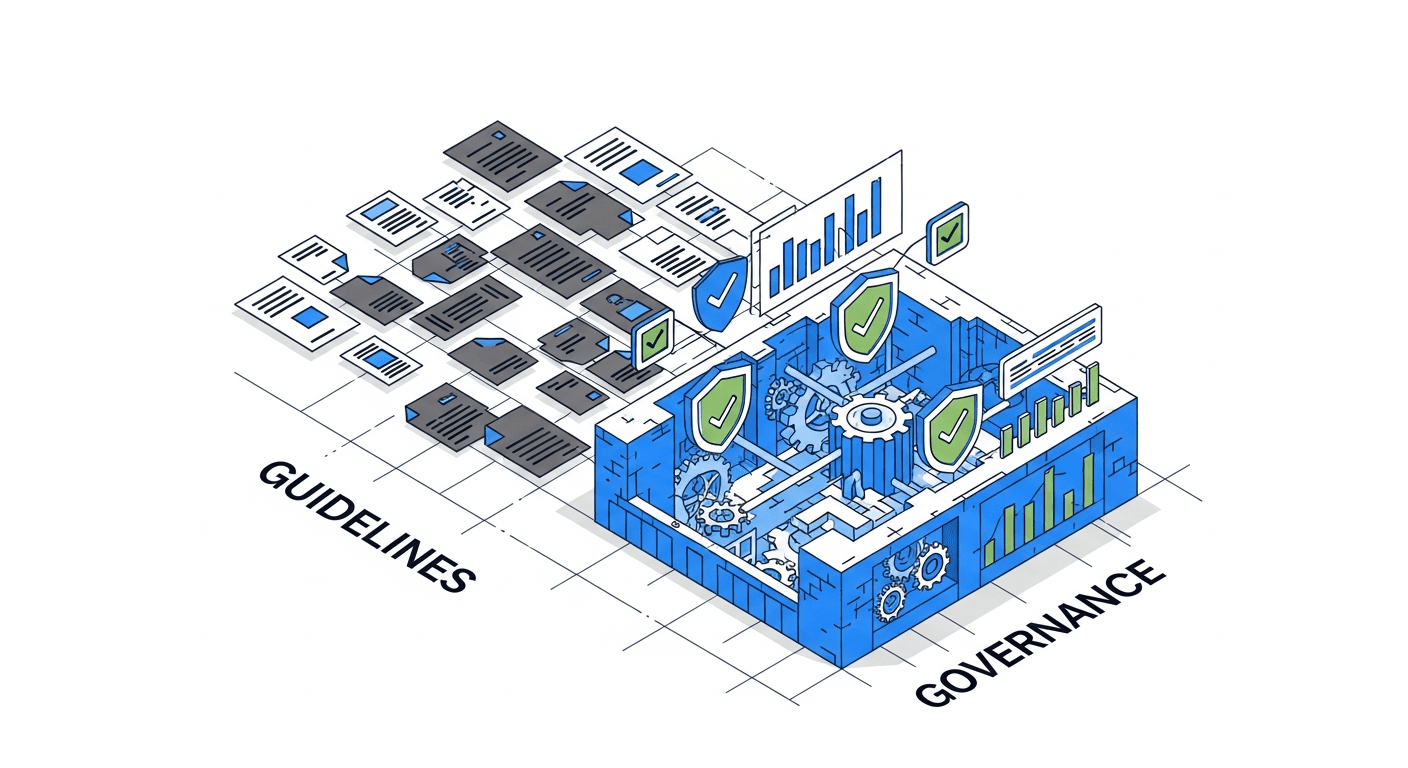
The difference between a guideline and governance comes down to one word: obligation. A guideline suggests. Governance requires. And in an environment where Google, ChatGPT, and Perplexity analyze the consistency of your digital signals, suggestion is no longer enough.
Guidelines vs Governance: An Unambiguous Comparison
What SEO Guidelines Actually Are
Traditional SEO guidelines function like an optional instruction manual. They document best practices, recommend actions, and hope teams will follow them out of goodwill. Their typical structure includes:
- Writing recommendations for meta tags
- Advice on URL structure
- Suggestions for image optimization
- Internal linking best practices
The fundamental problem: no control mechanism exists. When a product manager publishes a page without following the guidelines, nothing happens. When the IT team modifies the site architecture without consulting SEO, no one is alerted. Guidelines create the illusion of control without providing the tools for enforcement.
What SEO Governance Entails
SEO governance transforms recommendations into operational rules. It introduces three components that are absent from traditional guidelines:
- Mandatory processes: all publications or technical modifications go through formalized SEO validation
- Assigned responsibilities: each type of decision has an identified owner with blocking authority
- Control mechanisms: automated audits and periodic reviews detect deviations
Governance doesn't ask teams to "think about SEO." It integrates SEO into existing workflows as an essential step, just like legal validation or GDPR compliance.
Comparison Table: Guidelines vs Governance
To clarify the operational differences between the two approaches:
- Rule status: guidelines = optional recommendations; governance = internal contractual obligations
- Responsibility: guidelines = diffuse, collective; governance = assigned, individual
- Control: guidelines = absent or sporadic; governance = continuous and automated
- Sanctions: guidelines = none; governance = blocking of non-compliant publications
- Integration: guidelines = document external to processes; governance = native step in workflows
- Updates: guidelines = annual at best; governance = continuous according to algorithmic changes
Why Signal Consistency Becomes Critical in 2025
The Impact of Generative Search Engines on Your Consistency Requirements
Traditional search engines tolerated some inconsistency. A poorly optimized page simply ranked lower without affecting the rest of the site. Generative search engines like ChatGPT, Perplexity, or Google AI Overview work differently: they evaluate your brand as a global entity.
When Perplexity cites your company in a response, it synthesizes all the signals it has collected: your main website, your social profiles, your press mentions, your customer reviews. An inconsistency between these sources—for example, different positioning on your LinkedIn page and your About page—creates confusion for the AI. This confusion results in either no citation or, worse, incorrect attribution.
At AISOS, we observe that companies with formalized SEO governance obtain on average 3.2 times more citations in generative search engine responses than those operating with optional guidelines. The reason: their signals are consistent, therefore interpretable without ambiguity.
The Real Cost of Inconsistency
SEO signal inconsistency generates measurable costs that executives underestimate:
- Keyword cannibalization: multiple pages target the same queries, diluting each one's authority. Average observed impact: loss of 15 to 25% of potential traffic on affected queries.
- Undetected content duplication: similar versions of pages coexist without appropriate canonical tags. Google arbitrarily chooses which to index.
- Incomplete redirects: technical migrations leave redirect chains or 404 errors. Average loss of 30% of link equity transmitted.
- Contradictory structured data: different schemas describe the same entity with inconsistent attributes. Generative search engines then ignore this data.
These problems don't appear in standard marketing reports. They require specific technical audits that only structured governance can regularly enforce.
Framework for Implementing SEO Governance
Step 1: Map Decisions That Impact SEO
Before defining rules, comprehensively identify decisions that affect your SEO. In an average company, these decisions are made by at least six different teams:
- Marketing/Content: page creation, blog articles, campaign landing pages
- Product: product pages, categories, navigation filters
- IT/Development: technical architecture, loading times, migrations
- Communications: press releases, social profiles, executive biographies
- Sales: partner pages, case studies, customer testimonials
- HR: careers pages, job postings, team presentations
For each team, list the types of content created, publication frequency, and tools used. This mapping typically reveals blind spots: content published without any SEO consideration because no one thought to involve the SEO team.
Step 2: Define Non-Negotiable Rules
Effective governance distinguishes three levels of rules:
Blocking rules: non-compliance prevents publication. Examples: unique title tags, meta descriptions present, canonical URLs defined, valid structured data. These rules can be automatically verified before going live.
Mandatory rules with validation: their application requires human judgment. Examples: semantic field consistency, internal linking relevance, anchor text quality. An SEO specialist validates manually.
Recommended rules: their application remains desirable but non-blocking. Examples: optimal content length, number of images per article, update frequency. These rules are subject to periodic reviews without blocking publications.
Step 3: Assign Clear Responsibilities
Each rule must have an identified owner with three defined attributes:
- Validation authority: who can approve an exception to the rule?
- Control responsibility: who verifies actual implementation?
- Reporting obligation: who reports observed deviations?
In SMEs, these three roles can be held by the same person. In mid-market companies, they are generally distributed between an SEO Manager (validation), an SEO analyst (control), and a digital director (reporting).
The classic mistake: creating an "SEO committee" without decision-making authority. This committee becomes a rubber stamp where problems are discussed but never resolved. Governance requires individuals with veto power, not consultation meetings.
Step 4: Integrate controls into existing workflows
Governance fails when it adds steps perceived as obstacles. It succeeds when it inserts itself invisibly into existing processes.
Concretely, this means:
- Integrating SEO checks into your CMS via plugins or mandatory fields
- Adding an SEO checklist to your project management tools (Notion, Monday, Asana)
- Configuring automatic alerts in your monitoring tools (Screaming Frog, Semrush, Ahrefs)
- Including SEO metrics in your existing performance dashboards
A content writer shouldn't have to open an external document to check guidelines. Rules must appear in their usual work interface, when they need them.
Step 5: Establish mandatory periodic reviews
AISOS audits reveal that 78% of major SEO problems stem from progressive drift, not isolated errors. A page properly optimized at creation degrades through successive modifications. A technically sound site accumulates technical debt in small increments.
Governance imposes a schedule of non-negotiable reviews:
- Weekly review: automated control of new publications (tags, technical errors, indexing)
- Monthly review: performance analysis by content category, identification of underperforming pages
- Quarterly review: comprehensive technical audit, competitor analysis, keyword strategy adjustment
- Annual review: global evaluation of governance itself, rule updates based on algorithmic changes
Internal resistance and how to overcome it
The slowdown argument
"Governance will slow down our publications." This is the most frequent objection. It confuses control with bureaucracy.
Well-designed governance accelerates compliant publications by eliminating back-and-forth. When rules are clear and tools integrated, a writer knows exactly what they must produce. They don't wait for uncertain validation: they apply defined criteria and get automatic validation.
Slowness comes from ambiguity, not control. Vague guidelines generate clarification requests, multiple revisions, case-by-case arbitration. Explicit governance eliminates these frictions.
The team autonomy argument
"Our teams are experts in their field, they don't need to be told how to work."
SEO governance doesn't question business expertise. It simply recognizes that SEO is a cross-functional skill that business experts don't necessarily possess. A product manager excels at defining features: they don't need to master the subtleties of structured data.
Governance liberates teams by providing them with a clear framework. They know what's expected without having to become SEO specialists themselves.
The cost argument
"We don't have the resources to implement governance."
The cost of non-governance is invisible but real. Calculate the time spent correcting SEO errors after publication, traffic lost through cannibalization, missed opportunities in generative engines. These costs systematically exceed the initial investment in structured governance.
An SME can start with minimal governance: five blocking rules, an identified reference person, a monthly review. Infrastructure becomes more complex later based on identified needs.
Success indicators for SEO governance
Effective governance is measured by specific indicators, distinct from classic SEO metrics:
- Publication compliance rate: percentage of content respecting blocking rules from first submission. Target: above 90% after six months.
- Average validation time: time between content submission and publication. Effective governance reduces this delay, it doesn't increase it.
- Number of major SEO incidents: critical technical errors (deindexed pages, broken redirections, penalties). Target: zero preventable incidents.
- Decision coverage: percentage of SEO-impacting modifications that actually go through the validation process. Target: 100%.
- Signal consistency score: composite metric evaluating alignment between your different digital presences. GEO audit tools can calculate it.
Conclusion: from recommendation to obligation
SEO guidelines have played their role for fifteen years. They educated organizations, spread best practices, raised team awareness. But their optional nature condemns them to inefficiency in an environment where search engines, traditional and generative alike, demand perfect signal consistency.
SEO governance isn't an evolution of guidelines: it's a paradigm shift. It transforms SEO from an advisory function to a control function, with enforceable rules, assigned responsibilities, and verification mechanisms.
Companies that make this change see measurable performance improvements: better positioning on strategic queries, increased presence in generative engine responses, reduction of costly technical incidents.
The question is no longer whether your company should adopt SEO governance. The question is how much longer you can afford to operate without it. To evaluate your current maturity level and identify the first implementation steps, AISOS offers governance audits adapted to French-speaking SMEs and mid-market companies.


