Google I/O 2024: The Real SEO Impact on Businesses (Beyond the Panic)
Factual analysis of Google I/O 2024 announcements and concrete SEO adaptation strategies for B2B companies, without falling into the surrounding alarmism.

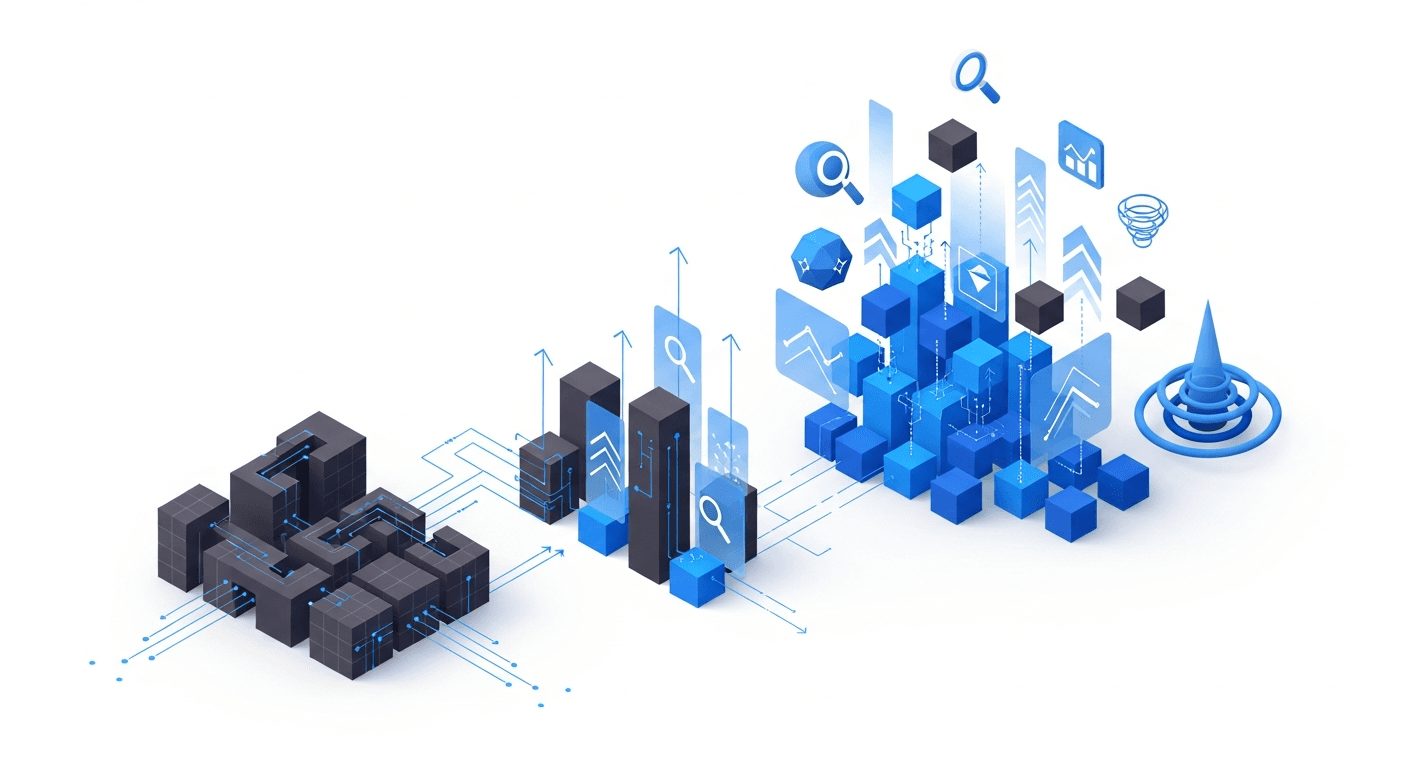
On May 14, 2024, Google presented its vision for search at Google I/O. Within hours, SEO social networks exploded. "The end of SEO," "80% less traffic," "Google is killing websites" – catastrophic predictions flooded LinkedIn and Twitter.
The reality is more nuanced. Above all, it requires a cool-headed analysis rather than an emotional reaction. Google I/O 2024's announcements are indeed transforming search, but the main risk isn't where the majority of SEO experts are placing it.
This article breaks down what was actually announced, identifies concrete impacts for B2B companies, and proposes adaptation strategies based on facts, not panic.
What Google actually announced at Google I/O 2024
Before evaluating the impact, let's clarify the announcements. Google presented three major developments that directly concern enterprise SEO.
Widespread AI Overviews: the answer at the top of the page
Google is rolling out AI Overviews (formerly SGE) at scale in the United States, with progressive expansion to other markets. These AI-generated summaries appear at the top of search results to directly answer user questions.
Important point: AI Overviews don't appear on all queries. Transactional, navigational, and certain complex searches maintain the classic format. According to initial data from BrightEdge, AI Overviews appear on approximately 15% of queries in the United States, primarily informational ones.
The new Google homepage: a discrete but significant change
Google is testing a redesign of its homepage integrating a personalized content feed, similar to Discover but on google.com. This evolution flies under the radar of SEO discussions, yet it could have considerable impact on search habits.
Users opening Google would see recommended articles, news, and content before even typing a query. Search behavior itself could evolve: fewer active queries, more passive consumption of suggested content.
Gemini integrated everywhere: the assistant becomes omnipresent
Google is pushing Gemini, its conversational AI model, into all its products: Search, Workspace, Android. The stated objective is to transform Google into a proactive assistant rather than a simple reactive search engine.
For businesses, this means contact points with potential customers are multiplying and diversifying. Traditional search is no longer the only acquisition channel via Google.
The real risk isn't the disappearance of SEO traffic
Contrary to alarmist predictions, SEO isn't disappearing. Current data even shows relative stability in organic traffic for the majority of sites. So where does the real risk lie?
The risk of information commoditization
The main danger for B2B companies isn't immediate traffic loss. It's the commoditization of their expertise. When an AI can summarize any informational content, the perceived value of that content collapses.
An article explaining "How to choose an ERP" becomes interchangeable with dozens of others. The AI extracts useful information, reformulates it, and users no longer need to visit the source site. The company loses the opportunity to demonstrate its expertise and create a relationship.
The risk of single-channel dependence
Companies that depend 70% or more on Google for their digital acquisition are vulnerable. Not because traffic will collapse tomorrow, but because concentrating risks on a constantly transforming channel is dangerous.
At AISOS, we observe that the most resilient companies are those that diversified their acquisition sources before being forced to. Direct traffic, referrals, professional social networks, and newsletters constitute channels that Google cannot disintermediate.
The risk of wait-and-see
Paradoxically, the biggest risk is doing nothing while waiting to "see how it evolves." Companies adapting their strategy now are building a competitive advantage. Those waiting will have to catch up in a more competitive environment.
Impact by B2B company type: segmented analysis
The impact of Google I/O announcements varies considerably depending on business model and the type of content produced by the company.
SaaS software publishers
Moderate short-term impact, high medium-term impact. Transactional queries ("buy CRM software," "cloud ERP pricing") remain little affected by AI Overviews. However, all top-of-funnel content (guides, comparisons, tutorials) sees its value diminish.
Priority strategy: strengthen high-value unique content (proprietary data, detailed case studies, exclusive benchmarks) and invest in brand awareness to generate branded searches.
Consulting firms and professional services
High impact. The business model often relies on demonstrating expertise through content. When AI can provide generic advice instantly, standard informational content loses its attraction power.
Priority strategy: position on expertise that AI cannot replicate: specific local context, French and Belgian regulations, concrete client experiences with named clients, strong opinions on controversial sector topics.
Industrial companies and manufacturers
Low to moderate impact. Specific technical queries, detailed product sheets, and specifications remain essential. AI cannot replace precise technical documentation for industrial equipment.
Priority strategy: optimize technical SEO and product data structure to maximize visibility on purchase-intent searches. Develop in-depth technical content that demonstrates industry expertise.
B2B distributors and resellers
Variable impact depending on differentiation. Distributors who merely list products without added value are vulnerable. Those providing expertise, advice, and complementary services maintain their relevance.
Priority strategy: create content that justifies intermediation: sector-segmented buying guides, comparisons with usage context, technical support and training.
Concrete adaptation strategies for 2024-2025
Beyond diagnosis, here are the priority actions to implement.
Strategy 1: become a primary source cited by AI
AI Overviews cite their sources. The goal is no longer just appearing on the first page, but being cited as a reference by the AI itself. To achieve this:
- Produce original data that AI cannot find elsewhere: studies, surveys, anonymized client data analysis
- Adopt structured content format with clear, direct statements, easily extractable by language models
- Establish author authority with complete expert profiles, referenced academic or professional publications
- Regularly update existing content with fresh data
Strategy 2: optimize for answer engines
ChatGPT, Perplexity, Claude, and Gemini are becoming acquisition channels in their own right. GEO (Generative Engine Optimization) now complements traditional SEO:
- Structure each page to autonomously answer a specific question
- Use explicit named entities: company names, products, people, places
- Include citations from recognized sources and verifiable references
- Write self-sufficient paragraphs that can be extracted and cited without losing meaning
Strategy 3: invest in brand to generate branded searches
Searches including your brand name cannot be disintermediated. A user typing "AISOS GEO audit" is specifically looking for your company, not a generic answer.
Priority actions:
- Develop presence in your sector's professional media
- Participate in events and conferences to increase awareness
- Create memorable brand assets: proprietary methodologies, frameworks, tools
- Encourage third-party mentions and citations
Strategy 4: diversify acquisition channels
Reducing dependence on Google Search has become a strategic necessity, not an option:
- Newsletter: build a proprietary audience you can reach directly
- LinkedIn: for French-speaking B2B, it's the dominant professional social network
- YouTube: the world's second search engine, with an algorithm different from Google Search
- Sector podcasts: build brand authority and voice recognition
- Partnerships: visibility exchanges with complementary non-competing companies
Strategy 5: measure what really matters
Traditional metrics become insufficient. Organic traffic alone no longer reflects real performance:
- Track brand impressions on AI tools (when measurable)
- Monitor mentions in ChatGPT, Perplexity, and other assistant responses
- Measure direct traffic and branded searches as awareness indicators
- Evaluate quality of generated leads, not just their volume
Action timeline: prioritizing initiatives
Faced with these changes, methodical action takes priority over scattered reaction.
Short term: 0 to 3 months
Vulnerability audit: identify content and keywords most exposed to AI Overviews. Analyze current traffic source distribution. Evaluate your company's presence in generative engine responses.
Medium term: 3 to 6 months
Priority content overhaul: transform the most strategic pages so they're citable by AI. Launch or strengthen an alternative acquisition channel (newsletter, LinkedIn, YouTube). Create a first proprietary data asset.
Long term: 6 to 12 months
Brand authority building: press relations and sector media program. Development of proprietary methodology or framework. Systematic measurement of presence in generative responses.
What Google I/O announcements don't change
In the general agitation, some fundamentals remain unchanged:
- Users are still looking for solutions to their problems
- Trust is built through demonstrating expertise and social proof
- Superior quality content outperforms mediocre content
- B2B commercial relationships rely on credibility and human connection
- A technically performant site remains a prerequisite
AI doesn't replace these fundamentals. It modifies the path by which potential customers discover your company and evaluate your credibility.
Conclusion: act without panicking
Google I/O 2024 marks an acceleration of search transformation, not a sudden break. Companies adapting now are building a lasting advantage. Those ignoring these signals or paralyzed by wait-and-see are accumulating strategic debt.
Priority actions are clear: diversify channels, invest in brand, create content that AI cites rather than replaces, and measure your presence at new customer touchpoints.
SEO isn't dead. It's evolving. And like every major evolution, companies that understand change before their competitors derive disproportionate benefit from it.
If you want to assess your digital strategy's vulnerability to these developments and identify your action priorities, contact the AISOS team for an audit of your presence in traditional and generative search engines.


