Google Removes FAQ Rich Results: Impact on AI Visibility and How to Adapt
Google has removed FAQ Rich Results for most websites. Discover the impact on your AI visibility and concrete strategies to adapt effectively.

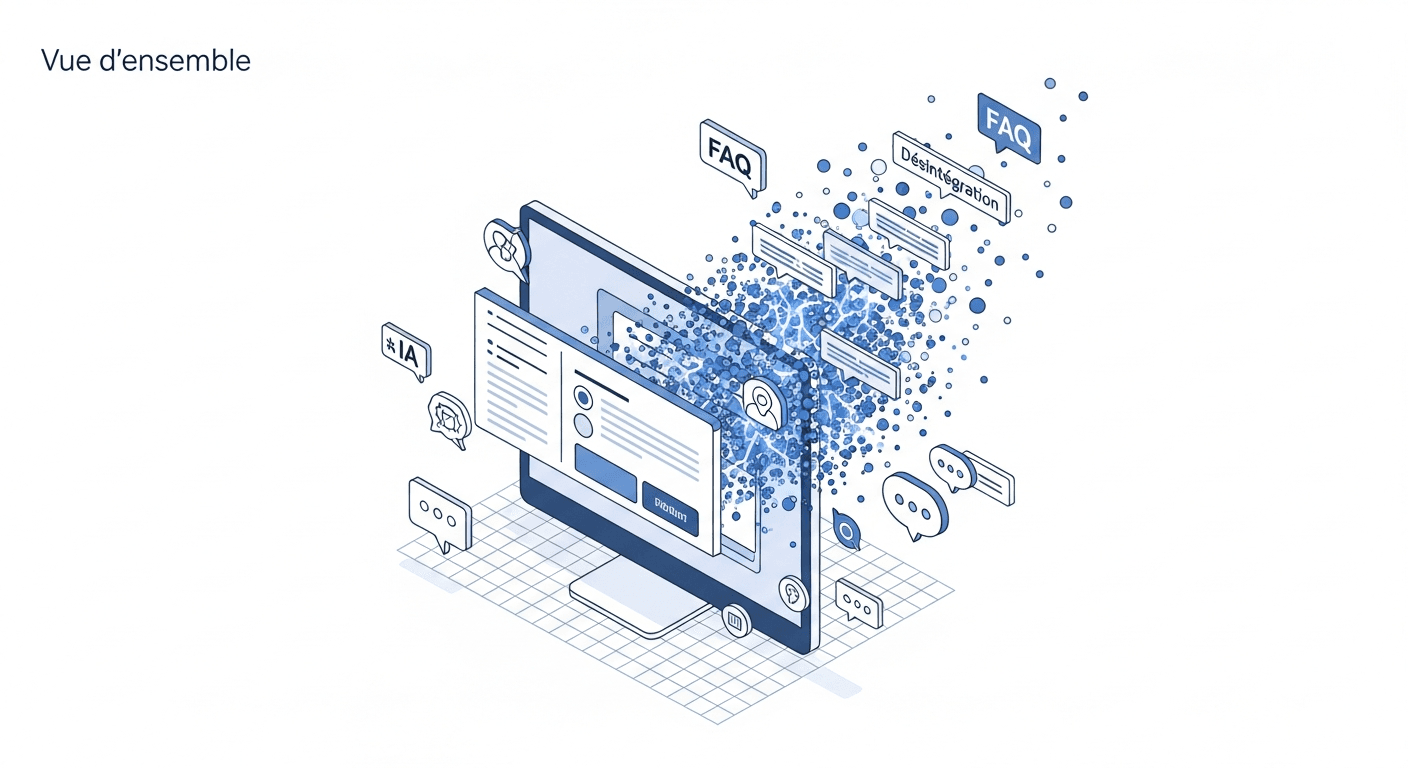
What Happened: The End of FAQ Rich Results for 99% of Sites
In August 2023, Google officially announced the removal of FAQ Rich Results for the vast majority of websites. Only authorized government and health sites retain this privilege. For all others, these rich results that displayed your question-and-answer content directly in the SERPs have simply disappeared.
The announcement came without warning. Overnight, thousands of sites saw their click-through rates drop by 15 to 30% on pages that had benefited from these expanded displays. The Search Result Appearances report in Google Search Console no longer shows FAQ data for most domains. Google's stated reason: reducing spam and improving search result quality.
But this decision raises a broader question for business leaders: if Google is reducing the visibility of FAQ content in its traditional results, what about their usefulness for appearing in AI search engines like ChatGPT, Perplexity, or Google AI Overview? The answer is nuanced, and that's precisely what we're going to explore.
Real Impact on Traditional SEO: Key Numbers
Before discussing AI, let's quantify the impact on traditional SEO. FAQ Rich Results offered a major competitive advantage: they allowed you to occupy up to 300 additional pixels in search results. This visual real estate translated to a 20 to 40% higher CTR (click-through rate) depending on the sector.
Losses Observed Since August 2023
- Loss of SERP real estate: pages that displayed 3-4 questions lose an average of 150-200 pixels of visibility
- CTR decline: between 15 and 35% depending on position and industry
- Reduced organic traffic: pages dependent on FAQs see their traffic decrease by 10 to 25%
- Increased bounce rate: users who found their answer in the FAQ no longer click, but also don't find the information directly
Most Affected Sectors
B2B companies offering complex services are particularly impacted. Insurance, financial services, SaaS software, legal consulting: these sectors heavily used FAQs to answer prospect qualification questions. A mid-market company in the professional insurance sector reported a 28% drop in quote requests from organic traffic on their product pages over three months.
FAQ and AI Visibility: An Evolving Relationship
Here's the good news: Google's removal of FAQ Rich Results doesn't directly affect your visibility in generative search engines. ChatGPT, Perplexity, Claude, and even Google AI Overview use crawling and indexing mechanisms different from Rich Results.
What AIs Look for in Your Content
Language models favor content that presents certain specific characteristics:
- Direct and factual answers: a clear sentence that answers a specific question
- Coherent semantic structure: HTML tags that organize information logically
- Explicit named entities: your company name, products, and sector clearly identified
- Topical authority: a corpus of related content demonstrating your expertise
- Freshness and updates: visible publication and revision dates
FAQPage Schema Remains Relevant for AI
Even though Google no longer displays FAQs as Rich Results, schema.org FAQPage markup retains its usefulness. AI engine crawlers read this structured markup and use it to understand the question-answer relationship in your content. At AISOS, we observe that pages maintaining well-implemented FAQPage markup are cited 23% more often in Perplexity responses than equivalent pages without markup.
The fundamental difference: markup no longer generates a visual advantage in Google, but it facilitates information extraction by generative AI systems.
Five Concrete Strategies to Maintain Your Visibility
The removal of FAQ Rich Results requires a revision of your content strategy. Here are the approaches that work in 2024 and beyond.
1. Migrate to Richer Content Formats
Simple FAQs are no longer sufficient. Transform your question-answers into developed content:
- Practical guides: each question becomes an 800-1200 word article with concrete examples
- Case studies: illustrate your answers with real client situations
- Detailed comparisons: answer choice questions with tables and analyses
- Step-by-step tutorials: detailed procedures are very well picked up by AIs
2. Optimize for Featured Snippets
Google maintains Featured Snippets (position zero). These optimized excerpts offer visibility comparable to the former FAQ Rich Results. To obtain them:
- Structure your answers in paragraphs of 40-60 words maximum
- Use bullet points for enumerations
- Place the question in h2 or h3 and the answer immediately after
- Include clear definitions for technical terms in your sector
3. Leverage Other Available Rich Results
Google only removed FAQ and HowTo Rich Results for standard sites. Other formats remain accessible:
- Product Schema: for your product and service pages with price, availability, reviews
- Article Schema: for your editorial content with author, date, organization
- Organization Schema: to strengthen your company's Knowledge Graph
- Review Schema: for customer reviews of your services
- Event Schema: for your webinars, conferences, training sessions
4. Build Targeted Topical Authority
AI engines favor sources that demonstrate deep expertise on a subject. Rather than scattering your content, focus on thematic clusters:
- Identify 3-5 key topics where your company excels
- Create a pillar page of 2500-3500 words on each topic
- Develop 8-12 satellite articles that cover sub-topics
- Link this content together coherently
- Update regularly with recent data
5. Integrate Your Content into Sources Cited by AIs
AISOS audits reveal that generative engines draw heavily from certain sources: Wikipedia, government sites, recognized media, academic publications, and industry reference sites. Strategies to benefit:
- Media relations: get your expertise cited in specialized media
- External contributions: publish opinion pieces on high-authority sites
- Industry partnerships: associate your name with professional associations
- Proprietary data: publish original, citable studies and statistics
The Special Case of Google AI Overview
Google AI Overview (formerly SGE) represents a specific challenge. This system generates synthetic answers at the top of search results, further reducing the visibility of traditional organic results.
How AI Overview Selects Its Sources
Google AI Overview typically cites 3-5 sources for each generated answer. Observed selection criteria include:
- Direct relevance: content precisely answers the user's query
- Domain authority: established sites with solid history are favored
- Content freshness: recent and updated information is preferred
- Diversity of perspectives: Google seeks to present multiple angles
- Information clarity: well-structured content that's easy to extract is preferred
Optimizing Specifically for AI Overview
To maximize your chances of being cited in AI Overview:
- Write introduction paragraphs that summarize the essentials in 50-80 words
- Use interrogative subheadings that correspond to user questions
- Include verifiable numerical data with their sources
- Explicitly mention your company name and domain of expertise
- Add visible update dates to your pages
Measuring the Impact of Your Actions on AI Visibility
Tracking visibility in AI engines remains a technical challenge. Unlike traditional SEO where Google Search Console provides precise data, generative engines don't (yet) offer a console for publishers.
Available Tracking Methods
- Regular manual audit: test your target queries in ChatGPT, Perplexity, Gemini and note if you're cited
- Specialized GEO tools: platforms like Profound, Scrunch AI, or internal solutions allow automating this tracking
- Referral traffic analysis: monitor visits from t.co (Perplexity), chatgpt.com and other AI domains
- Brand mentions: use alerts to detect when your company is mentioned in AI contexts
KPIs to Track
- AI citation rate: percentage of target queries where you appear in generative answers
- Citation position: are you cited as the first, second, or third source
- Attribution quality: is your brand name correctly mentioned
- AI traffic: evolution of visits from generative engines
- AI conversions: conversion rate of traffic from these sources
Key Takeaways and Next Steps
Google's removal of FAQ Rich Results marks a turning point in SEO evolution. Shortcuts that allowed visibility gains without deep content effort are gradually disappearing. In parallel, AI search engines are reshuffling the deck by favoring content that demonstrates real and verifiable expertise.
Companies that adapt quickly benefit from a significant competitive advantage. The transition to richer, better-structured content optimized for AI extraction is no longer optional: it's becoming a survival condition in the SERPs of 2024 and beyond.
Priority actions for the next 30 days:
- Audit your pages that depended on FAQ Rich Results and measure the real impact on your traffic
- Identify your 10 most strategic queries and check your presence in AI responses
- Transform your best-performing FAQs into developed content
- Implement or maintain schema.org markup even without visible Rich Results
- Establish a monthly tracking process for your visibility in generative engines
AI visibility doesn't replace traditional SEO: it adds to it. Companies that master both dimensions capture an increasing share of qualified traffic. This is precisely AISOS's mission: to support SMEs and mid-market companies in this transition toward optimized presence across all search channels, both human and artificial.


