Google's New Homepage (I/O 2024): SEO Impact for Businesses
Google unveils an AI-centered homepage. Discover how to adapt your SEO strategy to maintain your visibility.

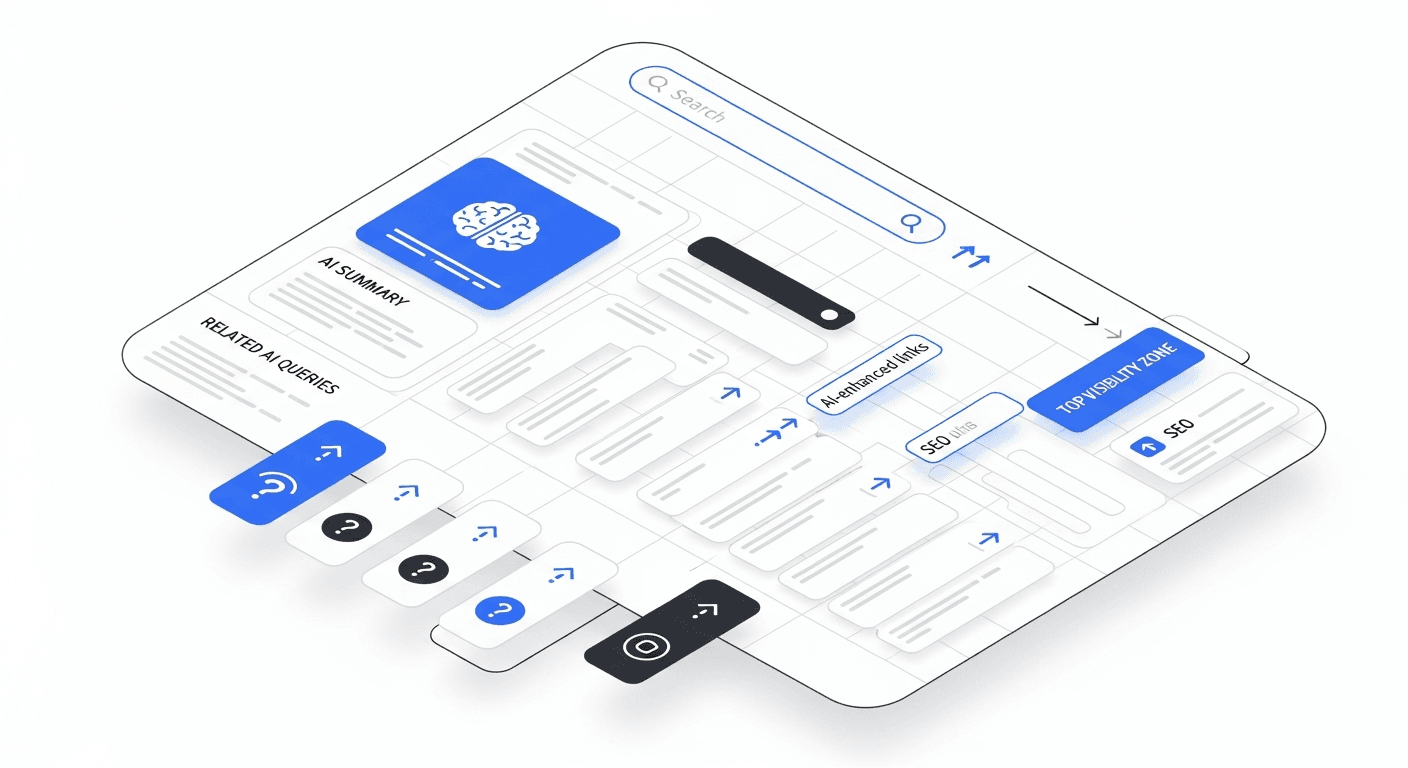
Google's New Look: What It Means for Your Business
At the Google I/O 2024 conference, Sundar Pichai unveiled what is likely the most radical change to Google's interface since 1998: a completely redesigned homepage built around artificial intelligence. Gone is the minimalist search bar on a white background. In its place is a conversational space where AI directly generates answers, suggests actions, and anticipates user needs.
For SME and mid-market business leaders in France and Belgium, this transformation is more than just a technological curiosity. It's redefining the rules of online visibility. Companies that quickly understand these new mechanisms will gain a decisive competitive advantage. Others risk seeing their organic traffic drop, even with good rankings for traditional queries.
In this article, we analyze the announced changes, their impact on organic search and local SEO, and the priority actions to adapt your SEO and GEO strategy starting now.
Major Changes to Google's New Interface
A Conversational Homepage
Google's new homepage abandons the keyword-based search paradigm in favor of a conversational experience. Specifically, users can now:
- Ask complex questions in natural language directly from the homepage
- Receive AI-generated summary responses before seeing traditional results
- Interact with an assistant that remembers conversation context
- Access personalized suggestions based on their history and preferences
Google has indicated that this interface will be rolled out gradually starting late 2024, with full deployment expected throughout 2025 across all markets, including France and Belgium.
AI Overview Takes Center Stage
AI Overview, initially launched in the United States in May 2024, will now occupy a dominant position in the interface. According to data shared at I/O, this AI-generated response block captures between 40 and 60% of users' visual attention on informational queries. This figure is expected to increase further with the new interface.
Traditional blue links aren't disappearing, but they're being relegated below the AI Overview block. For some queries, they're only accessible after an additional click or significant scrolling.
Integrated Multi-Modal Search
Google is natively integrating image, voice, and video search into its new homepage. A user can photograph a competitor's product, upload it, and ask: "What French companies manufacture an equivalent?" The AI will analyze the image and provide contextualized responses.
This functionality opens new opportunities for B2B companies with well-structured visual catalogs and optimized multimedia content.
Direct Impact on Corporate SEO Traffic
The Predictable Decline in Organic Click-Through Rates
Studies conducted on the US AI Overview show an average CTR (click-through rate) decrease of 18 to 25% on queries where the AI block appears. For a B2B company generating 10,000 monthly visits through organic search, this potentially represents 1,800 to 2,500 fewer visits each month.
This decline isn't uniform. It primarily affects:
- General informational queries ("what is," "how does it work")
- Searches for definitions and explanations
- Generic comparisons
However, transactional and navigational queries (searching for a specific company, requesting quotes) maintain click-through rates close to current levels.
The New Visibility Criterion: Being Cited by AI
In this new context, appearing in classic results is no longer enough. The goal becomes being cited as a source in AI-generated responses. At AISOS, we observe that companies cited in AI Overview capture higher-quality traffic, with conversion rates 30 to 40% higher than traditional organic traffic.
Why? Because users who click after reading a summary response already understand the context. They're seeking more detail or ready to take action, not discovering the topic.
Most Impacted B2B Sectors
Not all sectors will be affected equally. Here's an assessment based on initial US feedback:
- Professional services (consulting, accounting, legal): high impact. Informational queries often represent 60 to 70% of traffic.
- Industry and manufacturing: moderate impact. Specific technical searches remain less covered by generative AI.
- B2B software and SaaS: high to very high impact. Comparisons and buying guides are particularly affected.
- B2B distribution and commerce: variable impact depending on product specificity.
Adapting Your SEO Strategy: 2025 Priorities
Structuring Content for LLMs
AI response engines prioritize content that directly and structurally answers user questions. Here are the practices to adopt:
- Start each section with a clear statement: instead of "There are several types of...," write "The three main types of X are A, B, and C."
- Use structured lists for enumerations, steps, and comparisons.
- Include verifiable data: dates, percentages, amounts, sources.
- Explicitly name entities: companies, people, places, concepts. AI must be able to clearly identify what you're discussing.
Each section of your articles should function independently. AI often extracts a paragraph or two without taking the complete context.
Strengthening Brand Authority
LLMs preferentially cite sources they identify as authoritative on a topic. This authority is built through:
- Thematic consistency: publish regularly on your areas of expertise rather than dispersing your content.
- External mentions: press articles, citations in specialized publications, media appearances.
- Trust signals: detailed "About" page, executive and expert profiles, certifications, client references.
- Presence on reference sources: Wikipedia, professional directories, industry databases.
An industrial SME cited in a specialized publication like L'Usine Nouvelle or Industrie & Technologies will have a better chance of being picked up by AI than a competitor absent from these sources.
Developing a Complementary GEO Strategy
GEO (Generative Engine Optimization) complements traditional SEO by specifically targeting AI response engines: ChatGPT, Perplexity, Google AI Overview, Gemini. Priority actions:
- Audit your current presence: ask ChatGPT and Perplexity the questions your clients ask. Are you mentioned? Are your competitors?
- Create "citation-ready" content: short, affirmative paragraphs with your company name naturally integrated.
- Optimize your structured data: schema.org for products, services, FAQ, organizations.
- Work on your Knowledge Graph: Google Business profile, Wikidata, complete LinkedIn company profiles.
New Opportunities to Seize
Leveraging Multi-Modal Search
Google's new interface values visual and multimedia content. B2B companies can benefit by:
- Creating optimized product images with complete metadata (descriptive alt text, captions, context).
- Producing short explanatory videos (2-3 minutes) about their solutions.
- Developing shareable infographics and technical diagrams.
- Optimizing their PDFs and technical documents for indexing.
A machine tool company that visually documents its equipment with high-quality images and precise technical descriptions will be better positioned in B2B visual searches.
Targeting Specialized Long-Tail Queries
Generative AI effectively covers general queries but shows limitations on highly specialized questions. This is an opportunity for B2B companies:
- Specific technical questions: "ISO 2768-mK dimensional tolerance for aluminum machined parts"
- Specific use cases: "ERP software suitable for agri-food SMEs with batch traceability"
- Sector regulations: "CSRD compliance for French industrial mid-market companies 2025"
These queries generate less volume but attract highly qualified traffic with concrete purchase intentions.
Building Presence on AI-Consulted Sources
LLMs train and retrieve information from an identified corpus of sources. To increase your chances of being cited:
- Contribute to specialized publications in your sector.
- Participate in studies and reports from professional associations.
- Publish original data (surveys, barometers, market analysis).
- Participate in referenced podcasts and webinars.
AISOS audits reveal that companies present on at least five external reference sources in their sector are three times more likely to be cited by ChatGPT than those limited to their own website.
Six-Month Action Plan
Phase 1: Audit and Diagnosis (Months 1-2)
Before acting, measure your current situation:
- Analyze your SEO traffic breakdown: informational vs. transactional queries.
- Test your visibility on ChatGPT, Perplexity, and Gemini for your key queries.
- Identify pages generating the most informational traffic (most threatened).
- List competitors already cited by generative AIs.
Phase 2: Optimizing Existing Content (Months 2-4)
Rework your priority content according to GEO principles:
- Reformulate introductions for direct statements.
- Add structured data schema.org.
- Enrich content with data and sources.
- Create FAQ sections with explicit questions/answers.
Phase 3: Building Authority (Months 4-6)
Build your presence on external sources:
- Identify three to five target publications in your sector.
- Propose expert contributions (opinion pieces, interviews, studies).
- Update your profiles on professional directories and databases.
- Launch an original content initiative (study, barometer, report).
Conclusion: Anticipate Rather Than React
Google's new homepage announced at I/O 2024 marks a turning point in SEO history. For French and Belgian B2B companies, it's not about choosing between SEO and GEO, but integrating both dimensions into a coherent visibility strategy.
Changes will be gradual, allowing time to adapt. But companies that start now to structure their content for LLMs, strengthen their brand authority, and diversify their visibility sources will gain a significant advantage over competitors.
SEO isn't dead. It's evolving toward a model where quality, expertise, and trust become determining criteria. For SMEs and mid-market companies with real expertise to showcase, this is more opportunity than threat.
Want to assess the impact of these changes on your visibility and define an adapted roadmap? Contact the AISOS team for an audit of your SEO and GEO presence.


