Google Position 1 Mid-Page: How to Adapt Your SEO Strategy
The first organic Google result now appears mid-page. Discover how to adapt your SEO strategy in response to AI Overviews.

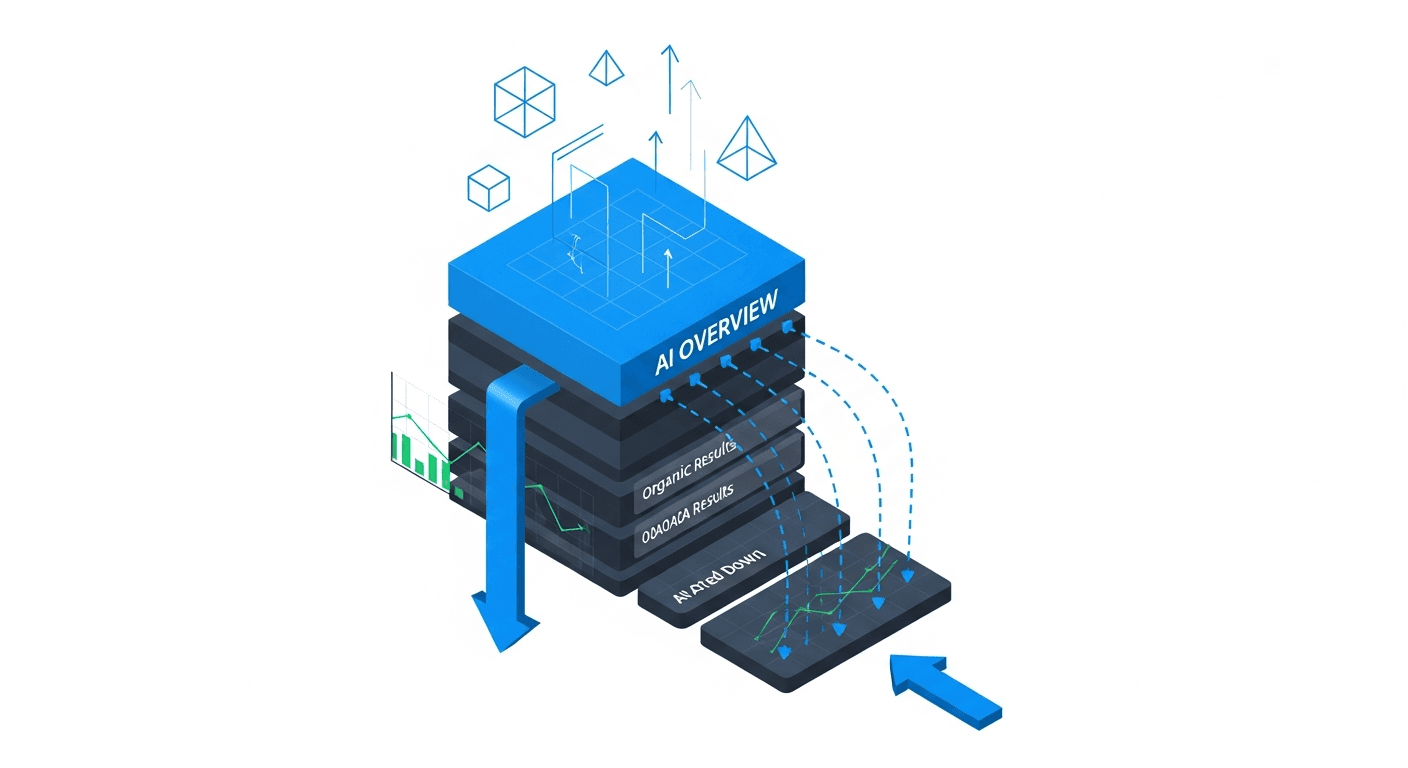
You've worked for months to reach position 1 on Google. Congratulations, you've made it. But when you search for your target query, your site appears... in the middle of the screen. Welcome to the new reality of SEO in 2025.
Google's AI Overviews have fundamentally altered the structure of search results pages. What was once the holy grail of organic search, the first organic position, now finds itself relegated beneath several hundred pixels of AI-generated content. For SME and mid-market business leaders who have invested in their online visibility, this evolution fundamentally changes the rules of the game.
This article analyzes the scope of this change, its measurable impact on your traffic, and most importantly, concrete strategies to maintain your visibility in this new environment.
The new anatomy of Google SERPs in 2025
Google's search results pages no longer resemble what they were two years ago. The organic position 1 that you target with your SEO strategy has literally slipped down the screen.
AI Overviews occupy the premium space
Google is deploying its AI Overviews across a growing number of queries. These AI-generated boxes appear at the top of the page and directly answer the user's question. According to recent analyses, these blocks can occupy between 400 and 800 pixels in height, sometimes more for complex topics.
In practical terms, on a standard screen, users must scroll down the page to see the first organic result. Position 1 now sits at approximately 50% of the initial visible height, or even below.
The stacking of SERP elements
The AI Overview isn't the only element pushing your results downward. The typical structure of a Google SERP in 2025 includes:
- Google Ads: 1 to 4 sponsored results at the top of the page
- The AI Overview: an AI response box of 400 to 800 pixels
- People Also Ask: an expandable frequently asked questions section
- Featured snippets: when they're not integrated into the AI Overview
- Organic results: finally, your position 1
This accumulation means that the first organic result can appear after 1000 pixels of scrolling on certain commercial queries.
Measured impact on click-through rates and organic traffic
This visual displacement isn't just a matter of aesthetics. It directly affects your site's performance.
The decline of position 1 CTR
Historically, organic position 1 captured between 25% and 35% of clicks on a given query. Recent data shows a significant erosion of this rate for queries where AI Overviews are present.
Several case studies report CTR drops of 30% to 60% on informational queries covered by AI Overviews. The reason is simple: users get their answer without needing to click.
The most affected queries
Not all queries are affected in the same way. AI Overviews appear primarily on:
- Informational queries: definitions, explanations, simple tutorials
- "How-to" queries: procedures, step-by-step guides
- Direct questions: who, what, when, why, how much
- Comparisons: differences between two concepts or products
Transactional and navigational queries are less impacted, but Google is progressively extending AI Overview coverage.
The paradox of visibility without clicks
A new phenomenon is emerging: your content can be cited in the AI Overview without you receiving a click. Google extracts information from your page, reformulates it, and presents it directly to the user. You contribute to the answer, but you don't capture the traffic.
At AISOS, we observe that some sites see their organic traffic drop by 15% to 25% on queries where they were actually cited in the AI Overviews. Brand visibility exists, but conversion to visits disappears.
Strategies to maintain your organic visibility
Faced with this new reality, inaction is not an option. Here are concrete action levers to adapt your strategy.
Target queries without AI Overview
The first approach is to identify queries where Google doesn't yet display an AI Overview. These queries exist and still represent a significant portion of searches.
Characteristics of queries without AI Overview:
- Very specific queries: technical niches, industry jargon
- Local queries: geolocated searches with proximity intent
- Brand queries: navigational searches toward a specific site
- Complex long-tail queries: combinations of multiple criteria
Your keyword research must now include systematic verification of the presence or absence of AI Overviews on each target query.
Optimize to be cited in AI Overviews
If you can't avoid AI Overviews, work to be included in them. Google cites sources in its generated responses, and these citations generate clicks, even if their volume is lower than traditional organic clicks.
Factors that favor citation in AI Overviews:
- Topical authority: a site recognized as an expert on a specific subject
- Content freshness: recent and updated information
- Clear structure: direct answers, lists, tables
- Proprietary data: statistics, studies, or exclusive information
Structure your content to facilitate AI extraction: clear declarative sentences, explicit definitions, bullet points for steps or criteria.
Strengthen your presence on other AI channels
Google is no longer the only search engine that matters. ChatGPT, Perplexity, Gemini, and other generative AI tools directly answer user questions and cite sources.
Diversifying your strategy toward GEO, Generative Engine Optimization, becomes essential. The citation criteria for these tools partially differ from Google's:
- ChatGPT: favors authoritative sources and recent content via its browsing functionality
- Perplexity: systematically cites its sources and favors structured content
- Gemini: relies on the Google ecosystem but with its own selection criteria
Rethinking your content strategy
Beyond optimization tactics, your overall approach to content must evolve.
Create content that AI cannot replace
AI Overviews excel at synthesizing existing information. They are less effective for:
- Original analyses: your unique interpretation of data or trends
- Experience feedback: concrete cases from your practice
- Reasoned opinions: positions supported by your expertise
- Interactive content: tools, calculators, configurators
Invest in these formats that AI cannot simply summarize and restate.
Develop your brand as a search criterion
Brand queries remain largely unaffected by AI Overviews. When a user specifically searches for your company, they arrive directly at your site.
This reality reinforces the importance of branding in your digital strategy:
- Create proprietary concepts: methodologies, frameworks, terms that only you use
- Associate your brand with your expertise: become the essential reference in your niche
- Multiply touchpoints: presence on social networks, podcasts, webinars, events
The goal is to transform your prospects into searchers for your brand, not just your generic services.
Leverage rich results formats
Certain enriched result formats appear above or alongside AI Overviews. Optimizing them becomes strategic:
- Local results: optimized Google Business Profile for geolocated searches
- Reviews and ratings: schema markup to display stars in results
- Images and videos: optimization to appear in visual carousels
- Events and products: structured data for specific rich snippets
Measuring and adjusting your performance
Traditional SEO metrics are no longer sufficient to evaluate your real visibility.
New indicators to track
Complete your dashboards with these metrics:
- Share of queries with AI Overview: among your target keywords, how many trigger an AI Overview
- Your AI citation rate: on the AI Overviews for your queries, are you cited as a source
- CTR by SERP type: compare your click rates between queries with and without AI Overview
- Multi-engine visibility: your presence in ChatGPT, Perplexity, and other responses
Adapt your reporting
Ranking alone no longer tells the whole story. Position 1 on a query with AI Overview and position 1 on a query without AI Overview don't have the same value.
Segment your analyses:
- Traffic from queries without AI Overview: your stable base
- Traffic from queries with AI Overview: monitor to detect erosion
- Brand traffic: indicator of your direct brand awareness
- Conversions by source: traffic quality matters as much as volume
Preparing for the future of your visibility
AI Overviews are just the beginning of a profound transformation in online search.
Predictable developments
Google continues to experiment with its AI response formats. Observed trends suggest:
- Extension of AI Overviews: growing coverage of query types
- More interactive responses: ability to ask follow-up questions
- Multimodal integration: images, videos, and audio in AI responses
- Increased personalization: responses tailored to user profiles
Building a resilient strategy
Facing these developments, AISOS audits reveal that the best-prepared companies share several characteristics:
- Traffic source diversification: no excessive dependence on Google
- Established topical authority: recognition as an expert in their field
- Proprietary assets: content, tools, and data that no one else possesses
- Strong brand: ability to generate direct brand searches
Position 1 on Google remains a worthwhile objective, but it can no longer be your only visibility strategy.
Conclusion: adapting your SEO to the reality of 2025
Google position 1 in the middle of the page is not a temporary anomaly. It's the new norm for a growing number of queries. AI Overviews, ads, and other SERP elements will continue to push organic results downward.
To maintain your visibility, three action areas are essential: intelligently target queries where position 1 retains its value, optimize to be cited in AI responses, and diversify your presence toward generative response engines.
This transition requires an evolution of your SEO strategy toward a broader approach to digital visibility. Organic search remains essential, but it must integrate into a strategy that encompasses GEO, branding, and creating high-value content.
Want to evaluate the impact of AI Overviews on your current visibility and identify adaptation opportunities? Contact AISOS for a complete audit of your presence in search engines and generative AI.


