Google Position #1: Why It Only Appears Mid-Page (And New Visibility Strategies)
Organic position 1 on Google now appears mid-screen. Discover how to adapt your B2B visibility strategy to these new SERP layouts.

Ranking #1 No Longer Guarantees Visibility: What Changed in 2024-2025
For twenty years, the objective was clear: reach the first organic position on Google. This spot guaranteed maximum clicks, the best brand visibility, and a steady flow of qualified prospects. That era is over.
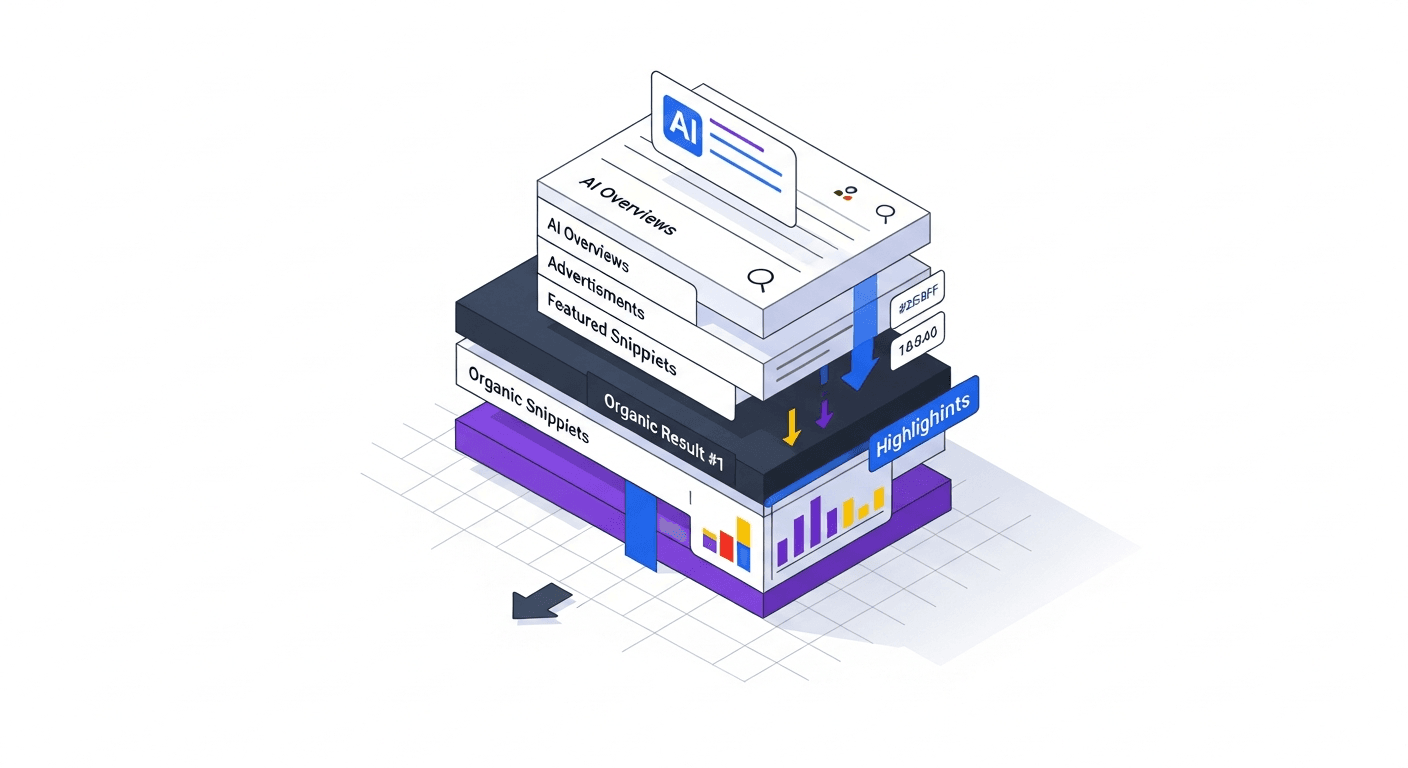
Today, on many commercial queries, the #1 organic position appears halfway down the page, sometimes even below the fold. Before it: Google Ads, AI Overviews, featured snippets, "People Also Ask" blocks, local results, images, videos. The first traditional organic result becomes invisible without scrolling.
For SME and mid-market company executives investing in SEO, this reality fundamentally changes the equation. Ranking first is no longer enough. The question becomes: how do you maintain real visibility when Google monopolizes the top of the page?
Anatomy of a SERP in 2025: Where is Position 1 Really Located?
Elements That Push Organic Results Down
Take a classic B2B commercial query like "enterprise project management software." Here's what a user sees before reaching the first organic result:
- 4 Google Ads: approximately 280 pixels in height
- AI Overview: between 300 and 500 pixels depending on the generated response length
- "People Also Ask" block: 150 to 200 pixels with 4 questions
- Image or product carousel: an additional 180 pixels
Result: the first organic link appears after 900 to 1,100 pixels of scrolling. On a standard 1080-pixel computer screen, this #1 result is invisible without scrolling. On mobile, the situation is even more critical with multiple screens of content before reaching organic results.
Data Confirming the Visibility Decline
According to analyses from Semrush and Sistrix published in early 2025, AI Overviews now appear on 35 to 40% of informational queries in the United States, with gradual deployment in Europe. On these queries, the CTR of the first organic result drops 30 to 50% compared to SERPs without AI Overview.
AISOS audits reveal a similar phenomenon in the French-speaking market: B2B companies maintain their #1 position on strategic keywords but experience a 20 to 35% erosion of organic traffic over 18 months, without losing position. The position remains, the traffic evaporates.
Concrete Impact on B2B Companies: Beyond Traffic
Loss of Brand Impressions
SEO doesn't just generate traffic. Each appearance of your brand in search results constitutes a brand impression, even without clicks. A decision-maker searching for solutions sees your name, associated with their problem, multiple times per week. This repetition builds awareness and trust.
When your #1 result disappears below the fold, these brand impressions collapse. Users find their answers in AI Overviews or click on ads before even knowing you exist. You lose a battle you didn't know you were fighting.
Extended Discovery Cycle
In a B2B buying journey, prospects perform an average of 12 searches before contacting a supplier. If your brand doesn't appear visually during these initial searches, you don't enter the shortlist. Traditional SEO gave you this discovery visibility. New SERP layouts reserve it for paid ads and sources cited by AI.
Traffic Concentration Among Few Giants
AI Overviews primarily cite high-authority sources: Wikipedia, government sites, major media outlets, established industry leaders. SMEs and mid-market companies, even with excellent content, struggle to be cited. Traffic concentrates on a reduced number of domains, intensifying the "winner takes all" effect.
Five Strategies to Regain Control of Your Visibility
1. Target SERP Features That Precede Position 1
Since enriched elements dominate the top of the page, optimize to appear in them:
- Featured snippets: structure your content with clear definitions, numbered lists, comparison tables. Featured snippets often appear above AI Overviews or within them.
- People Also Ask: identify frequent questions in your sector and answer them directly in your content. These responses feed PAA blocks.
- Images and videos: visual carousels capture attention before text links. A well-optimized image with relevant alt text can generate more visibility than a #1 text result.
2. Become a Source Cited by AI Overviews
Google selects AI Overview sources based on specific criteria: domain authority, content freshness, information clarity, absence of ambiguity. To maximize your chances of being cited:
- Publish proprietary data: studies, surveys, exclusive statistics that other sites will reference and that establish your expertise.
- Structure with schema.org markup: FAQ, HowTo, Article. These markings help Google extract and reformulate your information.
- Maintain regular updates: outdated content is passed over in favor of recent sources.
- Adopt a factual and direct tone: clear formulations are more easily cited than commercial texts.
3. Invest in Generative Engine Optimization (GEO)
Beyond Google, ChatGPT, Perplexity, Claude, and Gemini generate increasing volumes of B2B searches. These tools don't display #1 to #10 positions: they cite sources or formulate responses without visible attribution.
To appear in these responses:
- Establish your entity: ensure your company, executives, and products are recognized as entities by LLMs. This requires consistent presence on Wikipedia, Wikidata, LinkedIn, industry directories, and press mentions.
- Create citable content: clear statements, definitions, methodologies that AIs can reference. Each paragraph should function autonomously.
- Diversify your publication channels: LLMs aggregate varied sources. An article on your blog, picked up by industry media, cited in a podcast, mentioned on LinkedIn, builds multi-source presence that AIs detect.
4. Develop an Off-SERP Brand Strategy
If Google captures the top of the page, build your visibility elsewhere so prospects know you before they even search:
- Organic and paid LinkedIn: for French-speaking B2B, it's the most direct channel to decision-makers. Regular content positions your expertise before the search phase.
- Industry podcasts and webinars: these formats create brand familiarity that SEO alone can no longer guarantee.
- Press relations and guest posting: each mention in industry media reinforces your authority and increases your chances of being cited by AI.
5. Rethink SEO Performance Measurement
Traditional KPIs, focused on ranking and organic traffic, become insufficient. Integrate new indicators:
- Share of voice in AI Overviews: on your target queries, are you cited in generated responses?
- Real visibility: at what pixel position does your result appear, not just its rank?
- Citations in LLMs: regularly test responses from ChatGPT, Perplexity, and Gemini on your topics. Does your brand appear?
- Brand traffic: searches including your brand name escape competition from AI Overviews. Their growth indicates the effectiveness of your off-SERP visibility.
Case Study: How a B2B SaaS Publisher Adapted Its Strategy
A software publisher for industrial SME management, well-positioned on queries like "MRP software" and "MES manufacturing," experienced a 28% decrease in organic traffic between 2023 and 2024 despite stable top 3 positions.
Analysis revealed these queries now systematically triggered AI Overviews citing three sources: a comparison site, a tech media outlet, and a competitor that had published a market study. The publisher appeared nowhere in these generated responses.
Actions implemented:
- Publication of an annual industrial digitalization report with exclusive data, picked up by several industry media outlets.
- Redesign of product pages with schema.org Product and FAQ markup, enabling appearance in rich snippets.
- Launch of a monthly podcast featuring industrial directors, creating citable content and natural backlinks.
- Targeted LinkedIn campaign for industrial decision-makers, with non-promotional educational content.
Results after 9 months: organic traffic stopped declining, citations in AI Overviews began appearing on certain queries, and most importantly, brand traffic increased 45%, indicating visibility built outside SERPs.
What This Means for Your 2025-2026 Strategy
The #1 organic position remains a worthwhile goal, but it's no longer sufficient or sometimes even visible. SEO becomes a component of a broader visibility strategy, integrating:
- Optimization for enriched SERP features that dominate the top of the page.
- Generative Engine Optimization (GEO) to appear in AI responses.
- Brand development on complementary channels.
- Citable content creation: data, studies, methodologies.
B2B companies that anticipate these changes will maintain their competitive advantage. Those that continue measuring success solely by positions and organic traffic will see their visibility erode progressively, even while maintaining their rankings.
At AISOS, we help SMEs and mid-market companies through this transition, combining SERP visibility audits, GEO optimization, and multi-channel presence strategy. Because ranking #1 is no longer enough: you need to be seen, cited, and recognized, regardless of the response format Google or AIs choose to display.


