15 SEO + AI Mistakes Everyone Is Making in 2026 (and How to Fix Them)
After 200+ AI visibility audits, we have identified the same 15 recurring mistakes at French-speaking companies. Some are obvious, others surprising. This guide details each one with concrete solutions and real examples.

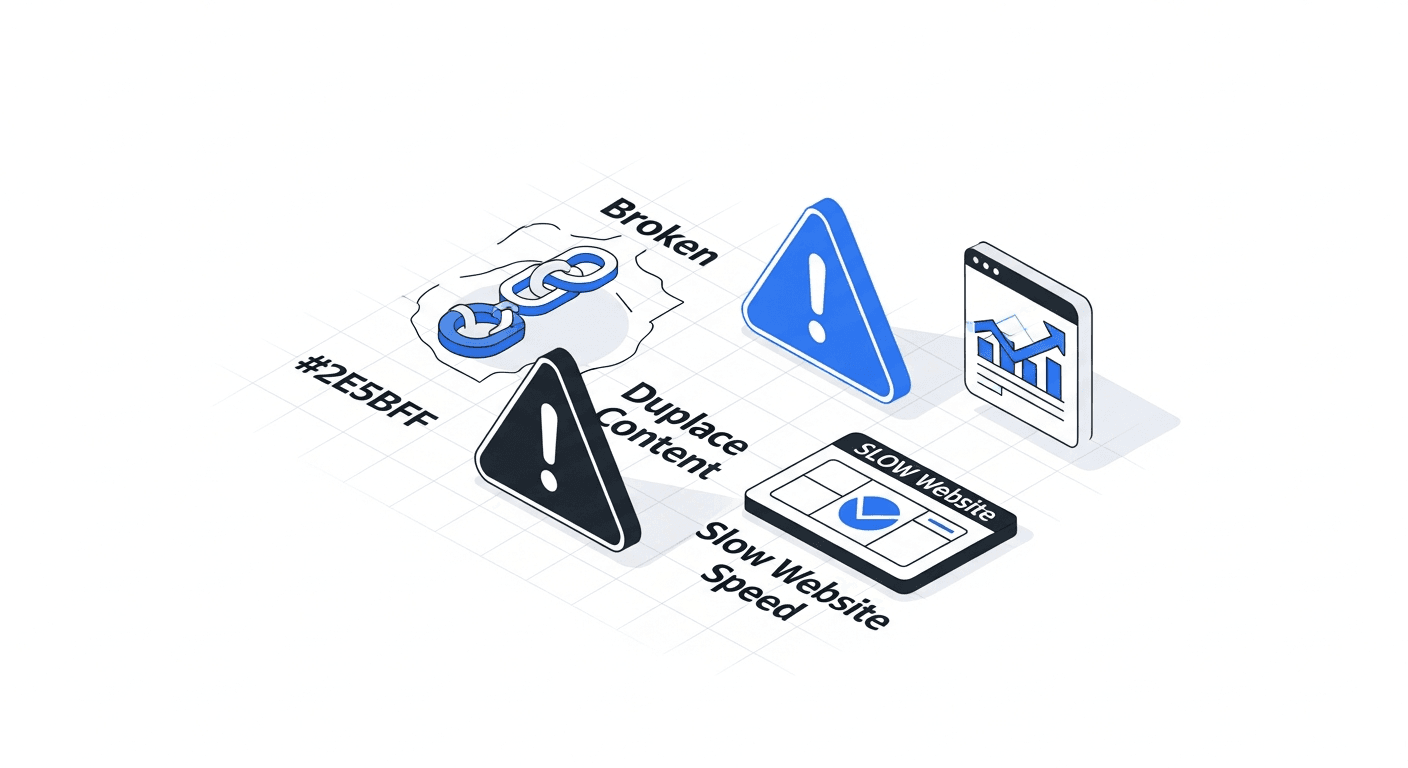
TL;DR: 15 systematic errors identified across 200+ audits of French-speaking sites. The most costly: unknowingly blocking AI bots (#1), ignoring structured data (#2), and continuing to do SEO like it's 2020 (#3). Each mistake is documented with its frequency in our audits, its impact, and a concrete solution. Fix the first 5 and you'll already be ahead of 80% of your competitors.
Critical Technical Errors (1-5)
Error #1: Blocking AI bots in robots.txt (38% of audited sites)
This is the most widespread and easiest mistake to fix. More than one in three French-speaking sites block at least one AI bot (GPTBot, ClaudeBot, PerplexityBot) without knowing it. The cause: WordPress security plugins (Wordfence, Sucuri) or server configurations that block all unrecognised bots by default.
Solution: Check your robots.txt now. Add explicit Allow rules for GPTBot, ClaudeBot, PerplexityBot, GoogleOther. See our robots.txt and AI guide for the full configuration.
Error #2: No structured data or minimal schema markup (72% of audited sites)
Nearly 3 in 4 sites have no schema markup, or only the basic Article schema generated by their CMS. No FAQPage, no Organization, no BreadcrumbList. LLMs use structured data to understand your content and assess its reliability. Without schema, you are less machine-readable than a competing site that has it.
Solution: Implement at minimum 4 schemas: Organization (homepage), Article (blog), FAQPage (pages with FAQ), BreadcrumbList (all pages). Our schema markup guide details each implementation.
Error #3: No LLMs.txt file (91% of audited sites)
LLMs.txt is the "robots.txt" of generative AI. It identifies the strategic pages you want LLMs to consume. 91% of sites don't have one. That's understandable (the standard is still recent), but it's a 30-minute "quick win" that delivers a measurable advantage.
Solution: Create an llms.txt file at the root of your domain. List your 10-20 most strategic pages. Our LLMs.txt guide explains the process.
Error #4: HTML polluted by page builders (45% of WordPress sites)
Page builders (Elementor, Divi, WPBakery) generate cluttered HTML: dozens of nested divs, random CSS classes, inline scripts. The text-to-code ratio drops below 15%. LLMs struggle to extract useful content from this noise, reducing your chances of being cited.
Solution: Migrating to Gutenberg is ideal. If that's not feasible, use Perfmatters to remove unnecessary scripts and favour the custom HTML widget for strategic content sections. More details in our WordPress and SEO + AI guide.
Error #5: Slow site (LCP > 3s) that causes AI bot timeouts (28% of audited sites)
Perplexity and Google AI Overview bots have aggressive timeouts: if your page takes more than 3 seconds to respond, it is ignored. A slow site is doubly penalised: by Google (Core Web Vitals) and by LLMs (timeout). See our Core Web Vitals guide for solutions.
| Error | Frequency in our audits | AI visibility impact | Fix time |
|---|---|---|---|
| #1 AI bots blocked | 38% | Critical (0 citations possible) | 15 minutes |
| #2 No schema markup | 72% | High (-40% citations) | 2-4 hours |
| #3 No LLMs.txt | 91% | Medium (-15-25% citations) | 30 minutes |
| #4 Polluted HTML | 45% | High (-30% citations) | 4-20 hours |
| #5 Slow site (> 3s) | 28% | High (bot timeouts) | 4-8 hours |
Content and Structure Errors (6-10)
Error #6: No structured FAQ on strategic pages (78% of audited sites)
FAQs are the format most cited by LLMs. Each structured FAQ with FAQPage schema is an opportunity for direct citation. 78% of sites have none, or have them without schema markup. Solution: add 5-8 questions per strategic page, marked up with FAQPage. Our FAQ SEO guide covers the method.
Error #7: Unedited AI-generated content (35% of recently audited sites)
The irony: using AI to create content that will be ignored by AI. Content generated by ChatGPT or Claude without substantial human editing is detectable by Google's algorithms and ignored by LLMs in their source selection. LLMs prefer original content with verifiable factual data and an author's point of view.
Solution: AI is an excellent drafting tool, but each article must be enriched with your own data, real examples, verified citations and a contrarian point of view. This is what distinguishes citable content from generic noise.
Error #8: Chaotic heading hierarchy (55% of audited sites)
H2s that jump directly to H4s, H3s used for styling rather than structure, pages with 3 H1s. LLMs use the heading hierarchy to understand content structure. A chaotic hierarchy reduces machine readability and the probability of citation.
Error #9: No comparison tables in long articles (65% of audited articles)
Tables are the most easily parsable format for LLMs. A 2,000-word article without a table is less cited than an equivalent article with a comparison table. It's a simple optimisation that takes 15 minutes per article.
Error #10: Sources exclusively from the US in the content (48% of audited sites)
For a site targeting the European French-speaking market, American sources reduce the perceived relevance of LLMs in a local context. Favour European sources: studies from Sistrix (Germany), SE Ranking (Europe), Authoritas (UK), Searchmetrics (Berlin), or French-language specialist media.
Strategic Errors (11-15)
Error #11: SEO 2020 in 2026 (60% of audited companies)
The majority of companies still do "old school" SEO: light keyword stuffing, focus on search volume, content optimised for Google only. In 2026, effective SEO is hybrid SEO that simultaneously optimises for Google AND for LLMs. This is a paradigm shift that many have not yet made.
Error #12: No AI visibility measurement (85% of audited companies)
You can't optimise what you don't measure. 85% of companies have no idea of their AI Visibility Score. They invest in SEO without knowing whether LLMs cite them. The first step is an AI visibility audit. See our AI visibility audit guide.
Error #13: Ignoring author authority (E-E-A-T) (70% of audited sites)
No author page, no bio, no Author schema, no link to social profiles. LLMs use these signals to evaluate content credibility. An article signed by "Admin" is less cited than an article signed by an identifiable expert with a linked LinkedIn profile.
Error #14: Non-existent or random internal linking (58% of audited sites)
Articles that link to no other articles, or link randomly without a topical silo strategy. Internal linking builds the topical authority that LLMs evaluate. Without it, each article is an isolated island. See our internal linking strategy guide.
Error #15: Total absence of an AI visibility strategy (75% of audited companies)
Most companies have no deliberate strategy for AI visibility. They do SEO, content marketing, social media, but none of these efforts are oriented towards the goal of being cited by LLMs. The result: scattered efforts that don't capitalise on the biggest visibility opportunity of the decade.
| Error | Frequency | Impact | Fix |
|---|---|---|---|
| #11 SEO 2020 | 60% | High | Training + strategy overhaul |
| #12 No AI measurement | 85% | Critical | AI visibility audit |
| #13 No E-E-A-T | 70% | High | Author pages + Author schema |
| #14 No internal linking | 58% | High | Silo strategy |
| #15 No AI strategy | 75% | Critical | AEO strategic plan |
FAQ: SEO + AI Errors
What is the most serious error for AI visibility?
Blocking AI bots in robots.txt (#1) is the most serious because it makes any citation impossible. It's also the easiest to fix (15 minutes). If you only fix one mistake, fix this one.
How many errors need to be fixed to see an impact?
Fix the first 5 technical errors and you'll already be ahead of 80% of your French-speaking competitors. The impact is measurable within 4 to 8 weeks. For maximum impact, address all 15 errors over a 3-month horizon.
Is AI-generated content always penalised?
No. Google and LLMs don't penalise AI-generated content per se. They penalise low-quality content, whether human or AI-generated. The problem with unedited AI content is that it lacks original data, a unique point of view, and verifiable citations. Edit it substantially and it will perform well.
Are these errors specific to the French-speaking market?
The errors are universal, but their frequency is higher in the French-speaking market. English-speaking companies, particularly in the UK, are generally more advanced in technical SEO and structured data adoption. This is an opportunity for French-speaking companies that fix these errors before their competitors do.
How do I know if my site is making these mistakes?
Use our 50-point SEO + AI checklist for a self-diagnosis. For a professional audit, request your free audit from AISOS. Within 48 hours, you'll know exactly which errors to fix and in what order.
What budget should I set aside to fix all 15 errors?
Technical errors (1-5) can be fixed in 10-30 hours (1,000-3,000 EUR with an agency). Content errors (6-10) require 20-40 hours. Strategic errors (11-15) require ongoing support. At AISOS, our 12-week programme covers everything for a structured investment. See our pricing.
Conclusion: Every Fixed Error Is a Competitive Advantage Gained
These 15 errors are not isolated cases. They are systematic patterns we find in the vast majority of French-speaking sites. The good news: every error you fix gives you an advantage over competitors who haven't fixed it yet.
Start with the 5 technical errors (15 minutes to 8 hours of work). The impact is fast and measurable. Then tackle the content and strategy errors in a 3-month plan.
For a personalised diagnosis, request your free audit. And to avoid repeating these mistakes, see our 50-point SEO + AI checklist and our SEO + AI tools comparison.
Co-founder and COO of AISOS. GEO Expert, he builds the AI visibility system that turns businesses from invisible to recommended.


