DeepSeek vs ChatGPT: A B2B Enterprise Guide to Navigating AI Censorship
DeepSeek and ChatGPT comparison for SMEs and mid-market companies: analyzing censorship limitations, B2B usage impacts, and GEO visibility strategies.

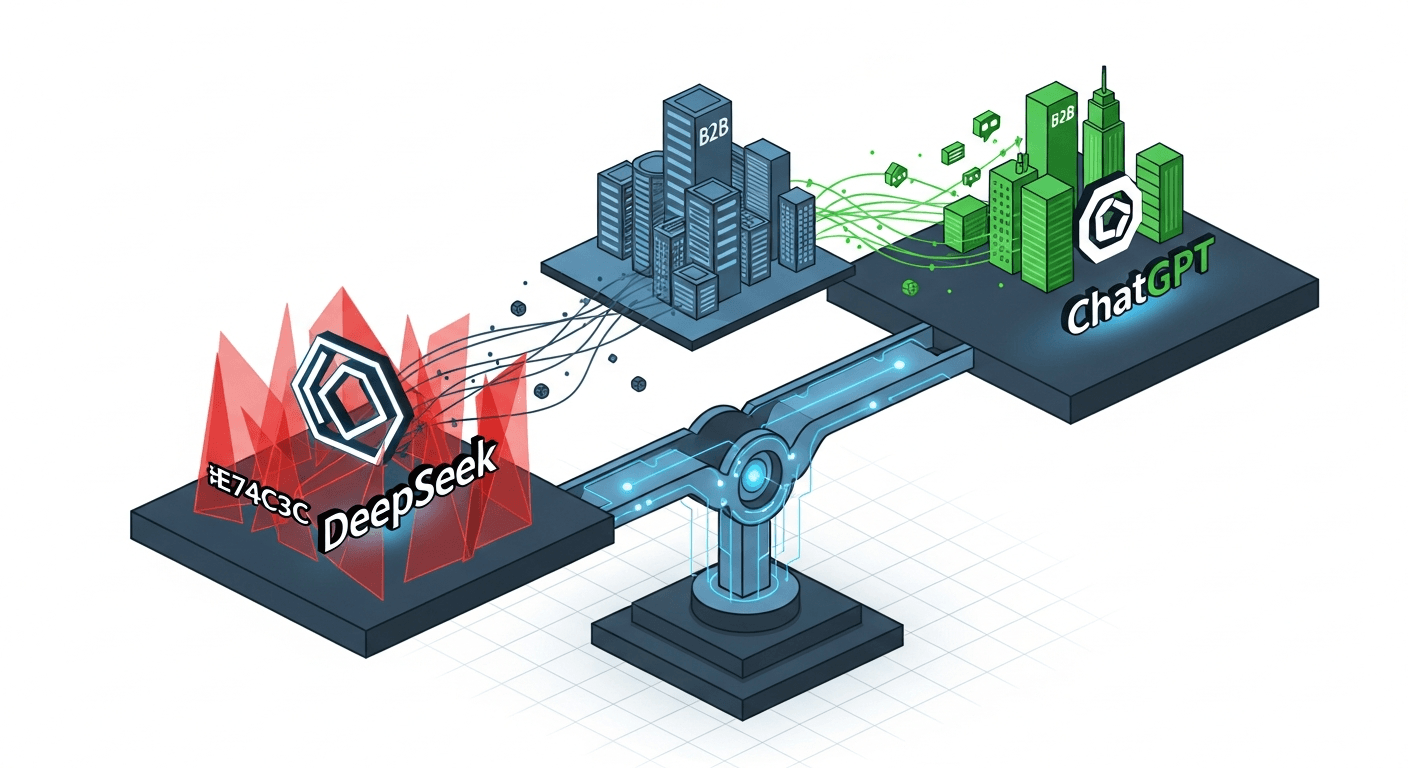
Censorship in Generative AI: A Critical Issue for B2B Companies
In January 2025, DeepSeek burst onto the generative AI market with impressive performance and reduced costs. But a Reddit post with over 48,000 upvotes highlighted a major problem: DeepSeek applies extensive censorship on numerous topics, well beyond Chinese political issues.
For SME and mid-market company leaders in France and Belgium, this raises a strategic question: which tool should you choose for your B2B operations? The answer depends on your use cases, industry sector, and visibility goals in generative search engines.
This guide objectively compares DeepSeek and ChatGPT from the perspective of censorship and professional use, with concrete recommendations for making the right choice.
DeepSeek: Technical Performance vs Content Limitations
What DeepSeek Does Well
DeepSeek R1, the Chinese company's reasoning model, shows remarkable results on technical benchmarks. According to published tests, it rivals GPT-4 on coding, mathematics, and logical reasoning tasks, with an estimated training cost of $5.6 million versus several hundred million for competing models.
For B2B companies, the potential advantages include:
- Significantly lower API usage costs compared to OpenAI
- Advanced reasoning capabilities for data analysis
- Open source architecture allowing on-premise deployment
- Solid performance on pure technical tasks
Documented Censorship Areas
Tests conducted by the community and researchers reveal that DeepSeek refuses to answer or provides biased responses on:
- Sensitive political topics: Taiwan, Tibet, Tiananmen events, Hong Kong
- Geopolitical comparisons: any question involving China in a potentially critical context
- Certain historical content: events related to the Chinese Communist Party
- Sensitive economic topics: certain questions about Chinese business practices
More problematic for businesses: censorship sometimes extends to seemingly neutral topics when they relate directly or indirectly to Chinese interests. A simple test: ask DeepSeek to compare governance systems of different countries. The responses will often be evasive or biased.
ChatGPT: The Reference Standard for Professional Use
Content Policy and Transparency
OpenAI also applies content restrictions, but with a fundamental difference: the limitations are documented and predictable. ChatGPT refuses to generate illegal, dangerous, or explicitly harmful content, but handles political, economic, and geopolitical topics without systematic bias linked to any government.
For European B2B companies, this distinction is crucial. You can use ChatGPT to:
- Analyze international markets, including Asian ones, without blind spots
- Produce content on sensitive topics in your sector
- Obtain objective comparative analyses between regions
- Generate reports for international clients or partners
GDPR Compliance and European Hosting
OpenAI now offers data hosting within the European Union for Enterprise and API accounts. DeepSeek, based in China, raises more complex compliance questions. Data transits through Chinese servers, subject to local legislation on data access by authorities.
For SMEs and mid-market companies handling client data or strategic information, this point is not negligible. AISOS audits reveal that the data hosting question is becoming a major selection criterion for executive management in 2025.
B2B Use Cases: Where Each Tool Excels
When DeepSeek May Be Suitable
Despite its limitations, DeepSeek remains relevant for certain circumscribed professional uses:
- Software development: code generation, debugging, technical documentation
- Internal data analysis: processing datasets without geopolitical dimensions
- Repetitive task automation: reformulation, structured information extraction
- Prototyping and R&D: concept testing, technical exploration
If your use is limited to these cases and you deploy the model locally via the open source option, DeepSeek can represent a viable economic option.
When ChatGPT Is Essential
For the majority of B2B uses, ChatGPT remains the default choice for several reasons:
- Marketing and commercial content production: articles, emails, presentations without bias risk
- International competitive analysis: complete and objective market studies
- Customer support and chatbots: reliable responses on all topics
- Training and internal documentation: educational content without blind spots
- GEO strategy and AI visibility: optimization for Western generative search engines
Impact on Your Visibility in Generative AI
How Generative Search Engines Select Their Sources
ChatGPT, Perplexity, Google AI Overview, and Gemini share a common objective: providing reliable and complete answers. To appear in these responses, your content must meet specific criteria:
- Demonstrated authority and expertise on your topic
- Clarity and structure facilitating information extraction
- Complete coverage of questions related to your theme
- Currency and relevance of cited data
At AISOS, we observe that content performing best in AI responses is that which treats topics comprehensively, without avoiding difficult or controversial angles in their sector.
The Risk of Producing Content with a Censored Tool
If you use DeepSeek to produce your B2B content, you take a strategic risk: your content could inherit the biases and limitations of the tool. An article on international trade that avoids certain topics will be perceived as incomplete by generative search engines.
More concretely, generative AIs compare sources with each other. Content that treats a topic partially will be systematically disadvantaged compared to a competitor that covers the same topic comprehensively.
Practical Recommendations for SMEs and Mid-Market Companies
Evaluate Your Real Needs
Before choosing, ask yourself these questions:
- Does your business involve Asian markets or partners?
- Do you produce content on potentially sensitive topics?
- Are your clients or partners international?
- Is GDPR compliance a strong issue for your sector?
- Are you seeking to appear in generative AI responses?
If you answer yes to at least two of these questions, ChatGPT or an equivalent uncensored model should be your primary choice.
Recommended Multi-Tool Strategy
The best approach for B2B companies in 2025 combines several tools according to use cases:
- ChatGPT Enterprise or API for content production, strategic analysis, and client-facing uses
- DeepSeek locally (if relevant) for internal technical tasks without sensitive dimensions
- Anthropic's Claude as an alternative for content requiring nuanced analysis
- Perplexity for monitoring and documented research with sources
Verification Checklist Before Publication
If you use generative AI to produce B2B content, systematically verify:
- Does the content cover all aspects of the topic, including the most delicate ones?
- Are the statements balanced and documentable?
- Are there suspicious omissions about certain actors or regions?
- Is the tone neutral and professional on geopolitical topics?
- Are the sources cited or suggested verifiable?
The Future of Competition Between AI Models
The generative AI market is evolving rapidly. DeepSeek has demonstrated that it's possible to create high-performing models at lower cost, which pushes OpenAI, Google, and Anthropic to optimize their own offerings. For B2B companies, this competition is beneficial: it drives down prices and improves performance.
However, the question of censorship and bias will remain a lasting differentiating factor. Models developed under different jurisdictions will inevitably carry the constraints of their regulatory environment. European companies have every interest in favoring tools aligned with their values of transparency and objectivity.
The rise of European AIs like Mistral could offer an interesting third way: high-performing models, without political censorship, and compliant with the European regulatory framework. A development worth watching closely for B2B decision-makers.
Conclusion: Choosing Reliability for Your AI Strategy
The DeepSeek vs ChatGPT debate for B2B companies comes down to a question of priorities. If your objective is solely cost reduction on isolated technical tasks, DeepSeek may have a place in your stack. But for any use involving content production, strategic analysis, or visibility in generative search engines, censorship limitations represent too high a risk.
For French and Belgian SMEs and mid-market companies that want to appear in responses from ChatGPT, Perplexity, and Google AI Overview, the choice of production tool is strategic. Content produced with invisible biases will be less well referenced, less cited, and ultimately less effective for your visibility.
Our recommendation: favor ChatGPT or Claude for your critical B2B uses, test DeepSeek locally for specific technical tasks, and above all, have your current presence in generative AIs audited to identify your visibility opportunities. AISOS supports leaders in this approach with comprehensive GEO audits that reveal how your company appears, or doesn't, in responses from major generative search engines.
Co-founder and COO of AISOS. GEO Expert, he builds the AI visibility system that turns businesses from invisible to recommended.


