
TL;DR
An SEO entity is any uniquely identifiable concept: a person, a company, a place, a product. Google and LLMs reason in entities, not keywords. Optimising for entities means being recognised as a distinct "thing" in the Knowledge Graph, which multiplies your chances of being cited by AI. This guide explains how to build and strengthen your entity identity.
Traditional SEO is built on keywords. You target "AI visibility for business", you optimise your page, you get traffic. Simple. But this model is dying.
Google and LLMs no longer reason in keywords — they reason in entities. When you search "AISOS", Google doesn't simply match the letters A-I-S-O-S: it consults its Knowledge Graph to understand that AISOS is a company, based in Brussels, specialising in AI visibility, founded by Alan Schouleur.
Understanding entities means understanding how Google and AI "think". This guide demystifies the concept and shows you how to leverage it.
1. What is an SEO entity?

An SEO entity is any concept that can be identified in a distinct and unambiguous way. Google defines an entity as "a thing or concept that is singular, unique, well-defined and distinguishable".
Entities include:
- People: Alan Schouleur, Tim Berners-Lee
- Organisations: AISOS, Google, CERN
- Places: Brussels, Silicon Valley
- Products: ChatGPT, Perplexity
- Concepts: AEO, GEO, technical SEO
- Events: Web Summit, FOSDEM
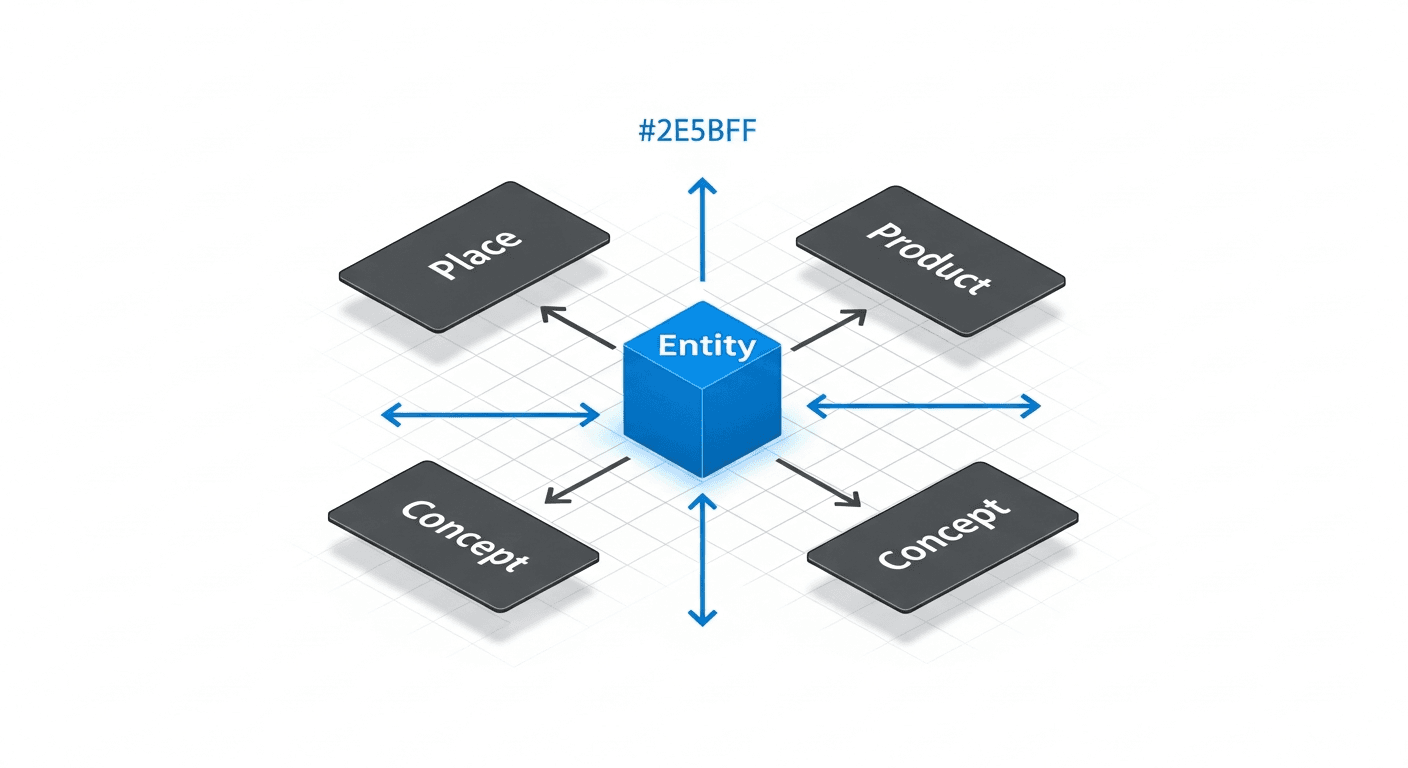
Each entity has attributes (properties) and relationships with other entities. AISOS (entity) has the attribute "registered office: Brussels" and the relationship "founder: Alan Schouleur".
Diagram: example of an entity graph — AISOS and its relationships
2. Entities vs keywords: the paradigm shift
The shift from keywords to entities is the biggest change in SEO since the introduction of PageRank. Here is why:
Keywords are ambiguous, entities are not
The word "Apple" can refer to the company, the fruit or the record label. The entity "Apple Inc." (Wikidata ID Q312) is unambiguous. Google uses entities to disambiguate queries and provide precise answers.
Entities are multilingual
The entity "Paris" is the same regardless of the language of the query. Optimising for entities means optimising for all languages simultaneously — a major advantage for multilingual European businesses.
LLMs reason in entities
Language models such as GPT-4 and Gemini encode knowledge as relationships between entities in their neural weights. Strengthening your entity presence means strengthening your "weight" in the model.
Dr. Fabian Suchanek, professor at Telecom Paris and creator of the YAGO knowledge base, points out:
"Modern search engines and LLMs have made the same shift: from text matching to semantic understanding. Entities are the common language of this understanding. Companies that don't think in terms of entities will be marginalised."
3. How LLMs use entities
LLMs use entities at three levels:
Level 1: identification
When a user mentions "AISOS" in a query, the LLM must identify the corresponding entity and its attributes. If your entity is well defined in its sources (web, Knowledge Graph), identification is reliable.
Level 2: thematic association
LLMs associate each entity with themes. AISOS = AI visibility, AEO, GEO, SEO. The more your content reinforces this association consistently, the more the LLM will associate you with these themes.
Level 3: recommendation
When the LLM must recommend a solution ("which agency for AI visibility?"), it selects entities with the strongest signal on the relevant theme. This is the ultimate stage of AI visibility.
4. Comparison: keyword vs entity optimisation
| Criterion | Keyword optimisation | Entity optimisation |
|---|---|---|
| Logic | Text matching | Semantic understanding |
| Linguistic reach | 1 language per page | Multilingual by default |
| Channel | Classic SERPs | SERPs + AI Overviews + LLMs + voice |
| Durability | Fragile (algorithmic) | Durable (structural recognition) |
| Initial effort | Low | High (but increasing returns) |
| Long-term ROI | Decreasing | Increasing |
5. Building your entity identity in 6 steps
Step 1: define your entity unambiguously
Write a clear and factual description of your company in 2-3 sentences. This description should be identical across all your digital presences.
Step 2: map your entity relationships
Identify the entities related to yours: founder, products, sector, location, notable clients. Each relationship strengthens your entity definition.
Step 3: deploy complete schema markup
Implement Organization, Person, Product schemas with sameAs, knowsAbout, and hasOfferCatalog properties.
Step 4: create your Wikidata entity
Create an entity on Wikidata.org with your basic properties. Link it to your other presences (website, LinkedIn, Crunchbase).
Step 5: publish content centred on your entity
Every article, every page should reinforce the association between your entity and your area of expertise. Mention your entity in context in every piece of content.
Step 6: obtain external corroborations
Press mentions, guest articles, academic references — every external source that corroborates your entity attributes strengthens your signal.
Dr. Elena Simperl, Professor of Computer Science at King's College London, confirms:
"Building a strong entity identity is a first-rate strategic investment. In the current ecosystem, where AI and search engines converge towards semantic understanding, being recognised as an entity is the prerequisite for any visibility."
6. FAQ — SEO entities and AI
Does entity optimisation replace keyword optimisation?
It complements and surpasses it. Keywords remain useful for content targeting, but entity optimisation is what determines your visibility in LLMs and AI Overviews.
How do I know if Google recognises my business as an entity?
Search for your company name on Google. If a Knowledge Panel appears, your entity is recognised. You can also check via Google's Knowledge Graph API.
Do you need a website to be an entity?
No, but it is strongly recommended. The website is the primary reference point for defining your entity attributes. Without a site, you are entirely dependent on third-party sources.
Is entity optimisation technical?
Partially. Schema markup implementation is technical, but the content and multi-source consistency strategy is accessible to everyone. The most important thing is rigour in describing your entity.
What is the link between entities and E-E-A-T?
Direct. E-E-A-T is an assessment of your entity's trustworthiness. The more your entity is well defined and corroborated by external sources, the higher your E-E-A-T score in Google's eyes.
Conclusion: think entities, not keywords
The shift of SEO towards entities is irreversible. Companies that continue to think only in keywords see their visibility decline in favour of those that build a strong and consistent entity identity.
At AISOS, we help businesses build their entity identity to maximise their visibility in the Google and LLM ecosystem. Contact us for an entity audit.
Audit my entity identity

