Review sites lost 90% of their traffic. AI still cites them.
Review and comparison sites are hemorrhaging traffic to AI. But paradoxically, they've become even more important as sources for LLM recommendations.

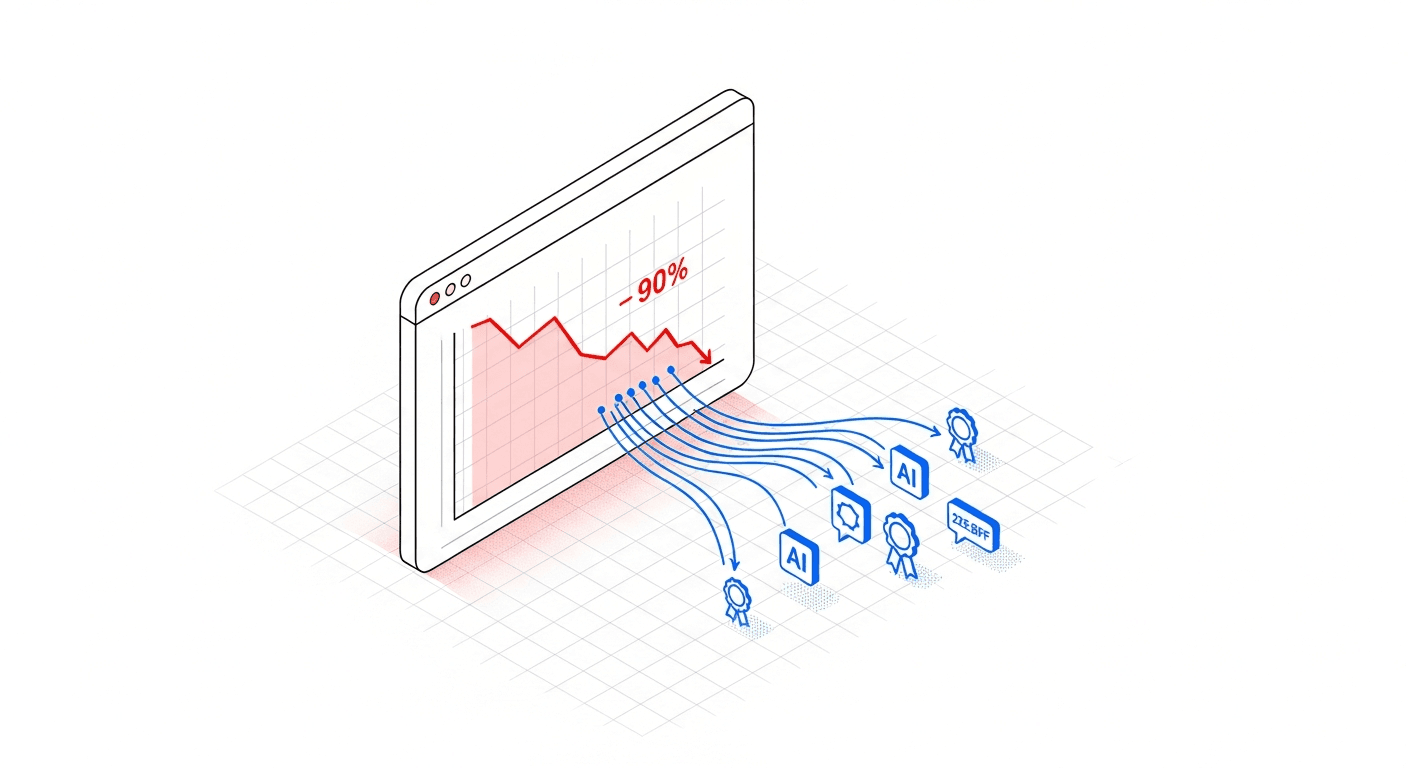
The data from SimilarWeb tells a brutal story: major review sites have lost between 50% and 90% of their organic traffic over the past 18 months. G2's organic traffic dropped 62%. Capterra lost 71%. Smaller review sites fared even worse.
The reason is straightforward: when someone asks "best project management tool for SMEs," AI now gives the answer directly. No need to visit G2 and scroll through 47 options.
But here's the paradox that matters for your business: AI cites these review sites more than ever as its sources.
Why AI loves review sites
LLMs need authoritative, structured, comparative data to make recommendations. Review sites are exactly that: organized collections of user opinions, feature comparisons, pricing data, and ratings.
When ChatGPT recommends "the best CRM for small businesses," it's pulling from G2 categories, Capterra comparisons, and Trustpilot ratings. These sites may be losing direct visitors, but they're gaining influence as the data layer behind AI recommendations.
Think of it this way: fewer humans visit G2 directly, but more AI systems query G2's data to formulate their responses. The audience changed from humans to machines.
What this means for your strategy
If review sites are the primary data source for AI product recommendations, your presence on these platforms isn't optional -- it's foundational.
Your G2/Capterra profile is now more important than your Google ranking for certain queries. When a prospect asks ChatGPT to compare tools, ChatGPT doesn't check your Google ranking. It checks your review profile. Rating, number of reviews, recency, category placement, feature comparison data.
This means the ROI of investing in your review profiles has actually increased, even as these sites' direct traffic has cratered. Your investment isn't buying you G2 visitors anymore -- it's buying you ChatGPT mentions.
The second-order effect: content sites
It's not just official review platforms. Blog posts that compare products -- "Best X for Y in 2026" -- are also being cited by AI even as their organic traffic declines.
A tech blogger who wrote "Best CRM for Belgian SMEs" might see their traffic drop from 5,000/month to 500/month. But that article is now being cited by Perplexity, referenced by ChatGPT, and included in Google's AI Overview. The article's impact has grown even as its direct readership shrank.
For your business, this creates an opportunity: getting mentioned in these comparison articles has more value today than it did two years ago. The article reaches fewer humans directly but influences millions of AI responses.
The E-E-A-T connection
Review sites thrive in the AI era because they embody E-E-A-T in its purest form:
Experience: real users sharing real experiences.
Expertise: specialized platforms dedicated to product evaluation.
Authoritativeness: aggregated opinions from hundreds of users.
Trustworthiness: verified reviews with identity checks.
If your brand has strong representation on these platforms, you inherit their E-E-A-T in AI systems. If you don't, you're asking AI to trust your own marketing claims. Guess which scenario leads to more citations.
Action plan
Audit your presence. Check every major review platform in your category. G2, Capterra, Trustpilot, TrustRadius, Clutch, Sortlist. Do you have a profile? Is it complete? Is it current?
Invest in reviews. The minimum viable presence is 30+ reviews on one major platform. Ideal is 50+ on two platforms. Quality matters: detailed reviews with specific use cases carry more weight than generic "great product!" one-liners.
Get into comparison articles. Identify the "best of" articles in your category. Reach out to authors. Submit your product for inclusion. This isn't vanity -- it's AI visibility infrastructure.
Monitor the feedback loop. Check monthly what ChatGPT, Perplexity, and Gemini say when asked to recommend products in your category. Track changes. Correlate with your review profile activity.
The review sites' loss of human traffic is irreversible. But their gain of AI influence is accelerating. Your presence on these platforms isn't about reaching the G2 visitor anymore. It's about reaching the AI that reads G2 and recommends to millions.
Co-founder and COO of AISOS. GEO Expert, he builds the AI visibility system that turns businesses from invisible to recommended.


