
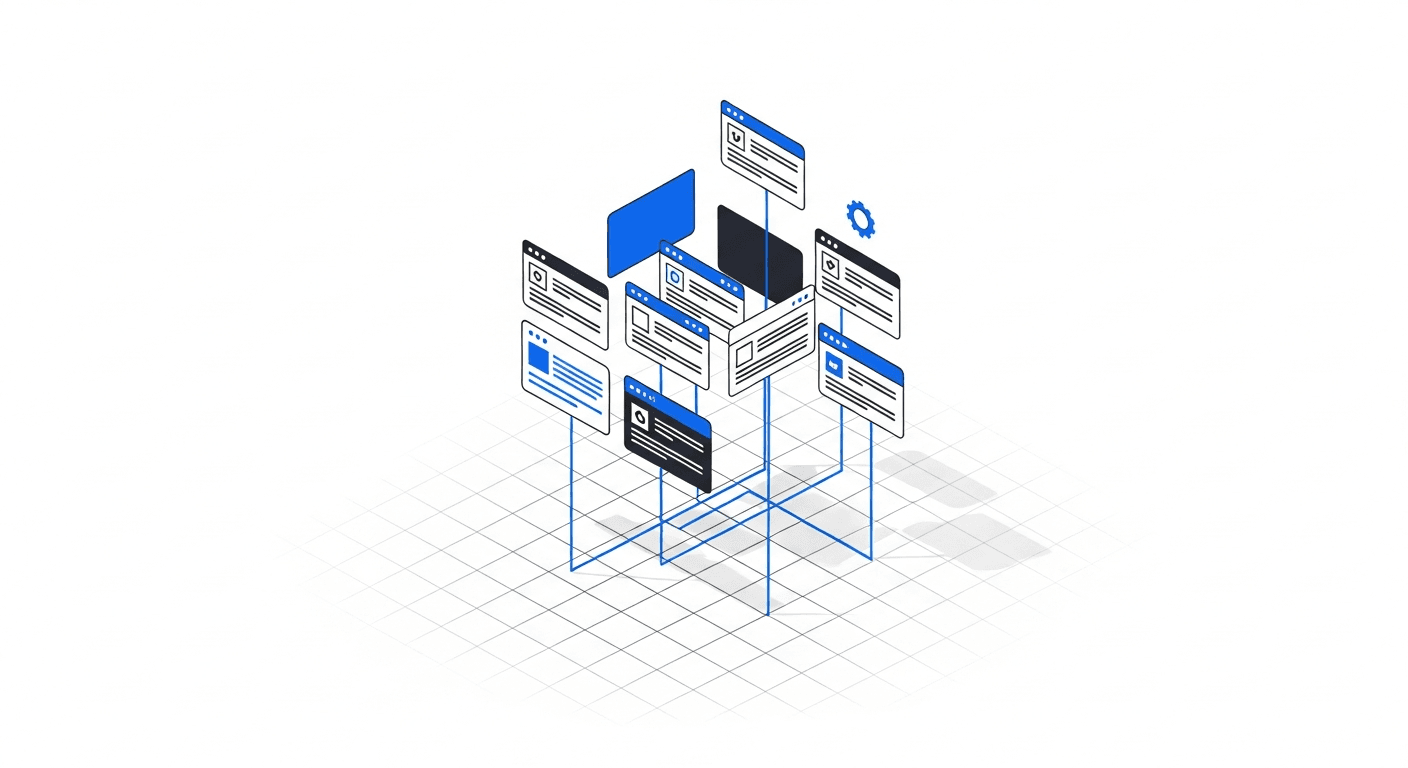
TL;DR: A pillar page is comprehensive content (3,000-5,000 words) that covers a broad topic and links to more specific cluster articles. Sites using a pillar + cluster architecture see organic traffic increase by 40-60% in 6 months. This guide shows you how to design, write and optimize pillar pages that become the references in your industry for Google and generative AI.
Imagine your website as a library. Each blog post is a book. But without shelving, without classification, without an index, even the best books remain unfindable. Pillar pages are your shelving system: they organize your expertise into coherent themes and guide readers (and search engines) to the right content at the right time.
The pillar-cluster model, popularized by HubSpot, has become the standard in SEO content strategy. According to a study by Ahrefs Europe (2025), sites that move from a flat blog structure to a pillar-cluster architecture see organic traffic increase by 40 to 60% in 6 months, with a 25% improvement in their topical authority.
In this guide, we will show you how to design, write and optimize pillar pages that become the essential references in your industry.
What is a pillar page and why it is essential
Definition
A pillar page is long, comprehensive content that covers a broad topic panoramically. It serves as a central hub for a cluster of more specific content pieces that deepen each sub-topic.
Characteristics of a pillar page
| Characteristic | Pillar page | Cluster article |
|---|---|---|
| Length | 3,000-5,000 words | 1,000-2,500 words |
| Scope | Broad (overview) | Specific (one sub-topic) |
| Target keyword | Head term (e.g., "technical SEO") | Long-tail (e.g., "optimize core web vitals") |
| Linking | Links to all clusters | Links back to pillar page |
| Update frequency | Quarterly | Semi-annually |
| Target search volume | 1,000+ searches/month | 100-500 searches/month |
Why it is essential in 2026
- Topical authority: Google understands you are an expert on a topic when it sees a network of interconnected content around a pillar
- User navigation: visitors easily find the content they are looking for thanks to the hierarchical structure
- Link equity: backlinks to the pillar page benefit all cluster articles via internal linking
- AI citations: pillar pages, with their exhaustive coverage, are ideal candidates for generative AI citations
The pillar-cluster architecture explained
The pillar-cluster architecture is built on three levels:
Level 1: The pillar page
This is your ultimate guide on a topic. It covers all aspects of the theme at a high level and links to cluster articles for each sub-topic. Example: "Complete guide to AI content strategy in 2026".
Level 2: Cluster articles
Each article delves deeper into a specific sub-topic from the pillar page. They link back to the pillar page (and to each other when relevant). Example: this article on pillar pages is a cluster article for the "Content Strategy" pillar.
Level 3: Support articles
Highly specific content that deepens one aspect of a cluster article. They target very specific long-tail queries. Example: "How to implement FAQPage schema on WordPress".
As Kevin Indig, Europe-based Growth expert, explains: "The pillar-cluster model is not just an SEO method. It is a way of thinking about your expertise as an interconnected network. The denser and more coherent your network, the more Google and AI tools consider you an authority." (Source: kevin-indig.com)
How to design a pillar page
Step 1: Choose the pillar topic
- Identify 3-5 broad topics at the core of your expertise
- Verify search volume (minimum 1,000+ searches/month)
- Ensure you have enough sub-topics for 10-20 cluster articles
Step 2: Map the clusters
- List all sub-topics that make up the pillar theme
- Group them into 10-20 logical cluster articles
- Identify keywords for each cluster
- Use tools like content clustering to structure your map
Step 3: Write the pillar page
- Introduction: define the topic, its importance and what the reader will learn
- Table of contents: with anchor links to each section
- H2 sections: one per sub-topic, with a panoramic summary + link to cluster article
- Tables and visuals: minimum 2-3 comparison tables and 3-5 images/diagrams
- FAQ: 8-10 questions covering cross-cutting queries
- CTA: clear call to action toward the next step
Step 4: Create the linking structure
- The pillar page links to each cluster article
- Each cluster article links back to the pillar page (ideally within the first 100 words)
- Cluster articles link to each other when relevant
Internal linking strategy for pillar pages
| Link type | Direction | Frequency | Best practices |
|---|---|---|---|
| Pillar to cluster | Downward | 1 link per cluster (in body) | Descriptive anchor text with keyword |
| Cluster to pillar | Upward | 1-2 links per article | Link in first 100 words + conclusion |
| Cluster to cluster | Horizontal | 2-3 links per article | Contextual link when topic is mentioned |
| Pillar to commercial page | Cross | 1-2 CTAs | Natural link to /contact or /#pricing |
| Navigation | Global | Breadcrumb + menu | Visible hierarchy pillar > cluster |
The power of internal linking
Internal linking in a pillar-cluster architecture distributes "link equity" effectively. A backlink to your pillar page benefits all cluster articles via internal links. Conversely, cluster articles that earn backlinks strengthen the pillar page through upward links.
Pillar pages and generative AI
Pillar pages are ideal candidates for AI citations, for several reasons:
- Exhaustive coverage: they cover a topic in depth, providing AI tools with a complete source
- Clear structure: H2s, tables and lists allow AI tools to easily extract structured information
- Demonstrated authority: the network of inbound and outbound links signals expertise to AI crawlers
- Regular updates: quarterly-updated pillar pages show that the content is reliable and up-to-date
According to Lily Ray, SEO and E-E-A-T expert: "Pillar pages are what generative AI tools look for: comprehensive, well-structured content with demonstrated authority. If you want to be cited by ChatGPT or Perplexity, having solid pillar pages is the first step." (Source: lilyray.com)
FAQ
How many pillar pages should you create?
Most companies need 3 to 5 pillar pages, corresponding to their 3-5 main areas of expertise. Each pillar page should be supported by 10-20 cluster articles. It is better to have 3 excellent pillars with complete linking than 10 incomplete pillars.
What length should a pillar page be?
Between 3,000 and 5,000 words is ideal. Long enough to cover the topic exhaustively, but not so long that the reader disengages. Each H2 section should be 300-500 words with a referral to the cluster article to go deeper.
Should the pillar page be published before or after the cluster articles?
Ideally, publish the pillar page first, then progressively add cluster articles by linking them to the pillar page. Each new cluster article strengthens the pillar page. If you already have articles, create the pillar page and link the existing articles to it.
How to avoid cannibalization between pillar page and cluster articles?
The key is keyword differentiation. The pillar page targets a broad head term ("technical SEO"), while each cluster targets a specific long-tail ("optimize core web vitals"). The two complement each other instead of competing. Check in Search Console that the right pages rank for the right queries.
How often should a pillar page be updated?
At minimum every quarter. Add new cluster articles as they are created, update statistics and data, and enrich the best-performing sections. A living pillar page always outperforms a static one.
Do pillar pages work for small sites?
Yes, and it is even more effective. A small site with 1-2 solid pillars and 10-15 well-linked cluster articles will outperform a large site with hundreds of articles and no structure. The quality and coherence of the linking matters more than raw volume.
Conclusion: structure to dominate
Pillar pages are not simply long articles. They are strategic architectures that organize your expertise, reinforce your topical authority and guide search engines and AI tools to your content. It is the foundation on which every effective content strategy in 2026 rests.
Start by identifying your 3 pillar topics, map the clusters, and create your first pillar page. The linking and cluster articles will follow naturally.
Need help architecting your content strategy? Contact us and discover how AISOS structures your content for maximum AI visibility.


