
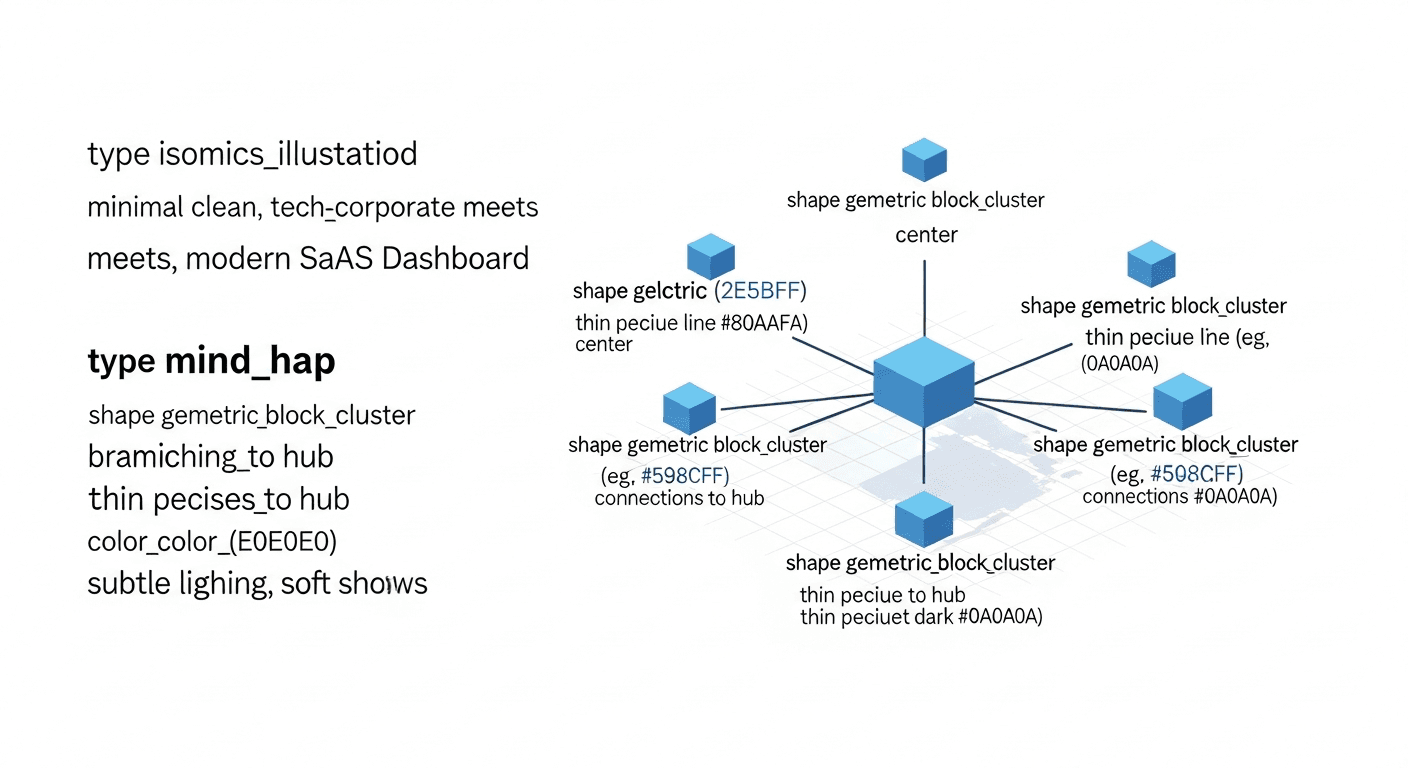
What is content clustering exactly
Content clustering (or "thematic content grouping") is an editorial organisation method that structures your content into semantically linked groups. Each cluster consists of:
- A pillar page (hub): a long, comprehensive article covering a broad topic (e.g. "AI Content Strategy")
- Satellite articles (spokes): targeted articles that explore each sub-aspect in depth (e.g. "SEO Editorial Calendar", "E-E-A-T Guide", etc.)
- Bidirectional internal linking between the hub and each satellite, and between related satellites
This is not a new concept — serious SEOs have been practising it since 2018. What is new is its importance for LLMs. AI answer engines do not cite an isolated article: they cite content ecosystems that demonstrate systematic expertise.

"Sites that structure their content in coherent thematic clusters receive on average 3.2 times more citations in generative responses than sites publishing disparate articles. AI looks for corpora, not pages."
Why clustering outperforms linear publishing
Linear publishing — one article after another, without architecture — is the default mode of 80% of corporate blogs in Europe. It is an approach that wastes resources.
According to a Searchmetrics analysis covering 15,000 European domains ("Content Performance 2025" report), sites with a cluster architecture show:
- +67% organic traffic on informational keywords at 12 months
- +41% indexed pages in the month following publication
- x2.4 time spent per session (users navigate between cluster articles)
- +89% AI citations compared to unstructured sites (Otterly Q4 2025 measurement)
The explanation is simple: clustering sends a massive thematic authority signal. Google understands that you are not treating a subject superficially — you are covering it from every angle. And LLMs, which evaluate the reliability of a source partly by the depth of its expertise, reach the same conclusion.
The 5-step method for creating your clusters
Step 1: Identify your pillar themes
Start from your offering. What are the 3 to 5 major topics on which you need to establish authority? For an AI visibility agency like AI SOS, these would be: AI Visibility & AEO, Technical SEO, Content Strategy, Sector Use Cases, Tools & Comparisons.
Step 2: Map sub-topics
For each pillar theme, list 15 to 20 sub-topics. Use:
- Google "People Also Ask"
- Perplexity and ChatGPT suggestions
- Analysis of your competitors' content (what do they cover that you do not?)
- Questions from your prospects and clients
Step 3: Define the hub / satellite hierarchy
The hub covers the broad topic (2,500-3,500 words, all facets). Each satellite targets a specific sub-topic (1,500-2,000 words, maximum depth on one angle). Do not confuse hub and "catch-all" article: the hub must provide a structured overview, not say everything.
Step 4: Build the internal linking
Cluster linking rules:
- Each satellite links to the hub (descriptive text anchor)
- The hub links to each satellite (in the body of the text, not just in a footer)
- Related satellites link to each other (2-3 links per article)
- Each article links to 1-2 articles from another cluster (inter-pillar linking)
Step 5: Plan production
Publish the hub first, then satellites at a rate of 2-3 per week. The hub can be published "incomplete" and enriched over time. The important thing is that the internal linking is in place from the start. Use an editorial calendar to pace production.
Comparison: content structures
| Criterion | Linear publishing | Thematic silos | Content clustering |
|---|---|---|---|
| Organisation | Chronological | By rigid category | By semantic cluster |
| Internal linking | Weak / random | Vertical only | Dense, bidirectional, multi-level |
| Thematic authority signal | Weak | Medium | Strong |
| Impact on AI citations | Negligible | Moderate | High (+89% according to Otterly) |
| Ease of implementation | Very easy | Easy | Moderate (planning required) |
| Scalability | Limited (cannibalisation) | Good | Excellent |
| User experience | Basic | Acceptable | Superior (logical navigation) |
| Maintenance effort | Low | Medium | Medium-high |
Common mistakes that ruin your clusters
When auditing dozens of European sites, we see the same mistakes recurring:
- Keyword cannibalisation: two articles in the same cluster target the exact same keyword. Solution: one unique primary keyword per article, tracked in a spreadsheet.
- Hub too thin: the hub is 800 words and adds no unique value. A hub must be your best content on the subject, not just a summary.
- Forgotten internal linking: articles are published but internal links are never added. Automate with reminders in your editorial calendar.
- Clusters too broad: 50 articles in a single cluster dilutes authority. Aim for 10-20 articles per cluster.
- No updates: a cluster published 18 months ago without updating progressively loses authority.
"The greatest failure of content clustering is not the structure — it is execution. 90% of companies plan a magnificent cluster and only publish half of it. A half-cluster is worse than no cluster."
FAQ
How many satellite articles are needed per cluster?
Aim for 10 to 20 satellite articles per cluster for significant impact. Fewer than 8, the authority signal is too weak. More than 25, you risk dilution and cannibalisation. Start with 5 satellites and progressively add more.
Can you restructure an existing blog into clusters?
Yes, and it is even recommended. Audit your existing content, identify recurring themes, create the missing hubs, and add internal linking. This is often faster than starting from scratch because you already have content to organise.
Does content clustering work for small sites?
Absolutely. It is even where it is most effective. A small site that covers a single cluster in depth (1 hub + 12 satellites) can outperform a large site that covers the same topic superficially. This is the principle of concentrated topical authority.
Should URLs be siloed (/blog/cluster/article) or flat (/blog/article)?
Both work. A flat URL architecture with internal linking is simpler to maintain and equally effective. Google and LLMs rely more on internal links than URL structure to understand content relationships.
Which tool should you use to plan your clusters?
A simple spreadsheet is sufficient to start. For advanced planning, tools like MarketMuse, Semrush Topic Research or Frase allow you to identify thematic gaps and plan your clusters. The important thing is not the tool but the discipline of execution.
How long before seeing results?
Allow 2 to 3 months for the first visible SEO improvements, and 3 to 6 months for a significant impact on AI citations. Clustering is a structural investment — the benefits accumulate over time and accelerate as the cluster grows.
Does your blog look like a collection of disparate articles?
We restructure your content into thematic clusters that boost your SEO and AI citations. Free diagnostic.
Restructure my blog

