
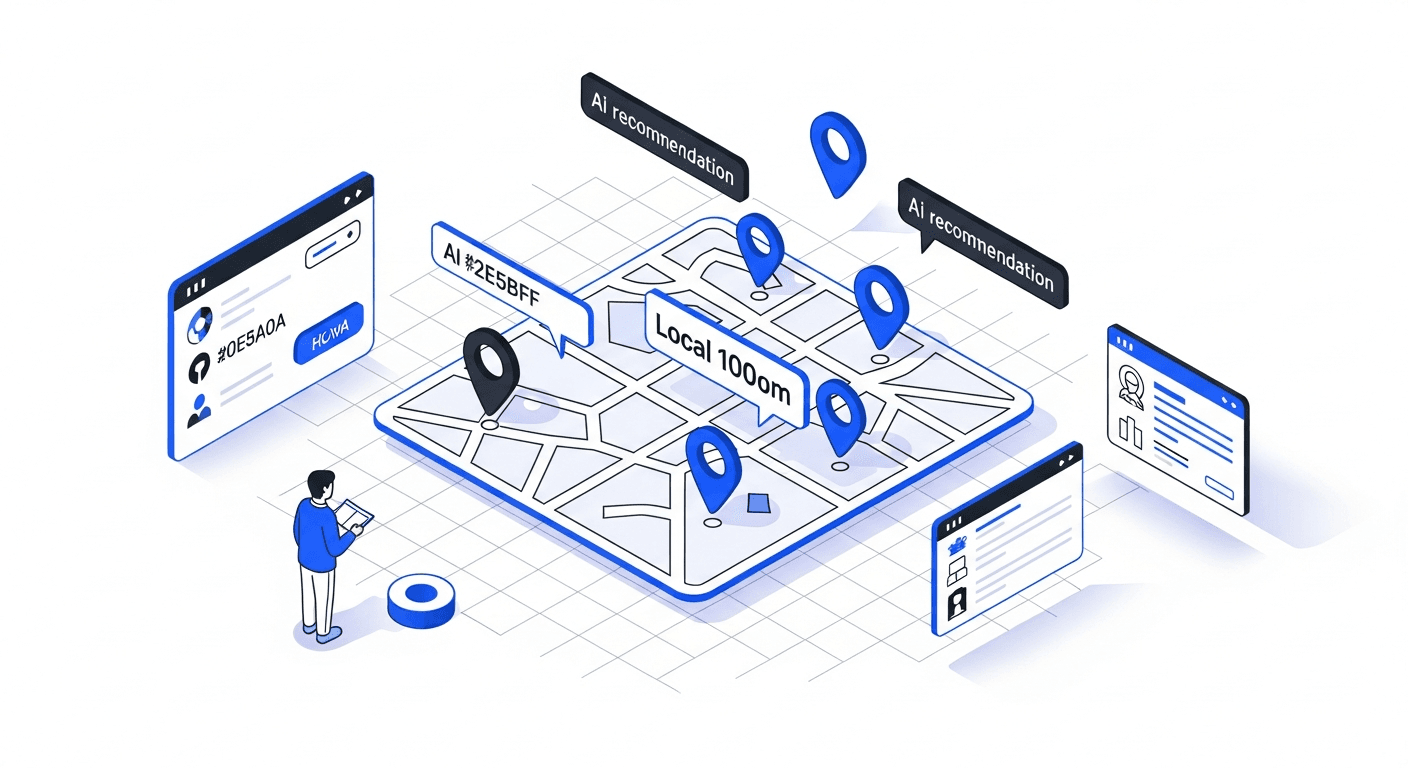
When a Brussels resident asks ChatGPT 'what is the best plumber in Ixelles?', the answer does not come from Google's local pack. It comes from a blend of training data, real-time web sources and aggregated digital reputations. If your local business is only visible on Google Maps, you are already losing half your potential customers.
According to a Statista (2026) study, 58% of searches with local intent in Europe begin with an AI assistant — whether ChatGPT, Gemini or a voice assistant. This shift is even more pronounced among 18-35 year olds, where the ratio reaches 71%.
This guide details how to merge traditional local SEO and AI visibility to capture every proximity search, whatever channel the customer uses.
The local search revolution driven by AI
Local search behaviour has changed profoundly. Before, a user would type 'Italian restaurant Liege' into Google, check the local pack, read the reviews and choose. Today, they ask their AI assistant: 'where can I eat Italian tonight in Liege, not too expensive, with a terrace?' The query is conversational, contextual and multi-criteria.
LLMs like ChatGPT and Perplexity now use real-time search capabilities (RAG) that include Google Maps data, reviews, local websites and mentions in local media. But their selection logic is different from Google's local algorithm. They prioritise:
- Information consistency across all sources (NAP: Name, Address, Phone)
- Content richness on the business website (not just a 3-page showcase)
- Contextual mentions in third-party sources (local blogs, regional media, quality directories)
- Review freshness and frequency of profile updates
As BrightLocal reports in its 2026 European report: Local businesses that optimise only for Google Maps lose an average of 34% of the intentional traffic they captured in 2024.
The limits of classical local SEO in 2026
| Criterion | Classical local SEO | Local SEO + AI |
|---|---|---|
| Main channel | Google Maps / Local Pack | Google Maps + ChatGPT + Perplexity + Gemini |
| Query type | Short keywords ('plumber Brussels') | Conversational multi-criteria questions |
| Ranking factors | Proximity, relevance, prominence | + topical authority, content structure, AI mentions |
| Customer reviews | Quantity + average rating | + review content (LLMs read the text) |
| Site content | Basic pages sufficient | Rich content, FAQ, LocalBusiness schema |
| Monitoring | Google Search Console + GBP Insights | + multi-LLM local monitoring |
The critical point: LLMs do not simply read your Google Business Profile. They cross-reference information from your website, local directories, regional media and review platforms. If these sources contradict each other — even slightly — your perceived reliability drops.
Optimising Google Business Profile for AI
Your Google Business Profile remains the foundation, but it needs to be enriched well beyond the minimum required:
1. Full, structured description. Use all 750 available characters. Include your main services, geographic area and specialties. LLMs extract this information to respond to local queries.
2. Exhaustive categories and attributes. Do not limit yourself to the main category. Add all relevant secondary categories and tick every applicable attribute (accessibility, payment methods, specific services).
3. Regular posts. Publish at least one post per week on GBP. This content is indexed and consumed by LLMs via RAG. An active profile is a freshness signal.
4. Responses to reviews. Respond to every review, positive or negative. LLMs analyse the content of responses to assess the professionalism and engagement of the business.
5. Recent photos and videos. At least 10 quality photos, updated quarterly. Multimodal LLMs are beginning to incorporate visual analysis into their recommendations.
In addition, make sure your website includes the full LocalBusiness schema with all properties: name, address, telephone, openingHours, geo, areaServed, priceRange.
Local citations and LLM mentions
Local citations — the presence of your NAP in directories and third-party sites — remain a major trust factor. But for AI visibility, you need to go beyond classical directories.
Priority sources for geolocated LLMs:
- Local and regional media (Le Soir, La Libre, Sud Presse for Belgium)
- Neighbourhood blogs and community sites
- Chambers of commerce and professional associations
- Specialist directories (not just the Yellow Pages)
- Local Wikipedia (articles about your municipality/neighbourhood mentioning your business)
According to the Search Engine Land EU Report (2026): A mention in a European local media outlet has 4.2x more impact on AI visibility than a link in a generic directory.
Local content strategy for AI visibility
Your website must become a local reference, not just a showcase. Here is the local content strategy that works for AI visibility:
Geolocated service pages. Create one page per service AND per geographic area. 'Plumbing in Ixelles', 'Plumbing in Saint-Gilles', 'Plumbing in Uccle'. Each page must contain unique content.
Local blog. Publish articles linked to your activity and area: 'The 5 most common plumbing problems in Brussels art deco buildings' or 'Heating maintenance guide in Liege: what Walloon regulations say'.
Structured local FAQ. Implement a FAQ with FAQPage schema answering local questions: 'How much does a plumber cost in Brussels in 2026?', 'Do you need a permit to renovate a bathroom in Belgium?'
Geolocated testimonials. Display client testimonials mentioning their location. 'Jean-Marc, restaurateur in Namur' has more local impact than 'Jean-Marc, restaurateur'.
At AISOS, we apply this method for our local clients with measurable results: on average, +180% mentions in local AI responses after 3 months of optimisation.
Comparison of local SEO + AI tools
| Tool | Local SEO | AI monitoring | Price/month | Belgium/FR adapted |
|---|---|---|---|---|
| BrightLocal | Excellent | No | 39 EUR | Yes |
| Semrush Local | Very good | Basic | 99 EUR | Yes |
| Otterly.ai | No | Excellent | 49 EUR | Yes |
| Whitespark | Good | No | 29 EUR | Partial |
| AISOS | Integrated | Integrated | On request | Native BE/FR |
Most local SEO tools do not include AI visibility monitoring. Conversely, AI monitoring tools do not cover local SEO. An integrated approach is therefore essential. Consult our full SEO + AI tool comparison.
[Image: Infographic of the multi-channel local customer journey in 2026]
[Image: Diagram of the integrated local SEO + AI strategy]
FAQ
Is classical local SEO still useful in 2026?
Yes, absolutely. Google Maps remains the first reflex for 42% of local searches in Europe. But it is no longer sufficient on its own. The combination of local SEO + AI visibility covers 90%+ of the local search journey.
How do I know if my business is cited by AI locally?
Test manually by posing your key queries to ChatGPT, Perplexity and Gemini. You can also use tools like Otterly.ai or AISOS monitoring to automate this tracking.
What budget should I allow for local SEO + AI?
For a local SME, allow between 500 and 1,500 EUR/month combining tools, content creation and monitoring. The average ROI observed among our clients is 3.2x after 6 months.
Are Google reviews read by AI?
Yes. LLMs with RAG capabilities (Perplexity, Gemini) read the textual content of reviews, not just the rating. Detailed, recent reviews strengthen your credibility in AI responses.
Should a multilingual site be created in Belgium for local AI SEO?
If you are targeting both language communities, yes. LLMs respond in the language of the query. A French-only site will be invisible for Dutch queries, and vice versa. Implement hreflang markup.
Is LocalBusiness schema really important for AI?
It is a major trust signal. LLMs use structured data to validate information. A site with complete LocalBusiness schema is 2.7x more likely to be cited in a local response.
Conclusion
Local SEO in 2026 is no longer a standalone discipline. It is a two-dimensional system: visibility on Google Maps AND visibility in local AI responses. Local businesses that integrate both channels capture significantly more customers than those sticking to classical local SEO.
The actions are concrete: enrich your GBP, create rich local content, earn mentions in local media, implement the appropriate schemas and monitor your AI visibility.
Is your local business visible in AI responses? Request a free local + AI visibility audit and discover your opportunities in 15 minutes.
For more depth, see our guides on AI SEO for restaurants and hotels, AI visibility by sector and technical SEO in 2026.


