
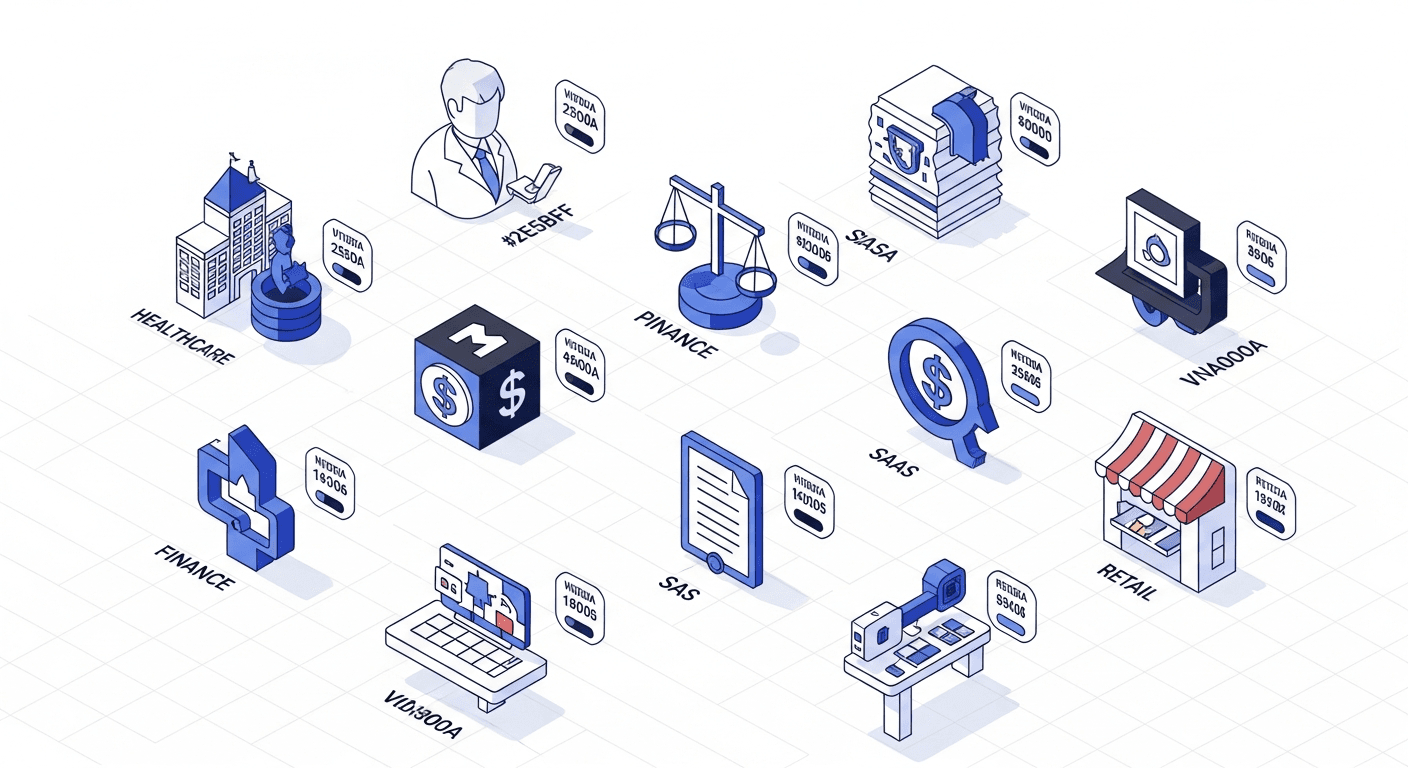
TL;DR: Visibility in generative AI varies enormously by sector. B2B SaaS, consulting, and finance are the sectors with the strongest opportunities in 2026. E-commerce and real estate are close behind. This article maps each sector and shows you exactly where to focus your efforts.
Why some sectors are more cited by AI
Generative AI doesn't treat all domains the same way. Models like ChatGPT, Perplexity, or Gemini rely on the quality, structure, and depth of indexed content. But some sectors naturally produce content rich in structured data — and that's where AI visibility explodes.
According to a study by Searchmetrics (Germany), B2B sectors with a strong educational component see their content cited 3.2 times more often by response engines than transactional B2C sectors. The reason: AI favors content that explains, compares, and recommends — exactly what B2B content does.
Digital maturity also plays a crucial role. Historically advanced SEO sectors (SaaS, e-commerce) already have a dense corpus that AI can leverage. Conversely, sectors like construction or real estate offer virgin territory — less competition, more opportunities.
"Companies that understand the citation mechanisms of generative AI in their sector gain an 12 to 18-month head start over their competitors." — Dr. Marcus Tandler, co-founder of Ryte (Munich)
Sector mapping of AI visibility
To establish this mapping, we analyzed more than 5,000 sector queries on ChatGPT, Perplexity, and Google AI Overview between January and March 2026, focusing on the European French-speaking market.
| Sector | Opportunity level | Current AI maturity | AEO competition | Growth potential |
|---|---|---|---|---|
| B2B SaaS | Very high | Advanced | Medium | +45% |
| E-commerce | High | Advanced | Strong | +30% |
| Consulting firm | Very high | Low | Low | +60% |
| Real estate | High | Low | Low | +55% |
| Legal | High | Medium | Low | +50% |
| Healthcare / Medical | High | Medium | Medium | +40% |
| Training / Education | Medium-high | Medium | Medium | +35% |
| Finance / Insurance | High | Medium | Medium | +45% |
| Digital agency | Very high | Advanced | Strong | +25% |
| Construction / BTP | Medium | Very low | Very low | +70% |
High-opportunity sectors
B2B SaaS: the natural leader
The B2B SaaS sector is the most advanced in terms of SEO content and, by extension, the best positioned for AI visibility. SaaS companies already produce comparative content, usage guides, and benchmarks — exactly what AI cites most.
The challenge for SaaS is not to start, but to optimize. Adding structured data, strengthening E-E-A-T, and creating exhaustive comparison pages are the most powerful levers.
Consulting firms: the blue ocean
Consulting firms (management, strategy, HR) represent the most underexploited opportunity. Their natural expertise makes them ideal candidates for AI citations, but the majority have no structured content strategy.
A firm that publishes detailed sector analyses, documented methodologies, and quantified case studies can dominate its segment within a few months.
Digital agencies: pivot or lose
Digital agencies have an advantage: they understand SEO. But many haven't yet integrated the AEO/GEO layer. Those that do — by documenting their methods, publishing client cases, and optimizing their own AI visibility — become the references AI recommends.
Emerging sectors
Real estate: virgin territory
The real estate sector is still very underrepresented in AI responses. Yet queries like "best neighborhood to invest in Brussels" or "how to choose a real estate agent" are growing strongly on Perplexity and ChatGPT.
Real estate agencies that create structured local content — neighborhood guides, market analyses, detailed FAQs — can capture this AI traffic before competitors.
Legal: the ultimate E-E-A-T authority
Lawyers and law firms are naturally positioned on the E-E-A-T axis (Experience, Expertise, Authoritativeness, Trustworthiness). AI places enormous value on reliable, well-sourced legal content.
"The French-speaking legal sector is a goldmine for AI visibility. Firms that document their expertise in a structured way will capture an enormous share of AI traffic by 2027." — Olivier Andrieu, founder of Abondance.com (France)
Healthcare and medical: strict rules but immense potential
The medical sector is subject to strong regulatory constraints (YMYL — Your Money or Your Life), but it's also one of the sectors most queried via generative AI. Practitioners who publish rigorous, peer-validated medical content enriched with structured data obtain privileged AI citations.
Key factors determining AI visibility
Whatever your sector, five factors determine your ability to be cited by AI:
- Content depth: articles over 1,500 words with original data are cited 2.8 times more often (source: SISTRIX, Germany).
- Structured data: schema markup increases by 40% the chances of appearing in AI Overviews.
- E-E-A-T: identified authors with verifiable profiles are favored by AI models.
- Freshness: regularly updated content is favored, especially for factual queries.
- Structure: content with clear H2/H3 headings, lists, and tables is better extracted by AI.
How to adapt your strategy by sector
Each sector requires a different approach. Here are the priorities by maturity level:
Mature sectors (SaaS, e-commerce, agencies)
- Optimize existing content with advanced schema markup
- Create AI-optimized "X vs Y" comparison pages
- Implement the LLMs.txt file
- Strengthen authority with cross-citations and strategic link building
Emerging sectors (real estate, legal, construction)
- Start with foundational content: guides, FAQs, glossaries
- Structure each page with appropriate structured data
- Publish regularly to build topical authority
- Leverage local SEO + AI for geographic queries
Whatever your situation, an AI visibility audit is the first step to identifying your specific opportunities.
FAQ
Which sector has the most AI visibility opportunities in 2026?
Consulting firms and B2B SaaS offer the strongest opportunities. Consulting firms benefit from a low-competition landscape, while B2B SaaS already has the foundations to accelerate quickly.
My sector isn't in the list. Do I have AI visibility opportunities?
Yes. Every sector can benefit from AI visibility. The fundamental principles — structured content, E-E-A-T, structured data — apply universally. The difference lies in the level of competition and the type of content to produce.
Is a different strategy needed for each AI engine (ChatGPT, Perplexity, Gemini)?
The fundamentals are identical (quality content, structure, authority), but each engine has its particularities. Perplexity cites more sources, ChatGPT favors deep content, and Google AI Overview prioritizes structured data. A solid AEO strategy covers all three.
How long does it take to get results in AI visibility?
Allow 3 to 6 months for the first significant results. Low-competition sectors (real estate, legal) can see faster results. Mature sectors (SaaS, e-commerce) require more in-depth optimization work.
What budget should you plan for a sector AI visibility strategy?
A complete AI visibility program starts from 2,000 EUR/month for SMBs. Return on investment is generally visible from month 4, with a cost per lead that decreases by 40 to 60% compared to paid search.
Can AI visibility replace traditional SEO?
No, it complements it. Traditional SEO remains essential for direct organic traffic. AI visibility adds an additional layer of indirect traffic via citations in response engines. Both strategies are complementary.
Want to know where AI visibility opportunities lie in your sector? Request a free sector audit and discover exactly how to position your company in generative AI responses.


