Uber Burns Through Its 2026 AI Budget in 4 Months: Key Lessons for B2B Companies
Uber spent $500 to $2,000 per engineer per month on AI. Learn how to avoid this budget overrun in your SME/mid-market company.

The Uber Case: When AI Devours Budgets Faster Than Expected
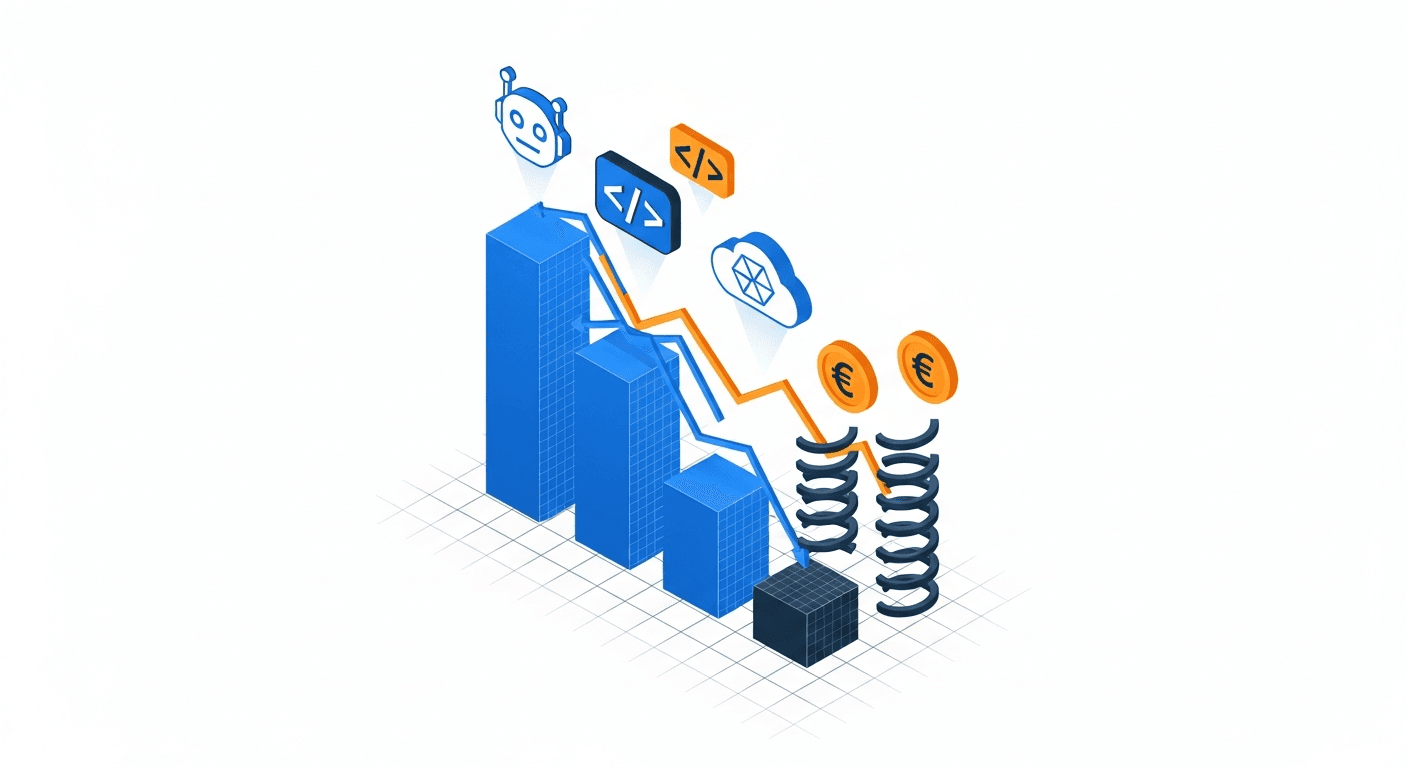
In May 2025, news that shook the global tech world emerged: Uber consumed its entire AI budget planned for 2026 in just four months. The cost? Between $500 and $2,000 per engineer per month, just for code assistance tools like GitHub Copilot and language model APIs.
This figure may seem astronomical, but it reveals a reality that many SME and mid-market company leaders will soon face: AI costs in enterprise are structurally unpredictable. Budget forecasts established at the end of 2024 become obsolete from the first quarter of actual usage.
This article analyzes the mechanisms that led Uber to this situation, and more importantly, how French and Belgian B2B companies can adopt AI without suffering the same fate. Because the question is no longer whether you'll use AI, but how to control costs when you do.
Understanding AI Cost Structure in Enterprise
Three Expense Categories That Leaders Underestimate
A company's AI budget breaks down into three categories that are rarely anticipated correctly:
- Tool licenses: GitHub Copilot Business costs $19 per user per month. Multiply by 50 developers, and you get $950 monthly. Add ChatGPT Team at $25 per user for marketing, sales, and support teams: the meter climbs quickly.
- API consumption: This is the trickiest expense category. GPT-4o charges approximately $5 for one million input tokens. An internal application that queries the API several thousand times per day can generate bills of several thousand euros monthly, without anyone having approved this expense.
- Infrastructure and integration: Running models internally, connecting AI tools to existing systems, training teams. These indirect costs often represent 40 to 60% of the total budget.
Why Budget Forecasts Systematically Fail
The fundamental problem is that AI usage grows exponentially, not linearly. At Uber, engineers started by using Copilot for simple code suggestions. Then they discovered they could generate entire unit tests. Then complete documentation. Each new use case increases token consumption.
AISOS audits reveal that companies deploying AI tools without governance see their consumption double every two months during the first year. A phenomenon that traditional annual budgets cannot absorb.
The Real Cost per Employee: 2025 Benchmark for SMEs/Mid-Market Companies
Cost Ranges by Usage Profile
Based on market data and feedback from European companies, here are the average monthly costs per employee by AI usage level:
- Occasional user (AI assistant for emails, research): EUR 20 to 50 per month
- Regular user (content creation, data analysis): EUR 50 to 150 per month
- Intensive user (developer with Copilot, data analyst): EUR 150 to 400 per month
- Expert user (ML engineer, advanced automation): EUR 400 to 1,500 per month
For an SME of 80 people including 15 intensive users and 40 regular users, the realistic monthly budget ranges between EUR 4,000 and 10,000. That's EUR 48,000 to 120,000 per year, a budget line comparable to one or two employees.
Hidden Costs That No One Budgets
Beyond licenses and APIs, several costs fly under the radar:
- AI shadow IT: employees subscribing to personal accounts and getting reimbursed through expense reports, without central visibility
- Unstructured experimentation: each team testing its own tool, creating technical debt and redundancies
- AI error correction: time spent verifying and correcting AI outputs represents a rarely measured labor cost
- Security and compliance: GDPR audits, setting up DPAs with vendors, training teams on best practices
Five Strategies to Control Your AI Budget Without Stifling Innovation
Strategy 1: Centralize AI Tool Governance
Uber's first mistake was letting each team adopt AI according to their needs, without coordination. Result: proliferation of tools, subscriptions, and non-optimized usage.
Concrete action: appoint an AI manager (even part-time) responsible for validating new tools, negotiating contracts, and monitoring consumption. In a 50-person SME, this role can be assumed by the CIO or CFO with an investment of 2 to 4 hours per week.
Strategy 2: Implement Consumption Caps per Team
APIs from OpenAI, Anthropic, and Google allow you to set monthly spending limits. Use them systematically.
Concrete action: define a monthly budget per team or project. When the cap is reached, the team must justify an overage. This administrative friction, deliberately light, is enough to reduce waste by 30 to 50%.
Strategy 3: Prioritize Models Suited to Each Use Case
Using GPT-4o to generate standard emails is like taking a plane to travel 10 kilometers. Less powerful models like GPT-4o-mini or Claude 3 Haiku cost 10 to 20 times less and are sufficient for 80% of daily tasks.
Concrete action: establish a usage matrix that matches each type of task to the appropriate model. Reserve premium models for cases that truly justify them: complex analyses, critical code generation, long document processing.
Strategy 4: Measure Real ROI, Not Expected ROI
Many companies invest in AI hoping for productivity gains they never measure. Six months later, they have substantial bills but no proof of return on investment.
Concrete action: before each AI tool deployment, define precise metrics. For a sales writing assistance tool: number of proposals generated, average writing time before/after, conversion rate. Review these metrics quarterly.
Strategy 5: Negotiate Annual Contracts with the Right Leverage
AI vendors offer significant discounts for annual commitments and volumes. An SME committing to 12 months can get 20 to 30% reduction on GitHub Copilot or API credits.
Concrete action: consolidate your AI purchases during a single annual negotiation. Use your actual consumption from the first 3 months as a negotiation basis, not the salesperson's estimates.
Case Study: Realistic AI Budget for a 200-Person Mid-Market Company
Typical Scenario and Expense Categories
Let's take the example of a French industrial mid-market company with 200 employees, including an IT team of 12 people, 25 salespeople, and a marketing department of 8 people.
Recommended monthly budget:
- IT team (12 people, Copilot + API): 12 × EUR 200 = EUR 2,400
- Sales team (25 people, AI assistant): 25 × EUR 40 = EUR 1,000
- Marketing (8 people, content generation): 8 × EUR 100 = EUR 800
- Management and support functions (15 occasional users): 15 × EUR 30 = EUR 450
- Centralized APIs and integrations: EUR 1,500
- Safety margin (15%): EUR 925
Monthly total: approximately EUR 7,075, or EUR 85,000 per year.
Mistakes That Would Explode This Budget
This budget can easily double or triple if the company makes these common mistakes:
- Giving Copilot access to all employees "just in case"
- Letting teams experiment with generative AI solutions without validation
- Not monitoring API consumption in real-time
- Underestimating training needs and support time
What the Uber Case Teaches Us About the Future of AI Budgets
The End of Traditional IT Budgets
The traditional budget model, where you define an annual envelope and stick to it, doesn't work with AI. Consumption is too variable, use cases evolve too quickly, innovations arrive too frequently.
Companies that will succeed in their AI transition are those that adopt a rolling budget model, revised quarterly, with alert mechanisms for overruns and flexibility to seize opportunities.
AI as a Strategic Budget Item, Not an IT Line
At AISOS, we observe that the most mature companies treat their AI budget as a strategic investment, on par with R&D or business development. This positioning changes everything: executive management gets involved, decisions are made based on value created, not apparent cost.
The Uber case is not a failure. It's a signal that AI is becoming a central production tool, whose costs must be managed with the same rigor as payroll or raw material purchases.
Conclusion: Transform Budget Constraints into Competitive Advantage
Uber spent its 2026 budget in four months because generative AI creates value, and its engineers massively adopted it. The real problem wasn't the expense, but the lack of anticipation.
For French and Belgian SMEs and mid-market companies, the lesson is clear: adopt AI, but with appropriate financial governance. Centralize decisions, measure usage, negotiate contracts, and above all, align your AI investments with measurable business objectives.
Companies that master their AI costs aren't those that spend the least. They're those that know exactly what they're spending, why, and what return they're getting. In a market where AI is becoming a major differentiating factor, this budget mastery itself becomes a competitive advantage.
Want to audit your current AI spending and build a realistic budget for 2025-2026? The AISOS teams support SME and mid-market company leaders in this process, with a proven methodology and updated sector benchmarks.


