Real Cost of AI in Business vs Human Employees in 2026
Uber exhausted its 2026 AI budget in 4 months. Nvidia admits AI costs more than humans. Here's how to calculate the true ROI for your SME.

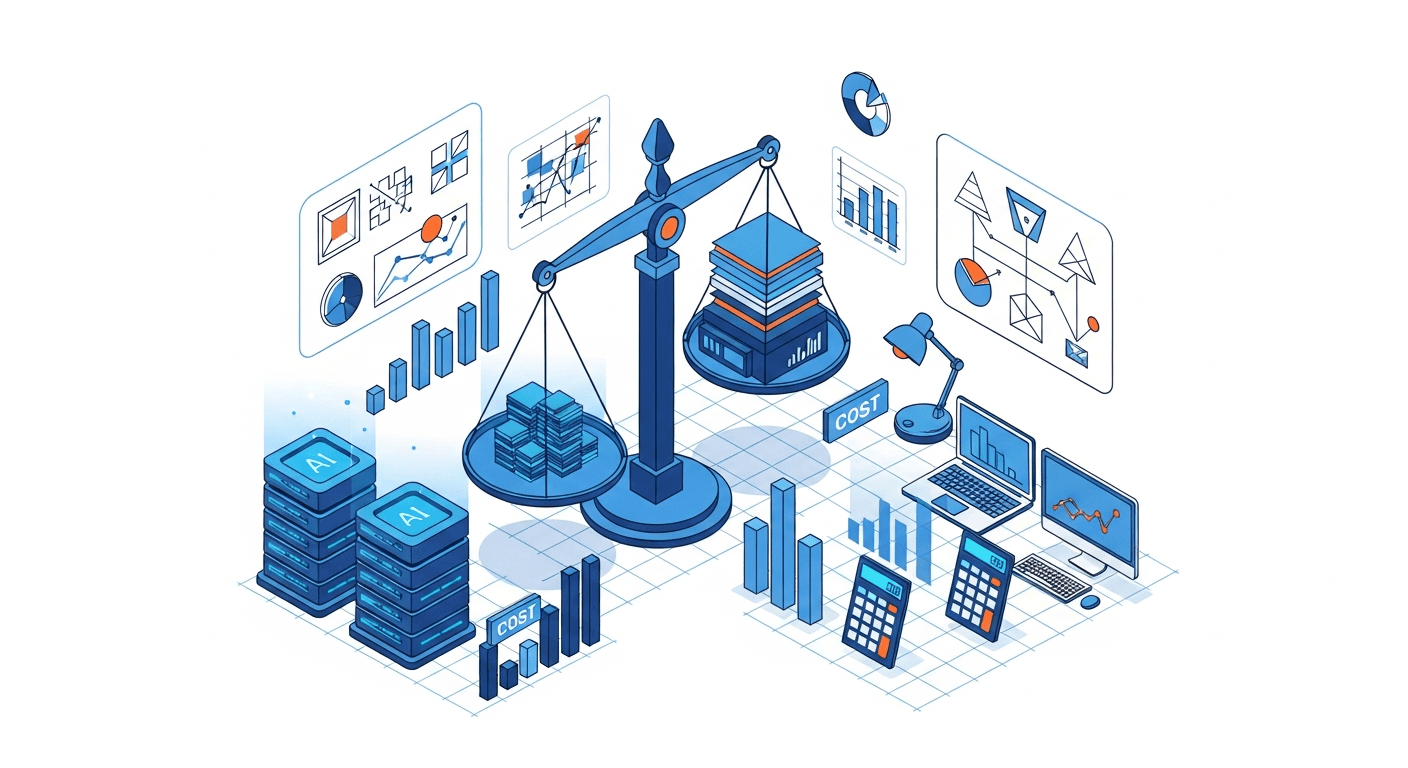
Generative AI Costs More Than Expected: Tech Giants Finally Admit It
Uber burned through its entire AI budget for 2026 in just four months. Cost per engineer: between $500 and $2,000 per month, just for code assistance tools alone. An Nvidia executive recently stated that AI currently costs more than paying human employees for many tasks.
These revelations are disrupting the dominant narrative around automation. For months, AI solution vendors have promised spectacular cost reductions. The reality for companies deploying these technologies at scale tells a different story.
For SME and mid-market leaders, these warning signals from tech giants are invaluable. They help avoid costly mistakes and calculate realistic ROI before investing. This article details the hidden costs revealed by these cases, offers a practical calculation framework, and identifies scenarios where AI becomes truly profitable.
The Uber Case: $500 to $2,000 per Engineer per Month in AI Tools
Numbers Revealed by Budget Overruns
In April 2025, Uber announced it had exhausted its annual AI tools budget for software development. The company employs approximately 3,800 engineers. The math is simple: with a range of $500 to $2,000 per person per month, the monthly bill sits between $1.9 and $7.6 million.
These costs cover only tool licenses like GitHub Copilot Enterprise ($39 per user per month at list price), Cursor Pro, and API access to GPT-4 and Claude models. Enterprise versions, with enhanced security and advanced features, cost three to five times more than consumer pricing.
Why Costs Exploded
Three factors explain this budget overrun:
- Real usage exceeds projections: engineers use AI assistants far more intensively than anticipated, multiplying API calls
- Top-performing models cost more: GPT-4 Turbo charges $10 per million input tokens, versus $0.50 for GPT-3.5
- Cascade adoption effect: when some developers gain productivity, others want the same tools
For an SME with 20 developers, these same ratios would generate a monthly bill of EUR 10,000 to 40,000, or EUR 120,000 to 480,000 annually. A cost rarely anticipated in business plans.
The Nvidia Admission: AI More Expensive Than Humans for Many Tasks
What the Nvidia Executive Actually Said
Rev Lebaredian, Nvidia's vice president of simulation and AI, stated in early 2025 that for many current applications, deploying an AI solution costs more than employing humans. This statement from the leading AI chip supplier had a sobering effect.
The explanation involves three elements: the cost of GPUs needed for inference, power consumption, and the need for human oversight. An H100 GPU costs approximately $30,000. To run a language model in production with acceptable response times requires several units.
Complete Inference Cost Calculation
Here are the components of real costs for running an enterprise AI assistant:
- Cloud infrastructure: $2 to $8 per GPU hour for inference on AWS, Azure, or Google Cloud
- Power consumption: an H100 GPU consumes 700 watts, roughly EUR 500 per month in 24/7 electricity
- Bandwidth and storage: EUR 200 to 500 per month for logs, monitoring, and network traffic
- Maintenance and updates: 0.5 to 1 FTE technical resource to manage infrastructure
- Human oversight: output verification, error correction, edge case management
For an AI assistant processing 10,000 queries daily with a high-performance model, total monthly cost ranges between EUR 8,000 and 25,000, excluding initial development costs.
Seven Hidden AI Costs Nobody Mentions
1. Integration Cost with Existing Systems
Connecting an AI model to your ERP, CRM, or business databases takes 20 to 100 person-days of development. Budget EUR 80,000 to 150,000 for complete integration with a specialized integrator. "Ready-to-use" connectors from vendors rarely cover more than 60% of real needs.
2. Data Quality Cost
An AI model is only as good as its training data. Cleaning, structuring, and enriching your data to feed an AI typically represents 40 to 60% of total project budget. AISOS audits reveal this line item is underestimated by half in 80% of SME AI projects.
3. Ongoing Human Supervision Cost
Generative AI produces "hallucinations": plausible but false responses. For customer-facing use or decision-making, every output must be verified. Budget 15 to 30 minutes of human work per hour of AI output to maintain acceptable quality levels.
4. Team Training Cost
Using AI tools effectively requires training. Average observed budget: EUR 2,000 to 5,000 per employee for operational proficiency, including training time and initial productivity loss.
5. Error and Correction Cost
A GitClear study on AI-generated code shows a 39% increase in "code churn" (code rewritten shortly after creation). Developers spend more time correcting AI code than they save generating it, in some cases.
6. Security and Compliance Cost
GDPR, trade secrets, intellectual property: using generative AI with enterprise data requires safeguards. Security audit, DPO, specific contract clauses: budget EUR 20,000 to 50,000 for a solid legal and technical framework.
7. Opportunity and Dependency Cost
Every euro invested in AI isn't invested elsewhere. And growing dependence on a vendor (OpenAI, Anthropic, Google) creates strategic risk. Prices may increase, usage terms may change, service may be interrupted.
Practical Calculator: Estimate True Cost for Your Business
Step 1: Identify Specific Use Case
Never calculate "AI cost" in general. Evaluate a specific use case with clear metrics:
- Number of tasks involved per day/week/month
- Current time spent by humans on these tasks
- Loaded hourly cost of people involved
- Required quality level (error tolerance)
Step 2: Estimate Direct AI Solution Costs
Use these ranges for an SME with 50 to 200 employees:
- AI tool licenses (SaaS): EUR 50 to 200 per user per month
- API costs for intensive usage: EUR 500 to 3,000 per month depending on volume
- Initial integration: EUR 30,000 to 100,000 (complete project)
- Annual maintenance: 15 to 25% of integration cost
Step 3: Add Hidden Costs
Multiply the "direct costs" budget by a coefficient of 1.5 to 2.5 depending on your digital maturity. This coefficient covers training, supervision, error corrections, and data integration. A less digitalized company will be closer to 2.5; a mid-market company with structured IT closer to 1.5.
Step 4: Calculate Break-Even Point
Simplified AI ROI formula:
Net annual savings = (Hours freed × Loaded hourly cost × Success rate) - Total annual AI cost
Concrete example: automating sales report writing
- 20 salespeople spend 3 hours per week writing reports
- Loaded hourly cost: EUR 45
- Annual hours: 20 × 3 × 47 weeks = 2,820 hours
- Current cost: 2,820 × 45 = EUR 126,900 per year
- Estimated AI success rate: 70% (remaining 30% requires human revision)
- Gross savings: 126,900 × 0.70 = EUR 88,830
- AI cost (licenses + amortized integration + supervision): EUR 45,000 per year
- Net savings: EUR 43,830 per year
The ROI is positive, but half of what a naive estimate ignoring hidden costs and real success rates would suggest.
When AI Becomes Truly Profitable: Three Winning Scenarios
Scenario 1: Repetitive Tasks at Very High Volume
AI becomes profitable when processing thousands of identical occurrences. Email classification, invoice data extraction, FAQ responses: AI unit cost drops drastically with volume. Typical profitability threshold: over 500 identical tasks per month.
Scenario 2: Augmenting Human Capabilities (Not Replacement)
AI as an assistant helping experts produce more, not as a replacement. A lawyer using AI for initial contract analysis handles three times more cases. AI cost adds to salary, but generated revenue increases proportionally.
Scenario 3: New Services Impossible Without AI
Creating offerings that wouldn't exist without AI: large-scale personalization, predictive analytics, 24/7 availability. Here, the calculation isn't "AI vs human" but "new revenue vs AI cost." Often the most profitable scenario, but also the riskiest.
What Profitable SMEs Do Differently
They Start Small and Measure Everything
Companies successful with AI launch pilots on restricted scope with precise KPIs. Three months of testing, rigorous measurement, then decision to expand or stop. Typical pilot budget: EUR 10,000 to 30,000 maximum.
They Negotiate AI Contracts with Caps
The Uber case illustrates the danger of unlimited consumption contracts. Demand monthly budget caps, alerts at 80% consumption, and exit clauses within 90 days maximum.
They Invest in Internal Skills
At AISOS, we observe that SMEs training an internal "AI champion" achieve 40% higher ROI than those completely outsourcing. This champion understands tool limitations, knows when to use them, and avoids doomed projects.
They Always Compare with Optimized Human Alternatives
Before deploying AI, they ask: "What if we first optimized the current process?" Sometimes better business tools, training, or reorganization costs less and produces better results.
Conclusion: AI Isn't Always the Answer, But It Can Be
The Uber and Nvidia cases remind us of a fundamental truth: AI is a tool, not a magic solution. Its real cost systematically exceeds initial estimates, often by 50 to 150%. Positive ROI isn't automatic.
For SME and mid-market leaders, the rational approach is: identify a specific use case, calculate total cost including hidden factors, honestly compare with human alternatives, then decide. The three winning scenarios (volume, augmentation, new services) remain real opportunities for those who can identify them.
Generative AI will transform your industry in coming years. The question isn't whether you should be interested, but how to invest intelligently. Start with an audit of your priority use cases, estimate real costs using the method described here, and make decisions based on numbers, not marketing promises.


