Nvidia Reveals: AI Costs More Than Human Employees - Impact for Businesses
An Nvidia executive admits that AI compute exceeds salary costs. Analysis and strategies for SMEs and mid-market companies looking to invest intelligently.

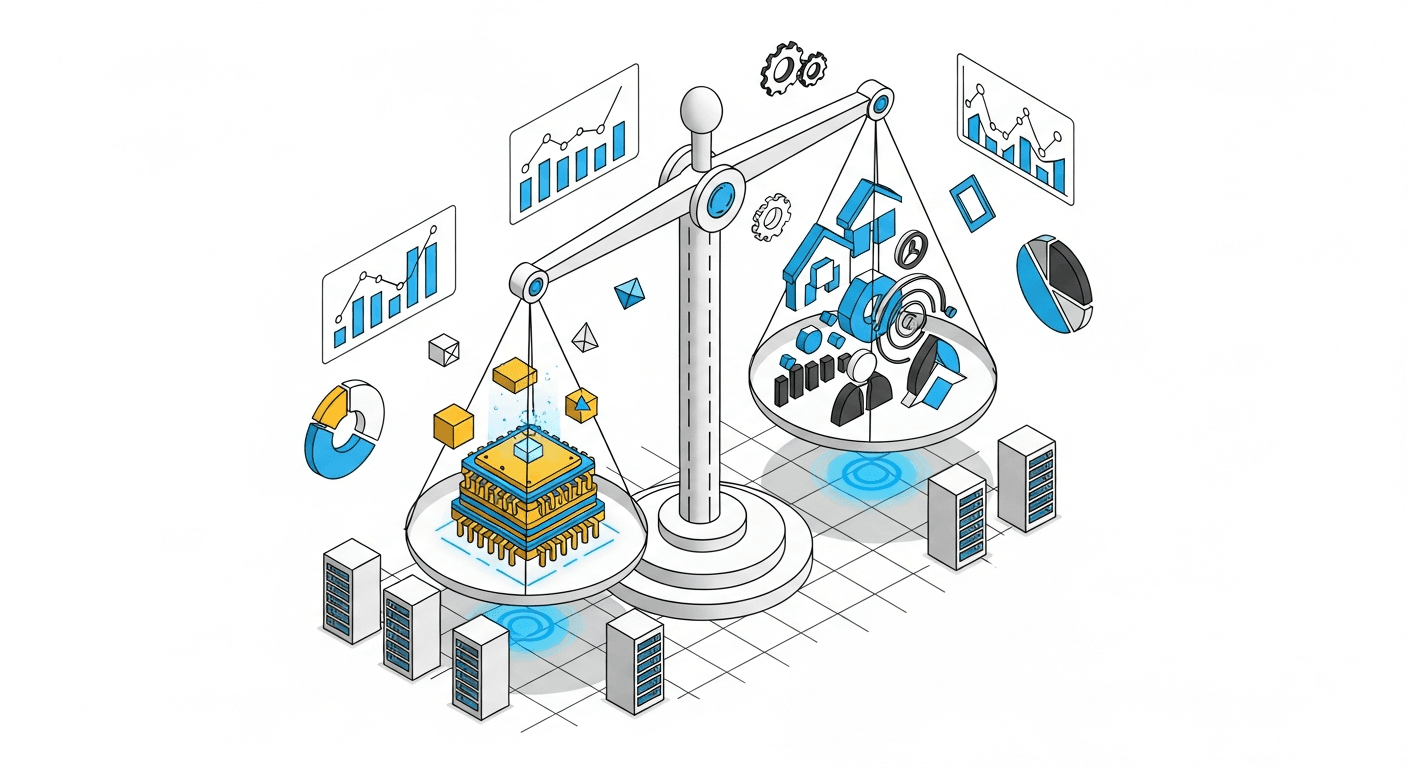
The Paradox Revealed by Nvidia: AI More Expensive Than Your Teams
In May 2025, a Nvidia executive dropped a bombshell at an investor conference: "The cost of compute far exceeds the cost of employees". This statement, coming from the world's leading supplier of artificial intelligence chips, deserves our attention.
For SME and mid-market company leaders considering AI investments, this finding changes the game. The economic equation that AI solution vendors present to you—where automation gradually replaces payroll costs—runs up against a technical reality: running generative AI models costs a fortune in infrastructure.
This article analyzes the concrete implications of this revelation for your business strategy. We'll examine why costs are so high, how they're evolving, and most importantly, how to invest intelligently in AI without burning through your cash reserves.
The Numbers Behind Nvidia's Statement
Real Cost of AI Infrastructure in 2025
To understand Nvidia's claim, let's look at the orders of magnitude. An H100 GPU, the reference chip for AI training and inference, costs approximately EUR 30,000 to 40,000 per unit. A company wanting to run a high-performance language model in-house needs several dozen of these chips.
Add to that:
- Power consumption: a cluster of 8 H100 GPUs consumes about 10 kW under load, nearly EUR 20,000 per year in electricity at current French rates
- Cooling: these machines generate enormous heat, requiring industrial air conditioning systems
- Maintenance and expertise: specialized engineers at EUR 80,000-120,000 annually to manage this infrastructure
- Rapid obsolescence: AI chips evolve every 18 months, making investments quickly outdated
Comparison with Employee Costs
In France, the total cost of a skilled employee, including benefits, ranges between EUR 50,000 and 90,000 per year depending on the position. A writer, administrative assistant, junior analyst: around EUR 55,000 all-in.
To have the same work performed by AI hosted in-house with comparable performance, you'll easily spend three to five times that amount on infrastructure and energy. Nvidia's calculation isn't marketing provocation: it's an accounting reality.
Why AI Compute Costs Are Exploding
The Race for Model Power
Generative AI models are growing exponentially. GPT-3 had 175 billion parameters in 2020. GPT-4, released in 2023, reportedly has over 1,000 billion according to estimates. Each generation multiplies computing requirements.
This inflation has direct consequences on usage costs. When you query ChatGPT or a competing AI assistant, each request mobilizes server resources billed per token, the text unit that models process. The bigger the model, the more expensive each token costs to process.
Global Demand Effect
Demand for AI chips far exceeds supply. Nvidia holds over 80% of the data center GPU market. This dominant position, combined with limited production capacity at foundry TSMC in Taiwan, keeps prices at high levels.
Cloud giants—Microsoft, Google, Amazon—pre-purchase colossal capacity for their services. SMEs and mid-market companies find themselves at the end of the chain, with pricing reflecting this structural shortage.
Hidden Costs of AI as a Service
Using AI via cloud APIs (OpenAI, Anthropic, Google) seems cheaper than investing in your own infrastructure. Only in appearance. At AISOS, we observe that companies systematically underestimate their actual consumption:
- Call volumes: an active customer chatbot generates thousands of daily queries
- Context length: the more information you give the model, the higher the bill
- Retries and corrections: imperfect responses often require multiple attempts
- Price evolution: providers regularly adjust their pricing, generally upward
A mid-market company deploying an AI assistant for customer service can easily reach EUR 5,000 to 15,000 monthly in API costs, not counting integration and maintenance.
What This Means for Your AI Investment Strategy
Abandoning the Fantasy of Mass Replacement
The promise of AI replacing entire teams at lower cost doesn't hold up. At least not in 2025, and probably not before 2028-2030 according to current analyst projections. Leaders who lay off to automate often discover that promised savings don't materialize.
The profitable approach consists of using AI as a productivity amplifier rather than a substitute. A writer assisted by AI produces three times more content. A salesperson equipped with AI analysis tools better qualifies prospects. ROI is found in increasing human capabilities, not eliminating them.
Targeting High-Value Use Cases
Not all AI uses are economically equal. Profitable applications share common characteristics:
- High volume of repetitive tasks: AI's fixed cost amortizes over a large number of operations
- Error tolerance: cases where approximation suffices cost less in human supervision
- High unit value: automating a process that generates EUR 10,000 per transaction justifies significant investment
- Exploitable proprietary data: your internal data provides an advantage competitors cannot replicate
AI Visibility: A Different Investment
There's a category of AI investment often overlooked: your company's visibility in generative search engine responses. ChatGPT, Perplexity, Google AI Overview, Gemini: these tools are becoming major entry points for your B2B prospects.
Unlike internal automation, investing in your AI presence doesn't require expensive infrastructure. It involves optimizing your content, structured data, and digital authority so language models cite you as a reference in your field.
The cost of such a program represents a fraction of what an ambitious automation project would cost, often for superior commercial impact. When an executive asks ChatGPT "who are the best X suppliers in France," appearing in the response is worth all advertising budgets.
2026-2028 Outlook: Toward Lower Costs?
Reduction Factors
Several developments could lower AI compute costs in coming years:
- Increased competition: AMD, Intel, and Chinese players like Huawei are investing massively to compete with Nvidia
- New architectures: specialized inference chips, cheaper than versatile GPUs, are entering the market
- More efficient models: compression and optimization techniques enable similar performance with fewer resources
- Economies of scale: increased production capacity should gradually ease the market
Price Maintenance Factors
Conversely, other dynamics maintain cost pressure:
- Ever-growing demand: each price drop stimulates new uses that absorb freed capacity
- Performance race: companies always want the latest, most powerful model
- Energy costs: electricity prices aren't falling—quite the opposite
- Geopolitical tensions: restrictions on chip exports to China disrupt global supply chains
Realistic Projection for SMEs/Mid-Market
Gartner and McKinsey analysts anticipate a 20-30% drop in AI inference costs by 2027, mainly through model efficiency gains. This won't be enough to make mass automation economically viable for most companies.
The strategic recommendation: plan your AI investments on assumptions of stable or even slightly rising costs. Any decrease will be a bonus, not a condition for project profitability.
Practical Guide: Investing Intelligently in AI in 2025
Step 1: Audit Your Real Needs
Before any investment, precisely map processes candidates for AI automation or augmentation. For each, evaluate:
- Monthly operation volume
- Current cost in time and human resources
- Error tolerance and cost of an error
- Technical complexity of automation
Step 2: Test Before Investing
Use trial offers and pay-as-you-go pricing from cloud platforms to validate your assumptions. A three-month proof of concept costs a few thousand euros and gives you real data on operational costs.
Be wary of commercial demonstrations: they always show optimal cases. Test with your real documents, real queries, real volumes.
Step 3: Prioritize Visibility Over Automation
For an SME or mid-market company, the commercial impact of being visible in AI search engine responses generally exceeds that of automating internal processes. A prospect discovering you via ChatGPT represents immediate value. An automated process represents future savings, often overestimated.
AISOS audits reveal that fewer than 15% of French SMEs appear in AI assistant responses for their key business queries. The differentiation potential is enormous for early entrants.
Step 4: Budget with Safety Margins
Multiply vendor cost estimates by 1.5. Plan for maintenance and evolution costs representing 20-30% of initial investment annually. AI isn't a project you install and forget: it's a living system requiring continuous attention.
Summary: Lucidity as Competitive Advantage
The Nvidia executive's statement sets the record straight. AI isn't a miracle solution for reducing labor costs. It's a powerful but expensive tool requiring deep strategic thinking before significant investment.
Companies that will succeed are those that:
- Lucidly evaluate real costs, not marketing promises
- Use AI to augment their teams, not replace them
- Invest in their AI visibility, a high-ROI lever with controlled costs
- Maintain budget flexibility to adapt to rapid market changes
Your next step: audit your company's current visibility in ChatGPT, Perplexity, and Google AI Overview responses. You'll likely discover that your competitors already appear there, or that no one has yet taken this position. Either way, the information is worth its weight in gold for your 2025-2026 strategy.


