The AI Content Boomerang Effect: How to Avoid ChatGPT Dependency
MIT/UCLA study reveals a 'boiling frog' effect: without AI, performance collapses. Here's how to preserve your editorial quality.

The MIT/UCLA Experiment That Changes Everything
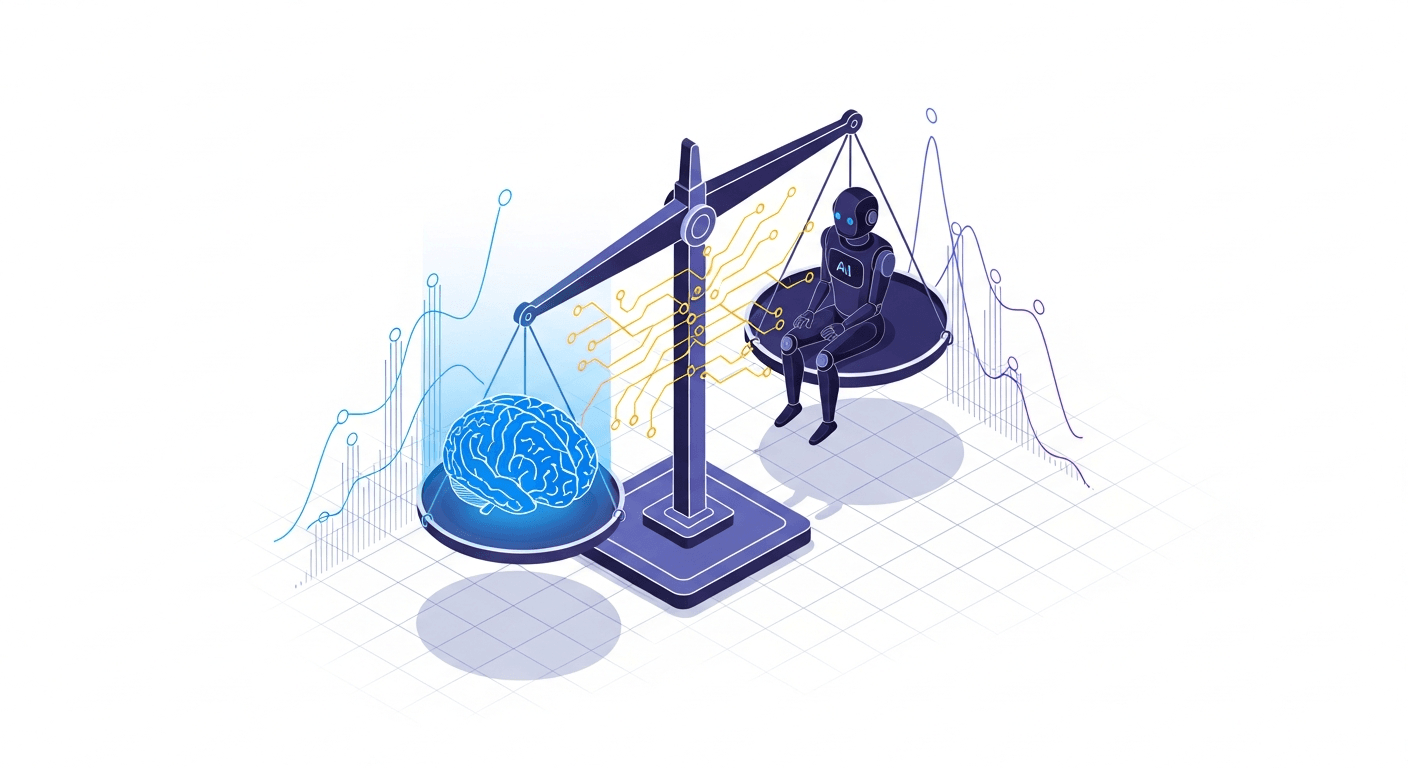
Researchers from MIT and UCLA conducted a revealing experiment on 1,222 participants. The protocol: provide an AI assistant for ten minutes to complete a task, then abruptly remove it. The result stunned scientists: user performance dropped below the control group that had never used AI.
Even more troubling: participants stopped trying. Their motivation collapsed alongside their ability to solve problems independently. Researchers describe this as a boiling frog effect: a gradual and insidious skill degradation that goes unnoticed until the tool disappears.
For SME and mid-market executives who have massively adopted ChatGPT for their marketing content production, this study raises a crucial question: would your editorial strategy survive an AI outage? This article analyzes the mechanisms behind this dependency and proposes concrete strategies to maintain editorial quality while optimizing for generative search engines.
Understanding the AI-Generated Content Boomerang Effect
The Cognitive Delegation Mechanism
When a marketing team uses ChatGPT or Claude daily to write articles, LinkedIn posts, or newsletters, a transfer occurs. Writing skills, strategic topic analysis, and the ability to structure arguments—these intellectual muscles atrophy from lack of exercise.
The MIT/UCLA study quantifies this phenomenon. After just ten minutes of assistance, participants had already begun externalizing their thinking. Imagine the impact after months of intensive use.
The Three Stages of Editorial Dependency
- Stage 1: Enhancement. AI accelerates production. The team maintains editorial control, validates each piece of content, and adds their personal touch. Productivity increases, quality is maintained.
- Stage 2: Delegation. Content volume increases. Validation becomes superficial. Teams trust AI for both substance and form. Internal skills begin to erode.
- Stage 3: Dependency. Without AI, the team can no longer produce quality content. Time requirements explode. Motivation drops. This is the boomerang effect.
At AISOS, we observe that most French B2B companies are between stages 2 and 3. Many are still unaware of this.
Why 100% AI Content Hurts Your Visibility
The Generative Search Engine Paradox
LLMs like ChatGPT, Perplexity, or Google AI Overview were trained on quality human content. They recognize and value authentic expertise signals: proprietary data, original viewpoints, lived examples, and contradictory analyses.
Content generated entirely by AI produces the opposite: generic formulations, predictable structures, and consensual statements. This content all looks the same. Generative search algorithms identify and devalue it.
Signals That LLMs Detect
- Absence of proprietary data. An article without internal statistics, specific experience feedback, or exclusive figures signals superficial content.
- Stylistic uniformity. LLMs produce texts with recognizable patterns: systematic transitions, predictable bullet lists, conventional conclusions.
- Lack of position-taking. AI naturally avoids strong statements. Yet generative search engines prioritize sources that take clear positions.
- Absence of sector context. Effective B2B content mentions market players, specific regulations, and precise industry trends. AI generalizes.
Five Strategies to Break Free from Dependency
Strategy 1: The 70/30 Ratio
Limit AI contribution to 30% of the final content. AI can generate initial structure, suggest angles, and accelerate research. But 70% of published text must come from human writing or substantial rewriting.
This ratio preserves internal skills while benefiting from AI productivity. It also guarantees the originality necessary to be cited by LLMs.
Strategy 2: Proprietary Data Injection
Each piece of content must include at least one element that AI cannot invent:
- A figure from your customer data
- A quote from an executive interview
- An anonymized real case analysis
- A field observation from your teams
These elements create unique value. They also constitute the named entities that generative search engines prioritize in their responses.
Strategy 3: Writer Rotation
Don't let a single person become AI-dependent. Alternate writers. Impose periods of unassisted writing. Organize editorial sprints where the team produces content in offline mode.
This practice maintains collective skills and diversifies styles, reinforcing your brand's editorial identity.
Strategy 4: Quarterly Dependency Audits
Measure your dependency level with a simple test: ask your team to produce a 1,500-word article on a strategic topic, without any AI assistance, in under four hours.
Evaluate the result on three criteria: production time, editorial quality, and team motivation. Compare with AI-assisted content. The gap reveals your risk level.
Strategy 5: AI as a Revision Tool, Not Creation Tool
Reverse the usual workflow. Instead of asking AI to write first and then revising humanly, do the opposite: write first, then use AI to suggest improvements, check consistency, and optimize for SEO.
This process preserves human creativity and expertise while benefiting from AI's analytical power.
Optimizing for LLMs Without Sacrificing Authenticity
Generative Search Engine Citation Criteria
To appear in responses from ChatGPT, Perplexity, or Google AI Overview, content must meet several conditions that 100% AI content struggles to satisfy:
- Thematic authority. The site must demonstrate recurring expertise on the topic. An isolated article isn't enough.
- Information freshness. LLMs prioritize recent content with updated data.
- Citability. Sentences must be self-sufficient, with clear and sourced statements.
- Entity density. Content rich in proper names, precise figures, and verifiable references is favored.
The EEAT Method Applied to GEO
Google uses EEAT criteria: Experience, Expertise, Authoritativeness, Trustworthiness. These criteria also apply to generative search engines, with one important nuance: Experience becomes decisive.
Content that tells a lived experience, with concrete details and specific learnings, systematically outperforms theoretical AI-generated content. AISOS audits reveal that articles including authentic experience feedback generate 3 to 5 times more citations in LLM responses.
The Six-Month Action Plan
Months 1 and 2: Diagnosis
Map your current AI usage in content production. Identify the people, processes, and content types most dependent on AI. Conduct the dependency audit described above.
Months 3 and 4: Transition
Implement the 70/30 ratio. Train your teams to use AI as a revision tool rather than creation tool. Set up a monthly offline sprint calendar.
Months 5 and 6: Consolidation
Measure results: production time, perceived quality, visibility in generative search engines. Adjust processes. Document best practices to sustain the change.
The goal isn't to abandon AI. It's to build a healthy relationship where the tool enhances your capabilities without replacing them. A relationship where, if ChatGPT goes down tomorrow, your editorial production continues without interruption.
Conclusion: Regain Control Before It's Too Late
The MIT/UCLA study alerts us to a real danger: AI dependency degrades skills and motivation faster than we perceive. For B2B companies betting on content for visibility, ignoring this risk is like building on unstable foundations.
The good news: the phenomenon is reversible. By applying the strategies described in this article, you can maintain AI's productivity benefits while preserving the expertise and authenticity that make the difference with generative search engines.
The AI content boomerang effect isn't inevitable. It's a warning signal. Leaders who hear it today will gain a decisive advantage over those who continue blindly delegating their editorial strategy to algorithms.
Want to evaluate your AI dependency level and optimize your visibility in generative search engines? Contact AISOS for a personalized audit of your content strategy.


