Why Keywords Are Becoming Obsolete According to Former Google Engineer (and What This Means for AI Visibility)
A former Google engineer reveals why the keyword system he helped create is becoming obsolete. Here's how to adapt your AI visibility strategy.

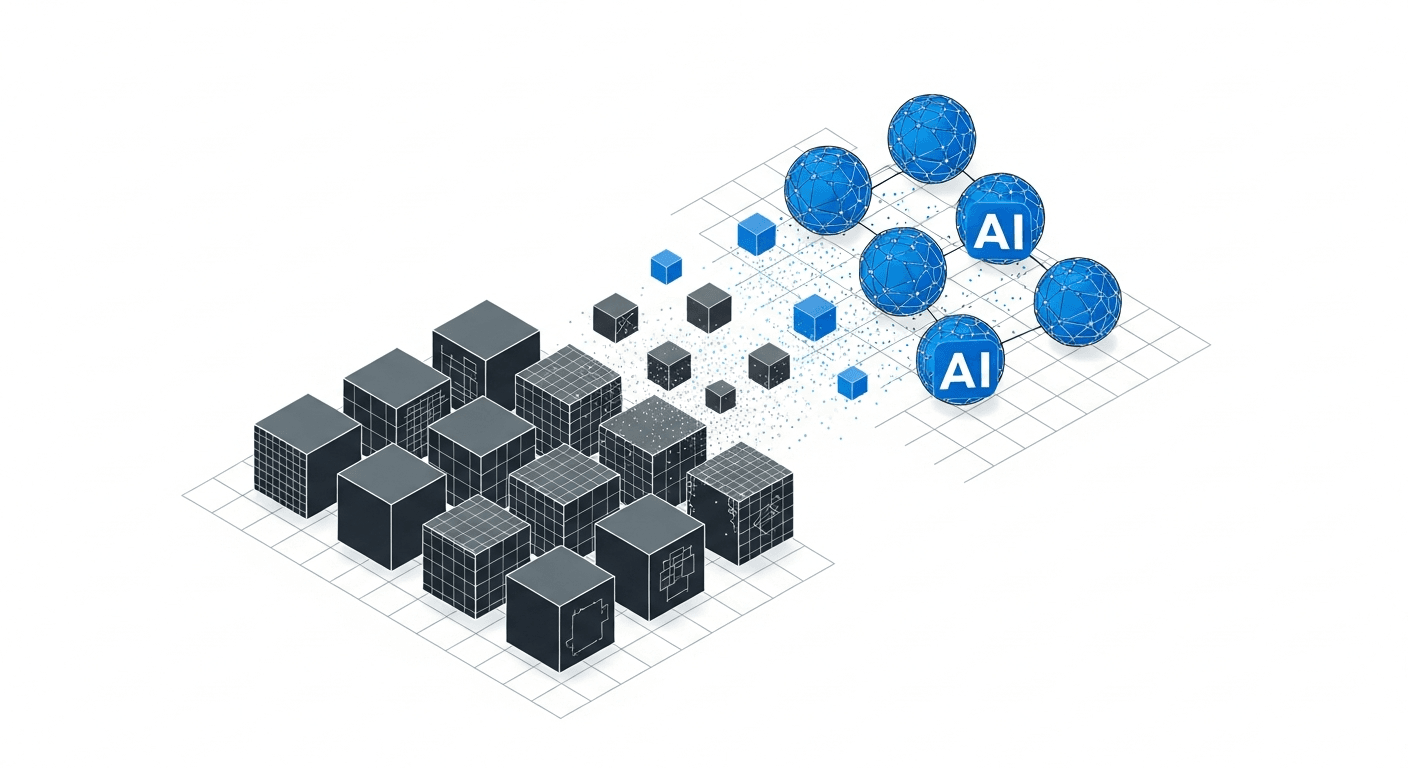
The Game-Changing Confession: A Google Ads Architect Announces the End of Keywords
When Jerry Dischler, former Vice President of Google Ads, publicly declares that the keyword system he helped build over 15 years is becoming obsolete, business leaders should listen. This isn't a consultant trying to sell training. This is one of the architects of history's most profitable advertising system sounding the alarm.
His thesis is crystal clear: search engines are evolving toward semantic understanding of intent, not term matching. Google, ChatGPT, Perplexity, and Gemini are no longer looking for words on your pages. They're looking for answers to questions that users sometimes haven't even explicitly formulated.
For SMBs and mid-market companies still investing heavily in keyword optimization, this revelation poses an urgent strategic question: how do you stay visible when the rules of the game are fundamentally changing? This article breaks down what's really happening and proposes concrete strategies for 2025-2026.
What the Former Google Engineer Actually Explained
From Lexical Matching to Semantic Matching
Google Ads' historical system worked on a simple principle: you buy the keyword "SMB accounting software," your ad appears when someone types that query or a close variant. This system has generated over $200 billion in annual revenue for Google.
But according to revelations from several former Google engineers, including Dischler, this model is reaching its structural limits. Why? Because users no longer search the same way. Conversational queries now represent over 40% of mobile searches. People ask complete questions, describe situations, request personalized recommendations.
"What accounting software for a 50-employee industrial SMB that exports to Belgium?" This query doesn't match any profitably purchasable keyword. Yet it's exactly what your prospects are typing.
AI Understands Intent, Not Terms
Current language models—those powering ChatGPT, Google AI Overview, and Perplexity—work differently. They analyze the global meaning of the query, identify the underlying intent, then search for sources that best answer that intent.
Concretely, if a manager asks Perplexity "how to reduce my production costs without layoffs," the AI doesn't search for pages optimized for that exact keyword. It identifies that the user wants cost reduction solutions, has ethical or social constraints, and likely runs a manufacturing business. Then it synthesizes the best answers found on the web.
Why 2026 Marks a Tipping Point
The Convergence of Three Phenomena
Several trends are converging to make the traditional keyword approach increasingly ineffective:
- Mass adoption of AI answers: Google AI Overview now appears on over 30% of commercial queries according to BrightEdge data. These generated answers capture zero-click traffic—users get their answer without visiting any site.
- Rise of conversational assistants: Gartner predicts that 25% of business searches will go through conversational interfaces by end of 2026. These interfaces don't work with keywords but through dialogue.
- Evolution of Google algorithms: recent updates (Helpful Content, March 2024 Core Update) explicitly penalize content optimized for keywords at the expense of real value.
Early Warning Signals Already Visible
At AISOS, we observe clear trends in the AI visibility audits we conduct for French and Belgian SMBs and mid-market companies. The companies dominating ChatGPT or Perplexity responses aren't those with the best traditional SEO. They're those whose content precisely answers specific business questions, with concrete data and demonstrable expertise.
A striking example: a Lyon-based industrial mid-market company with a technically mediocre website consistently appears in Perplexity responses about their sector. Why? Because their blog has published detailed technical analyses for 5 years, with figures, case studies, and comparisons. LLMs love this type of content.
What This Concretely Changes for Your Visibility
GEO Optimization Progressively Replaces Classic SEO
GEO, or Generative Engine Optimization, refers to all techniques for appearing in AI-generated responses. This discipline is emerging as a complement to, then progressively as an alternative to, traditional SEO.
Fundamental differences from classic SEO:
- Optimization unit: in SEO, you optimize pages for queries. In GEO, you optimize entities (your company, products, experts) for intents.
- Success criteria: in SEO, you measure ranking and traffic. In GEO, you measure citation in AI responses and association with key topics.
- Ranking factors: in SEO, backlinks and technical optimization dominate. In GEO, it's informational quality, data freshness, and topical authority that count.
Your Competitors Can Overtake You Without a High-Performing Website
This is the most destabilizing consequence for companies that have invested heavily in SEO. A competitor with a mediocre site but strong presence on sources that LLMs consult (Wikipedia, sector studies, interviews in reference media, quality LinkedIn publications) can supplant you in AI responses.
LLMs don't crawl the web like Google. They train on specific corpora, consult APIs, analyze structured databases. Your position on Google's first page no longer guarantees your visibility in ChatGPT.
Concrete Strategies to Adapt Your Approach
Moving from Keywords to Business Questions
The first adaptation involves restructuring your content around real questions your clients ask, not keywords they might type. This nuance is fundamental.
A keyword like "SMB ERP price" produces content optimized for search rankings. A question like "What budget should you plan for computerizing the management of a 30-100 employee industrial SMB?" produces useful content that LLMs will cite.
Concrete actions:
- Interview your salespeople: what questions do prospects ask in meetings?
- Analyze your client emails: what information requests come up regularly?
- Consult forums and LinkedIn groups in your sector: what problems do your targets discuss?
Creating LLM-Citable Content
Language models preferentially cite certain types of content. Understanding these preferences allows you to adapt your editorial production.
Characteristics of frequently cited content:
- Proprietary data: studies, statistics, benchmarks that only you possess
- Clear definitions: explanatory formulations that directly answer "what is" or "how does it work"
- Structured lists: steps, criteria, factors presented in an organized manner
- Identifiable expertise: content signed by named experts with verifiable credentials
- Freshness: visible publication and update dates, references to recent events
Building Your Entity in the Knowledge Graph
LLMs don't think in web pages but in entities: companies, people, products, concepts. Your objective is to strengthen your entity's representation in the knowledge bases these systems consult.
Levers to activate:
- Wikipedia and Wikidata: if your company is eligible, a well-sourced Wikipedia page has major impact on your AI visibility
- Google Knowledge Panel: claim and enrich your panel if you have one, or work to obtain one
- Structured data: implement schema.org Organization, Product, Person on your site
- Third-party mentions: multiply citations of your company in authoritative sources (press, sector studies, professional directories)
Diversifying Your Presence Points
As keywords lose importance, visibility channels multiply. LLMs draw their information from varied sources that traditional SEO ignored.
Channels to invest in:
- LinkedIn: publications by executives and experts are indexed and cited by several LLMs
- Podcasts and videos: transcriptions feed training databases
- Studies and white papers: particularly effective when referenced by third parties
- Press interviews: quotes in recognized media reinforce your topical authority
How to Measure Your Visibility in the Post-Keyword Era
New Metrics to Track
Abandoning keywords as a compass doesn't mean navigating blind. New indicators allow you to manage your AI visibility.
GEO metrics to implement:
- AI citation rate: frequency at which your brand appears in ChatGPT, Perplexity, Gemini responses on your key topics
- Generative share of voice: comparison of your AI visibility versus competitors on a corpus of typical questions
- Sentiment and positioning: how do LLMs describe your company? What attributes do they associate with you?
- Topical coverage: on how many subjects in your expertise area are you cited?
Regularly Auditing Your AI Presence
AISOS audits often reveal surprising gaps between executives' perception of their visibility and the reality of AI responses. A company leading on Google can be completely absent from ChatGPT. Conversely, a discreet SMB can dominate Perplexity responses in its niche.
A quarterly audit of your AI visibility becomes as important as monthly tracking of your SEO positions. Results evolve rapidly, at the pace of model updates and their data sources.
Don't Abandon Everything: Strategic Balance 2025-2026
The announced obsolescence of keywords doesn't mean their immediate disappearance. Google Ads still generates results. Traditional SEO remains relevant for certain transactional queries. The challenge for leaders is to progressively rebalance their investments.
A realistic budget allocation for an SMB or mid-market company in 2025 might look like this: 60% on traditional SEO and SEA (progressively decreasing), 25% on GEO and topical authority building (increasing), 15% on experimenting with new AI channels.
Companies that act in 2025 will have a decisive advantage. When keywords become truly marginal, they'll have already built their visibility in the new paradigm. Others will discover they've disappeared from their prospects' radars, absent from the responses generated by the AI assistants their clients use daily.
The question is no longer whether this transition will happen. The system's architect himself has confirmed it. The question is whether you'll be ready when it accelerates.
Want to know where you stand? An AI visibility audit precisely identifies your current presence in ChatGPT, Perplexity, and Google AI Overview responses, and defines priority actions for 2025-2026. Contact AISOS to assess your situation.


