Claude vs ChatGPT for Business: Which LLM to Choose for Your AI Visibility?
Claude vs ChatGPT comparison for B2B SMEs/Mid-Market companies: selection criteria, each LLM's strengths, and strategies to optimize your presence across both platforms.

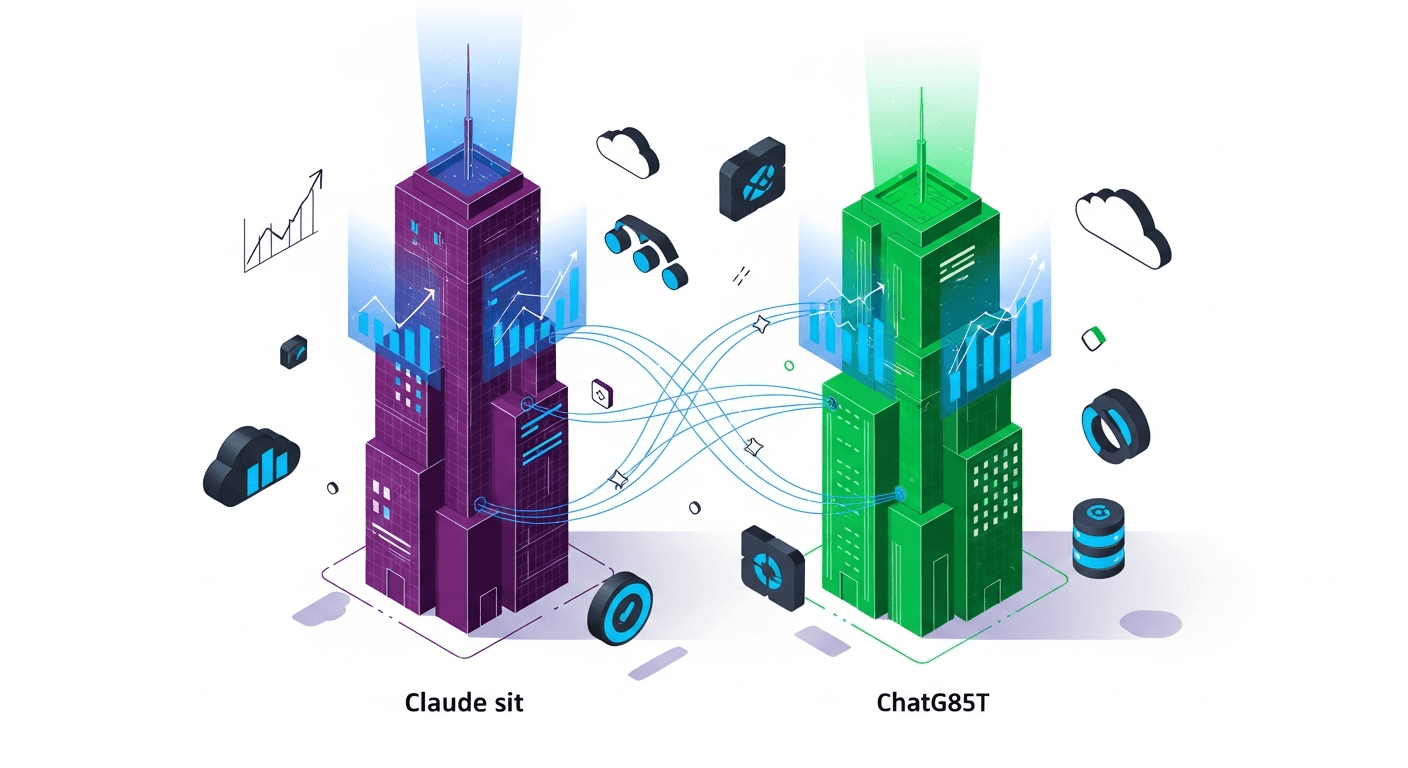
Everyone talks about ChatGPT. But Claude, Anthropic's model, is increasingly impressing entrepreneurs who discover it. A recent Reddit post captures this sentiment well: "Everyone talks about ChatGPT, but Claude blew me away."
For SMB and mid-market leaders, the question is no longer just "which tool should we use internally," but also "how does my company appear in these AI responses?" Because your customers and prospects now consult Claude and ChatGPT before contacting you. And these two LLMs don't work the same way.
This comparison gives you the keys to understanding the differences between Claude and ChatGPT from a business visibility perspective, with concrete strategies for each platform.
Claude and ChatGPT: two philosophies, two data sources
OpenAI's ChatGPT and Anthropic's Claude are both generative language models. But their approaches differ on several crucial points for your visibility.
ChatGPT: the dominant ecosystem with integrated web search
ChatGPT has over 200 million weekly active users in 2025. Its strength: native integration of web search via Bing, which allows it to cite recent sources and provide updated responses. For B2B companies, this means your web content can directly feed its responses.
OpenAI has also developed partnerships with major publishers (Associated Press, Axel Springer, Le Monde). These agreements influence which sources are prioritized in responses.
Claude: precision and long context
Claude 3.5 Sonnet, followed by Claude 4, stands out for its ability to process very long contexts (up to 200,000 tokens) and its "constitutional" AI approach. Anthropic emphasizes reliability and reducing hallucinations.
Claude doesn't have native web search in its standard version. It relies primarily on its training data, which radically changes the visibility strategy: your content must be sufficiently established and referenced to integrate into the training corpus.
How each LLM selects companies to cite
Understanding citation mechanisms is essential for adapting your GEO (Generative Engine Optimization) strategy.
ChatGPT's criteria
ChatGPT with web search prioritizes:
- Content freshness: recent articles that are regularly updated are favored
- Domain authority: traditional SEO signals (backlinks, age, traffic) still matter
- Clear structure: content with explicit definitions, lists, and quantified data is more easily extracted
- Presence on partner sources: being cited in media with OpenAI agreements increases your chances
At AISOS, we observe that B2B companies cited by ChatGPT share a common trait: they produce content that directly answers their customers' questions, with affirmative formulations and clearly named entities.
Claude's criteria
Claude works differently because it draws from its training data:
- Established reputation: your brand must be mentioned across multiple reliable sources (Wikipedia, press, industry publications)
- Information consistency: Claude cross-references data and prioritizes companies whose information is consistent everywhere
- Demonstrable expertise: in-depth technical content, case studies, and academic or professional publications carry significant weight
- Absence of negative signals: Claude is particularly sensitive to controversies and may avoid citing a company if negative information is present
Practical comparison: strengths and limitations for B2B SMBs/mid-market companies
Here's a decision-oriented comparative analysis for executives.
Immediate visibility vs. durable visibility
ChatGPT offers faster visibility. Content published today can appear in responses tomorrow if web search is enabled. This is the option for companies that publish regularly and want to capitalize on industry news.
Claude requires foundational work. Your company must build a solid web presence over several months before hoping to integrate into responses. In return, once you're in the corpus, your visibility is more stable.
Favorable query types
ChatGPT excels on informational queries requiring recent data: "best ERP software 2025," "SMB cybersecurity trends," "CSRD regulation for companies."
Claude performs well on queries requiring deep analysis or complex reasoning: "how to structure an RSE strategy for an industrial mid-market company," "comparison of digital transformation approaches."
Control over your image
With ChatGPT, you have more control because you can update your content and see effects quickly. Claude reflects a more "fixed" image of your company, which can be problematic if obsolete or incorrect information is circulating.
Platform-specific GEO strategies
Here are concrete actions to optimize your presence on each LLM.
Optimizing for ChatGPT: the living content strategy
Publish structured content for extraction. Each article should contain clear definitions ("[Your solution] is a [category] that enables [benefit]"), bullet points, and sourced figures. ChatGPT easily extracts this type of format.
Regularly update your key pages. A product page updated monthly with fresh data will be favored by ChatGPT's web search.
Work on your press relations. Mentions in OpenAI partner media (Le Monde, Les Échos for France) significantly increase your chances of being cited.
Create content that answers conversational questions. Analyze the questions your customers actually ask and create content that responds directly, using the question as a subheading.
Optimizing for Claude: the durable authority strategy
Consolidate your Wikipedia presence. If your company doesn't have a Wikipedia page and meets notability criteria, this is a priority project. Claude gives significant weight to this source.
Publish on high-authority platforms. Guest articles on industry media, LinkedIn publications (which is in the training corpus), contributions to studies or inter-professional white papers.
Ensure consistency of your information everywhere. Verify that your description, key figures, and positioning are identical across your website, social profiles, professional directories, and articles mentioning you.
Produce in-depth technical content. Claude values expertise. Detailed guides, documented methodologies, and industry analyses are more likely to integrate into its responses than superficial marketing content.
Should you choose one or optimize for both?
The answer depends on your resources and digital maturity.
Case 1: you're starting from scratch
Start with ChatGPT. Results are faster to obtain and measure. You can publish optimized content this week and observe if it appears in responses next month. This short feedback loop allows you to learn and adjust.
Case 2: you already have an established web presence
Work on both in parallel with different priorities. For ChatGPT: update your existing content and create articles answering your prospects' frequent questions. For Claude: consolidate your external reputation and presence on reference sources.
Case 3: you're in a B2B niche market
Claude may be more relevant. On technical or specialized topics, Claude tends to provide more nuanced responses and cite expert sources rather than general content. If your expertise is your differentiator, invest in a Claude strategy.
Mistakes to avoid on both platforms
Certain practices harm your visibility on both Claude and ChatGPT.
Overly promotional content. Both LLMs filter content perceived as disguised advertising. An article about your solution must provide real informational value, not just tout your merits.
Contradictory information. If your website indicates 150 employees, your LinkedIn page 180, and a press article 120, LLMs may either average them (which will be wrong) or ignore you out of caution.
Lack of updates. Content dated "2023" that talks about the "future" of your sector will be discarded, especially by ChatGPT which favors freshness.
Jargon without explanation. LLMs prefer accessible content. If you use acronyms or technical terms, define them. This increases your chances of being cited on queries from non-experts.
Measuring your visibility on Claude and ChatGPT
How do you know if your efforts are paying off?
Test regularly. Ask your sector's key questions monthly on both platforms and note if you're cited, how, and with what information.
Compare with your competitors. Who is cited in your place? Analyze their content and web presence to understand what they do differently.
Monitor variations. ChatGPT may cite you one week and not the next depending on its index updates. Claude is more stable but evolves with each major model update.
AISOS audits include a systematic testing protocol on major LLMs to precisely evaluate your visibility and identify improvement levers.
Key takeaways
Claude and ChatGPT represent two complementary visibility opportunities for B2B companies. ChatGPT, with its web search and 200 million users, offers rapid visibility for companies that publish structured and updated content. Claude values established authority and technical expertise, with more stable but longer-to-build visibility.
The winning strategy combines both approaches: fresh, well-structured content for ChatGPT, consolidated presence on reference sources for Claude. Companies that start optimizing for these platforms now gain a significant advantage over competitors who are still waiting.
To precisely evaluate your current visibility on Claude, ChatGPT, Perplexity, and other generative engines, and define a GEO strategy adapted to your sector, contact the AISOS team for a personalized audit.


