The AI Uniformization Trap: How to Prevent Your SEO Content from Becoming Generic
AI generates similar content for everyone. Discover how to escape the uniformization trap and regain a distinctive SEO advantage.

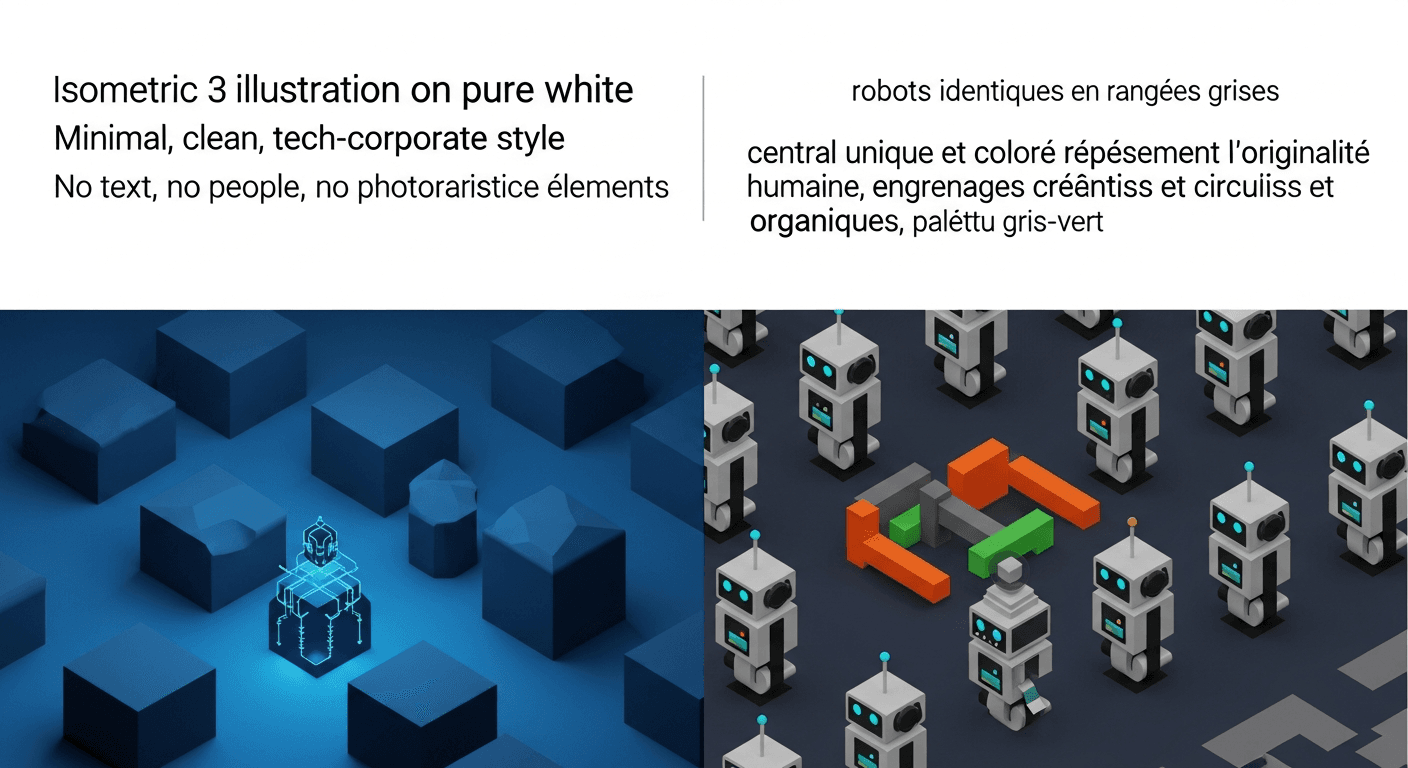
The Invisible Copy-Paste Syndrome
You've adopted generative AI to produce content faster. So have your competitors. The result: thousands of articles that look strangely similar, built on the same structures, using the same phrasing, citing the same sources. This is what experts now call the AI Sameness Trap.
This phenomenon isn't a theoretical hypothesis. A study by Originality.ai published in March 2024 reveals that 57% of content analyzed on Google's first pages shows stylistic signatures characteristic of generative AI. Even more concerning: Google's algorithms and answer engines like Perplexity or ChatGPT are beginning to penalize this homogeneity by favoring sources that bring a unique perspective.
For SME and mid-market leaders investing in content, the question becomes strategic: how can you continue using AI for its productivity benefits while preserving what makes your market difference?
Why AI Naturally Produces Generic Content
The Statistical Functioning of LLMs
Language models like GPT-4, Claude, or Gemini work through statistical prediction. They generate the next most probable word based on their training. This mechanism has a direct consequence: AI tends toward the average. It reproduces the most frequent patterns, the most common phrasing, the most widespread structures.
When you ask ChatGPT to write an article about digital transformation for SMEs, it draws from millions of similar texts. The result statistically resembles every other article on the subject. Your competitor using the same tool with a similar prompt gets nearly identical content.
The Amplification Effect Through Feedback Loops
The problem worsens over time. New models partially train on content generated by older models. This is what researchers call model collapse: a progressive degradation of output diversity. AISOS audits reveal that certain B2B sectors now show semantic similarity rates of over 80% between different market players' content.
Warning Signs in Your Own Production
How do you know if you've fallen into the trap? Here are the characteristic symptoms:
- Your introductions start with generalities: "In a context of accelerated digitalization..."
- Your tip lists resemble your competitors': same points, same order, same phrasing
- Absence of proprietary data: you cite the same studies as everyone else
- Neutral, impersonal tone: impossible to guess which company wrote the content
- Interchangeable conclusions: they could appear on any industry website
The Concrete Impact on Your SEO and AI Visibility
Google Detects and Devalues Homogeneity
Google's 2024 updates, notably the March Helpful Content Update, explicitly target content that doesn't provide distinctive value. The algorithm now evaluates what Google calls information gain: the amount of new information content brings compared to existing results.
Generic content, even well-written and technically optimized, receives a low information gain score. It merely repeats what already exists. Sistrix data shows that sites experiencing traffic losses exceeding 50% during 2024 core updates share a common characteristic: an undifferentiated AI content ratio above 60%.
AI Answer Engines Favor Distinctive Sources
Perplexity, ChatGPT with browsing, Google AI Overview: these systems don't just summarize the web. They seek to cite sources that bring specific expertise. When all sources say the same thing, these engines have no reason to cite yours over another.
Citation analyses in Perplexity show a strong correlation between citation rates and three factors:
- The presence of exclusive or proprietary data
- The expression of an identifiable and argued viewpoint
- The mention of concrete field experiences
Measurable Competitive Advantage Loss
Beyond technical SEO, standardization erodes your brand positioning. If your content is interchangeable with your competitors', why would a prospect choose you? Generic content generates generic traffic: visitors who don't perceive your difference and compare solely on price.
Five Differentiation Levers to Activate Immediately
1. Inject Proprietary Data
Exclusive data is the most powerful differentiator. Your internal data, even partial, constitutes an asset that AI cannot invent and competitors cannot copy.
Concrete actions:
- Analyze your customer data: conversion rates by sector, average sales cycle duration, recurring issues
- Document your interventions: anonymized project results, measurable before/after
- Create mini-studies: survey your clients on an issue and publish the results
- Leverage your support data: frequent questions reveal the market's real concerns
Example: instead of writing "industrial SMEs face recruitment challenges," write "of the 47 industrial SMEs we supported in 2024, 73% cite recruiting qualified technicians as their primary growth constraint."
2. Develop an Identifiable Editorial Voice
A strong brand voice isn't limited to tone. It includes clear positions, characteristic phrasing, an argument structure that belongs to you.
Elements to define:
- Your professional convictions: what do you believe that others in your sector don't?
- Your signature expressions: recurring phrases that become associated with your brand
- Your level of frankness: do you dare say when a common industry practice is ineffective?
- Your relationship to trends: are you a critical early adopter or pragmatic conservative?
3. Integrate Your Teams' Field Expertise
Your salespeople, consultants, and technicians accumulate tacit expertise that AI doesn't possess. This field knowledge constitutes your structural differentiator.
Extraction methods:
- Monthly interviews: 30 minutes with an internal expert on a recent client issue
- War story sessions: documenting difficult cases and solutions found
- Enriched industry glossary: terms your clients actually use, not manual terminology
- Reverse FAQ: questions clients should ask but never do
4. Create Distinctive Content Formats
AI naturally generates standardized formats: listicles, step-by-step guides, 5-point articles. Developing proprietary formats creates immediate recognition.
Examples of differentiating formats:
- Project autopsy: detailed analysis of a real case including mistakes made
- Internal debate: two team experts with opposing views
- Progress journal: chronological tracking of a client transformation
- Honest comparison: objective analysis including when your solution isn't suitable
5. Practice Continuous Enriched Updates
Rather than always producing more new content, enrich existing content with updated data and experience feedback. An article updated with fresh data outperforms a new generic article.
Recommended process:
- Quarterly audit of your 20 best-performing content pieces
- Systematic addition of recent data and client cases
- Integration of new questions identified by support
- Date updates and obsolete reference removal
The Production Workflow That Preserves Differentiation
Redefining AI's Role in Your Production Chain
The goal isn't to abandon AI but to reposition its usage. AI excels at certain tasks and generates mediocrity in others.
Tasks suited for AI:
- Preliminary research and source synthesis
- Detailed outline structuring
- Reformulation and stylistic improvement
- Coherence checking and repetition detection
- Variation generation for testing
Tasks to reserve for humans:
- Angle definition and editorial positioning
- Adding proprietary data and internal examples
- Expressing opinions and taking positions
- Final voice and tone validation
- Field expertise enrichment
The Four-Phase Process
Phase 1: Human Framework (Non-compressible)
Defining the differentiating angle, identifying internal data to integrate, choosing position. Duration: 20 to 30 minutes per content piece.
Phase 2: AI-Assisted Production
Generating structure and first draft with prompts enriched by the framework. AI works on an already differentiated base.
Phase 3: Expert Enrichment
Integrating internal verbatims, proprietary data, field examples. This is the phase that transforms correct content into distinctive content.
Phase 4: Editorial Validation
Differentiation-oriented review: could this content be published as-is by a competitor? If yes, something's missing.
Measuring Your Differentiation Level
Quantitative Indicators
Several tools allow objective evaluation of your content's uniqueness:
- Semantic similarity score: comparison with competitor content on the same query (tools: Clearscope, MarketMuse)
- AI response citation rate: appearance frequency in Perplexity, ChatGPT, Gemini
- Proprietary/generic data ratio: manual count of exclusive vs. public sources
- Differentiated engagement rate: reading time and scroll depth compared to sector average
Qualitative Differentiation Audit
At AISOS, we use a simple evaluation grid applicable to each content piece:
- Does this content contain at least one data point that only our company possesses?
- Does it express an opinion that some in the sector would contest?
- Could a reader identify the author company without seeing the logo?
- Does it provide information absent from the top 10 Google results?
Content answering "no" to all four questions is generic content, regardless of its writing quality.
Differentiation Is No Longer Optional
AI standardization isn't a future threat: it's already impacting SEO results and visibility in answer engines. Companies that continue producing generic content at scale will progressively lose their competitive advantage to those who have preserved their uniqueness.
The good news: differentiation doesn't require abandoning AI or multiplying resources. It's about reorganizing your production process to place human contribution where it truly creates value: proprietary data, field expertise, assumed positions.
Start this week: take your last published article and ask yourself: what in this content couldn't be written by an AI working for my competitor? If you can't find a clear answer, you know where to start.
To precisely assess your exposure level to the standardization trap and build a differentiation strategy adapted to your sector, AISOS teams conduct content audits specifically oriented toward AI visibility and distinctive SEO.


