AI Advertising Strategy: Microsoft Ads vs Google, Opportunities for SMEs
Microsoft Ads integrates AI differently than Google. Analysis of less competitive advertising opportunities for French and Belgian SMEs.

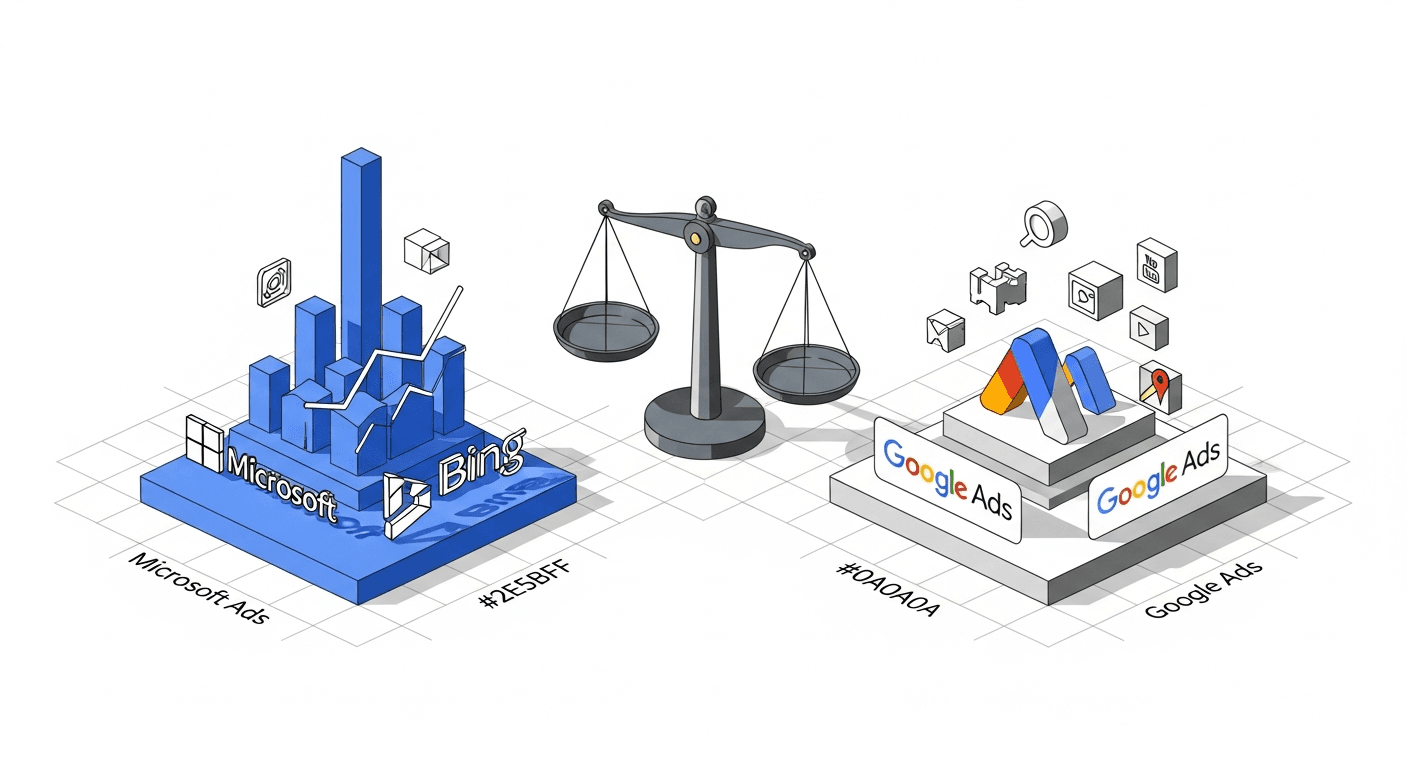
The advertising duopoly is cracking thanks to AI
Google captures 92% of searches in Europe. This figure, hammered home for years, pushes most SMEs to concentrate 100% of their advertising budget on Google Ads. Strategic mistake. The emergence of generative artificial intelligence is reshuffling the search marketing deck, and Microsoft Ads is positioning itself with a radically different approach from its competitor.
In 2024, Microsoft invested over $13 billion in OpenAI. This strategic alliance transforms Bing, Edge and the entire Microsoft ecosystem into an AI advertising experimentation laboratory. For SME leaders in France and Belgium, this creates a window of opportunity: cost per click rates 30 to 50% lower, an overrepresented B2B audience, and less saturated AI advertising formats.
This article breaks down the strategic differences between Microsoft and Google on AI-driven advertising. Objective: give you the keys to intelligently allocate your budget between these two platforms.
Microsoft Copilot vs Google AI Overview: two visions of advertising in AI responses
The Microsoft approach: native integration in Copilot
Microsoft has made a strong strategic choice: integrate advertising directly into Copilot conversations. When a user asks a question to Copilot in Bing or Edge, ads appear contextually within the generated response. It's no longer a list of sponsored links above organic results. It's a recommendation integrated into the conversational flow.
Concretely, if a Belgian decision-maker asks Copilot "which billing software for an SME with 50 employees", the AI response can mention sponsored solutions seamlessly, alongside organic recommendations. Microsoft calls this format "Ads for Chat". Initial tests show click-through rates 25% higher than traditional search ads.
The Google approach: AI Overview with separate sponsored links
Google has chosen a more cautious path. AI Overviews, those AI-generated summaries at the top of search results, remain largely separate from advertising for now. Google is testing the insertion of sponsored links in these summaries, but sparingly. The reason: protecting the golden goose. Google Ads generates over $230 billion annually. Any overly drastic modification risks cannibalizing existing formats.
This caution creates a paradox. Google possesses the most advanced AI technology with Gemini, but slows its advertising integration. Microsoft, the challenger, moves faster and experiments more freely.
The numbers that matter: costs and performance compared
Cost per click: Microsoft's advantage persists
Market data from France and Belgium confirms a significant gap:
- Average CPC Google Ads France: €1.20 to €2.50 depending on B2B sectors
- Average CPC Microsoft Ads France: €0.70 to €1.60 on the same queries
- Observed gap: 30 to 45% cheaper on Microsoft Ads
In Belgium, the gap is even more pronounced on Dutch queries, where competition on Microsoft Ads remains low. A Walloon SME targeting Flemish prospects can obtain CPCs 50% lower than Google Ads.
B2B audience quality
Microsoft Ads reaches a different audience. Bing is the default search engine on Windows workstations in companies. Edge equips the majority of professional computers. Result: Microsoft Ads audience overrepresents decision-maker profiles.
According to Microsoft data, Bing users have 25% higher purchasing power than average. In B2B context, this translates to more qualified leads. At AISOS, we observe that our clients' Microsoft Ads campaigns generate 15 to 20% higher conversion rates on decision-maker audiences, despite lower click volumes.
AI advertising features: the technical comparison
Automatic ad content generation
Microsoft Ads integrates Copilot directly into the campaign creation interface. AI generates headlines, descriptions and ad extensions from your website. It also suggests keywords and audiences. The "Copilot in Microsoft Advertising" feature analyzes your past performance to recommend optimizations.
Google Ads offers similar features with "Automatically Created Assets" and Performance Max campaigns. AI generates ad variants and optimizes their delivery. Google has the data advantage: more queries, therefore faster algorithm learning.
Predictive targeting and AI audiences
Both platforms use AI for targeting, but with different philosophies:
- Google: focuses on maximum automation with Performance Max. The advertiser defines an objective, AI manages everything else. Less control, but potentially more volume.
- Microsoft: offers a balance between automation and manual control. "Audience Ads" allow precise targeting based on LinkedIn data, Microsoft's property. This is a decisive B2B advantage.
Microsoft's LinkedIn advantage
Microsoft has owned LinkedIn since 2016. This integration enables unique advertising targeting: job function, industry, company size, directly from Microsoft Ads. A software publisher can specifically target financial directors of industrial SMEs in Belgium. Google cannot replicate this B2B precision.
Allocation strategy for French and Belgian SMEs
When to favor Microsoft Ads
Microsoft Ads becomes the strategic choice in several contexts:
- B2B target with senior decision-makers: directors, senior executives, professionals. Microsoft's audience overrepresents these profiles.
- Limited advertising budget: with CPCs 30 to 50% lower, a €2,000 monthly budget will go further on Microsoft Ads.
- Niche sectors: fewer advertisers on Microsoft means less competition on specialized queries.
- Belgian Dutch-speaking market: competition remains particularly low there.
When to stick with Google Ads
Google Ads remains essential for:
- Lead volume: if you need 500 monthly leads, only Google can provide this volume in France.
- General public target: B2C or B2B targeting SMEs without defined IT strategy.
- High purchase intent queries: Google dominates immediate transactional searches.
The recommended hybrid approach
For most B2B SMEs, the optimal strategy combines both platforms:
- 70% Google Ads: for volume and high-intent queries
- 30% Microsoft Ads: for LinkedIn targeting, reduced costs and AI experimentation
This allocation captures the Microsoft audience, often ignored by competitors, while maintaining a presence on Google.
Preparing your visibility in generative AI responses
Beyond advertising: being cited by Copilot and Gemini
Advertising is only part of the equation. AI engines like Copilot, ChatGPT and Gemini generate responses by citing sources. Appearing in these organic responses becomes a major strategic challenge for SMEs.
Citation criteria by generative AIs differ from traditional SEO. These systems favor:
- Clearly identified entities: company name, location, specialty explicitly mentioned
- Direct and sourced statements: no vague formulations, quantified data
- Content freshness: AIs favor recent information
- Thematic authority: being recognized as an expert on a specific subject
GEO as a complement to AI advertising
GEO, or Generative Engine Optimization, refers to techniques for optimizing visibility in AI engine responses. For an SME, combining Microsoft Ads advertising and GEO strategy creates a dual lever: paid visibility in Copilot ads, and organic visibility in generated responses.
AISOS audits reveal that 78% of French SMEs have no strategy to appear in ChatGPT or Perplexity responses. This is a strategic blind spot, while these platforms capture a growing share of B2B informational searches.
Concrete actions to get started
Week 1: audit your current presence
Test your AI visibility by asking ChatGPT, Copilot and Perplexity questions your prospects would ask. "Which provider for [your service] in [your region]?" Note if you're cited, and which competitors appear.
Week 2: opening a Microsoft Ads account
Import from Google Ads is simple: Microsoft offers a migration tool that replicates your existing campaigns. Start with a €500 test budget over 30 days to measure comparative performance.
Week 3: LinkedIn targeting activation
Configure your first audiences based on LinkedIn data: function, sector, company size. Create specific ads for these B2B segments.
Month 2: analysis and allocation
Compare key metrics: CPC, conversion rate, cost per lead. Adjust budget allocation based on actual results from your sector.
Conclusion: seizing the opportunity before saturation
AI advertising is only in its infancy. Microsoft is taking the lead with Copilot and its LinkedIn integration, while Google advances cautiously to protect its existing revenue. For French and Belgian SMEs, this transition period creates a window of opportunity.
Costs on Microsoft Ads remain 30 to 50% lower than Google. The B2B audience is more qualified there. AI advertising formats are less saturated. These advantages won't last forever: as advertisers discover Microsoft Ads, competition will increase and prices will follow.
The challenge for SME leaders: test now, learn fast, and build a presence on Microsoft Ads before your competitors establish themselves there. The same logic applies to your organic visibility in AI engines: companies that structure their presence today will be those that Copilot, ChatGPT and Perplexity cite tomorrow.
AISOS supports SMEs and mid-market companies in their AI visibility strategy, both paid and organic. Contact us for an audit of your presence in generative engines.


