Google Tests AI Search Reports in Search Console: A Business Guide
Google is developing dedicated AI Search reports in Search Console. Learn how to prepare your website for this new AI visibility measurement.

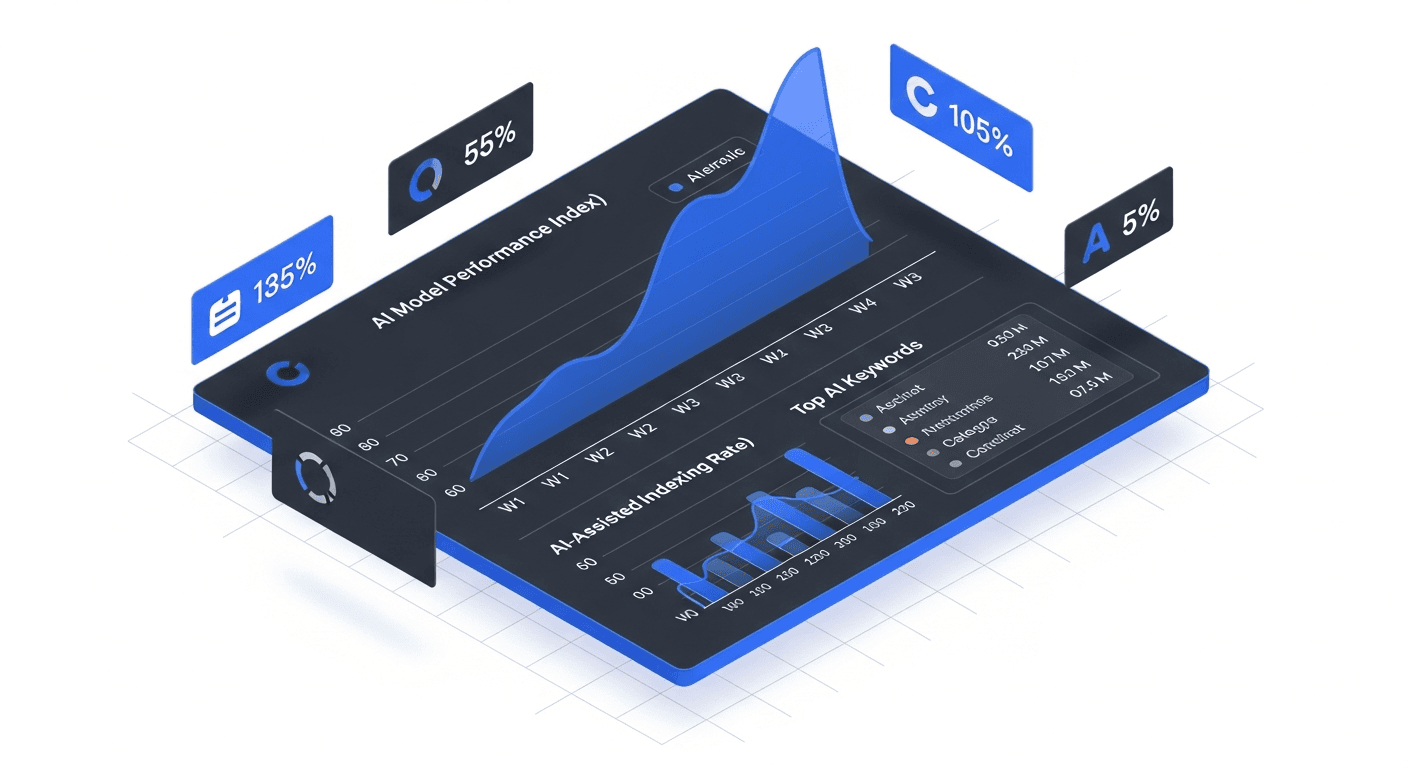
A New Era of Measurement for AI Visibility
Google has just confirmed testing of a major feature: dedicated AI Search reports integrated directly into Search Console. For SME and mid-market leaders, this announcement represents a turning point. You'll finally be able to measure how your website performs in responses generated by Google's artificial intelligence.
Until now, businesses were navigating blindly. Google's AI Overviews - those synthesized answers that appear at the top of search results - generated traffic that was impossible to trace precisely. The data was mixed with traditional organic search results, making any strategic analysis approximate at best.
This guide explains concretely what these new reports will change, how to prepare for them right now, and what actions to implement to maximize your visibility in AI search engines. You'll leave with an actionable checklist that you can apply this week.
What the First AI Search Report Tests Reveal
A Separate and Dedicated Reporting Interface
Circulating screenshots show a distinct section in Search Console, separate from traditional performance reports. Google seems intent on creating a clear distinction between traditional SEO and AI visibility. This approach confirms what experts anticipated: the two channels require different strategies and metrics.
Initial tests indicate the presence of familiar metrics adapted to the AI context: impressions in AI Overviews, clicks generated from these responses, and potentially the positioning of your citations in generated summaries. This data will enable calculating a CTR specific to AI Search - a crucial metric for evaluating the attractiveness of your content in this new format.
Why Google is Launching These Reports Now
Several factors explain this timing. First, AI Overviews now represent a significant portion of Google searches. According to industry estimates, between 15% and 30% of informational queries trigger an AI response in the United States. In Europe, deployment has accelerated since early 2025.
Second, Google is responding to pressing demand from digital marketing professionals. Without reliable data, it's impossible to justify Generative Engine Optimization investments to executive leadership. These reports legitimize GEO as a measurable discipline, with concrete KPIs to track.
Finally, Google needs publishers to continue producing quality content. If websites can't measure the ROI of their presence in AI Overviews, they risk reducing their content creation efforts. These reports create a virtuous circle: more transparency encourages more quality content, which feeds better AI responses.
Key Metrics to Monitor Upon Activation
AI Impressions vs Traditional Impressions
The first metric to isolate will be the number of impressions generated by AI Overviews. This data will tell you how frequently your site is cited in responses generated by Google's AI. A site with 10,000 traditional impressions but only 200 AI impressions has a visibility problem in the new search paradigm.
At AISOS, we observe that sites optimized for GEO can achieve an AI impressions to traditional impressions ratio of 1:5 to 1:3 on informational queries. Non-optimized sites often fall below 1:20, or never appear in AI responses at all.
Click-Through Rate from AI Overviews
CTR from an AI citation differs radically from traditional organic CTR. In an AI Overview, the user has already received part of the answer. The click to your site must provide additional value: deeper insights, complementary data, specific expertise.
Early market feedback suggests average CTRs between 2% and 8% from AI Overviews, compared to 15% to 35% for a traditional first organic position. These low figures aren't necessarily negative: they reflect more qualified traffic, with visitors actively seeking to deepen their understanding.
Queries Triggering AI Citations
The reports should reveal which queries generate citations of your site in AI Overviews. This information is strategic. It allows you to identify:
- Topics where Google considers you a reliable source
- Content formats that work best for AI
- Missed opportunities on queries where you have content but no AI visibility
- Topics to prioritize for developing your authority
Preparation Checklist: 12 Concrete Actions
Immediate Technical Actions
Start with these technical verifications that will determine your ability to leverage the new reports:
- Check your robots.txt file: ensure you're not blocking Googlebot from your strategic content. Blocked pages cannot be cited in AI Overviews.
- Review your meta robots tags: noindex or nosnippet directives exclude your pages from AI responses. Audit your key pages.
- Implement structured data: Schema.org helps Google understand your content. Article, FAQPage, HowTo, and Organization types are priority for GEO.
- Optimize loading time: slow pages are crawled and analyzed less frequently by Google's AI systems. Target an LCP under 2.5 seconds.
Content Optimizations
The structure and writing of your content determine their citability by generative AI:
- Add explicit definitions: start your sections with clear definitional sentences. "GEO (Generative Engine Optimization) refers to the set of techniques..."
- Structure in autonomous blocks: each H2 or H3 section should be understandable independently. AIs extract passages, not entire pages.
- Include sourced numerical data: precise statistics with their source increase perceived credibility by algorithms.
- Create lists and tables: these formats are favored by AI Overviews for their readability. Transform dense paragraphs into structured lists.
Monitoring and Governance Actions
Prepare your organization to leverage this new data:
- Create a dedicated dashboard: plan a specific section in your monthly reports for AI Search metrics.
- Define your target KPIs: set quantified objectives before having the data. For example: "reach 500 monthly AI impressions by Q3".
- Train your teams: brief your marketing managers and writers on GEO specifics.
- Plan quarterly audits: AI visibility will evolve rapidly. Institutionalize regular reviews.
Advanced Strategies to Maximize Your AI Visibility
Building Topical Authority Recognized by AI
AI search engines don't cite randomly. They favor sources that demonstrate deep and consistent expertise on a subject. This notion of topical authority, already important in traditional SEO, becomes decisive in GEO.
Concretely, this means developing comprehensive content clusters rather than isolated articles. An industrial manufacturer wanting to be cited on "equipment safety standards" must cover the topic from all angles: European regulations, certification, compliance implementation, periodic controls, legal responsibilities.
AISOS audits reveal that sites with complete topical coverage obtain 3 to 5 times more AI citations than their competitors on the same queries. Depth trumps quantity.
Optimizing for Different AI Response Formats
Google's AI Overviews present several formats depending on the query type:
- Synthetic responses: a paragraph summarizing multiple sources. Optimization: clear hook sentences and precise definitions.
- Bullet lists: process steps or selection criteria. Optimization: structure your content in numbered or bulleted lists.
- Comparative tables: product or option comparisons. Optimization: create structured HTML tables with comparative data.
- Multi-source responses: multiple sites cited with their specific contributions. Optimization: have an identifiable differentiating angle.
Leveraging Search Console Data for Iteration
Once AI Search reports are available, adopt a data-driven approach:
Identify your "quick wins": queries where you have AI impressions but low CTR. These pages are cited but don't encourage clicks. Rework their titles and enrich their content to create desire for deeper exploration.
Spot your blind spots: high-volume queries where you don't appear in AI Overviews despite good organic positioning. These cases reveal content structure or format issues.
Analyze the competition: note which sites are cited in your place and study their approach. Benchmarking remains an effective method, even in the generative AI universe.
Implications for Your 2025 Digital Strategy
Revising Your Budgets and Priorities
The arrival of official AI Search metrics will transform budget discussions. Executive teams can finally evaluate GEO investment ROI with reliable Google data. Anticipate these conversations by preparing projections based on your current SEO performance.
A well-positioned site in organic search generally has a starting advantage in GEO, but it's not automatic. Some SEO leaders discover they're absent from AI responses, while challengers perform better thanks to better-structured content.
Integrating GEO into Your Martech Stack
Google's AI Search reports will be just one piece of the puzzle. For a complete view of your AI visibility, you'll need to cross-reference this data with:
- Your presence in Perplexity (manual monitoring or third-party tools)
- Your citations in ChatGPT and Claude (regular testing on your target queries)
- Your visibility in Bing Copilot and Microsoft's AI Overviews
- Traffic analytics to identify visitors from AI sources
Preparing for the Post-AI Overview Era
Google will continue evolving its AI response formats. Companies that master GEO fundamentals today will be better equipped for future developments: conversational AI agents, multimodal search, integration into voice assistants.
Investing in a solid GEO strategy in 2025 means building a durable asset. The principles of citability, topical authority, and content structuring will remain relevant regardless of interface evolution.
Conclusion: Act Before General Activation
Google Search Console's AI Search reports represent a major advancement for companies concerned about their digital visibility. For the first time, you'll have official Google data on your performance in generative responses.
Don't wait for these reports to activate before taking action. The 12 checklist actions presented are immediately applicable and will improve your positioning right now. Companies that prepare their sites today will have a measurable advantage when the data becomes available.
GEO is no longer an experimental discipline reserved for early adopters. With these new measurement tools, it becomes a full-fledged marketing channel, with its own metrics, benchmarks, and optimization strategies. The question is no longer whether you should be interested, but how you'll structure your approach.
Recommended next step: conduct an AI citability audit of your 10 strategic pages. Check their structure, structured data, and ability to directly answer your prospects' questions. This is the starting point for any effective GEO strategy.


