Claude Surpasses ChatGPT: How to Adapt Your AI Visibility Strategy in 2026
Anthropic's Claude takes the lead in the AI market. Here's how to reposition your visibility strategy to stay visible across all generative engines.

The shift no one anticipated
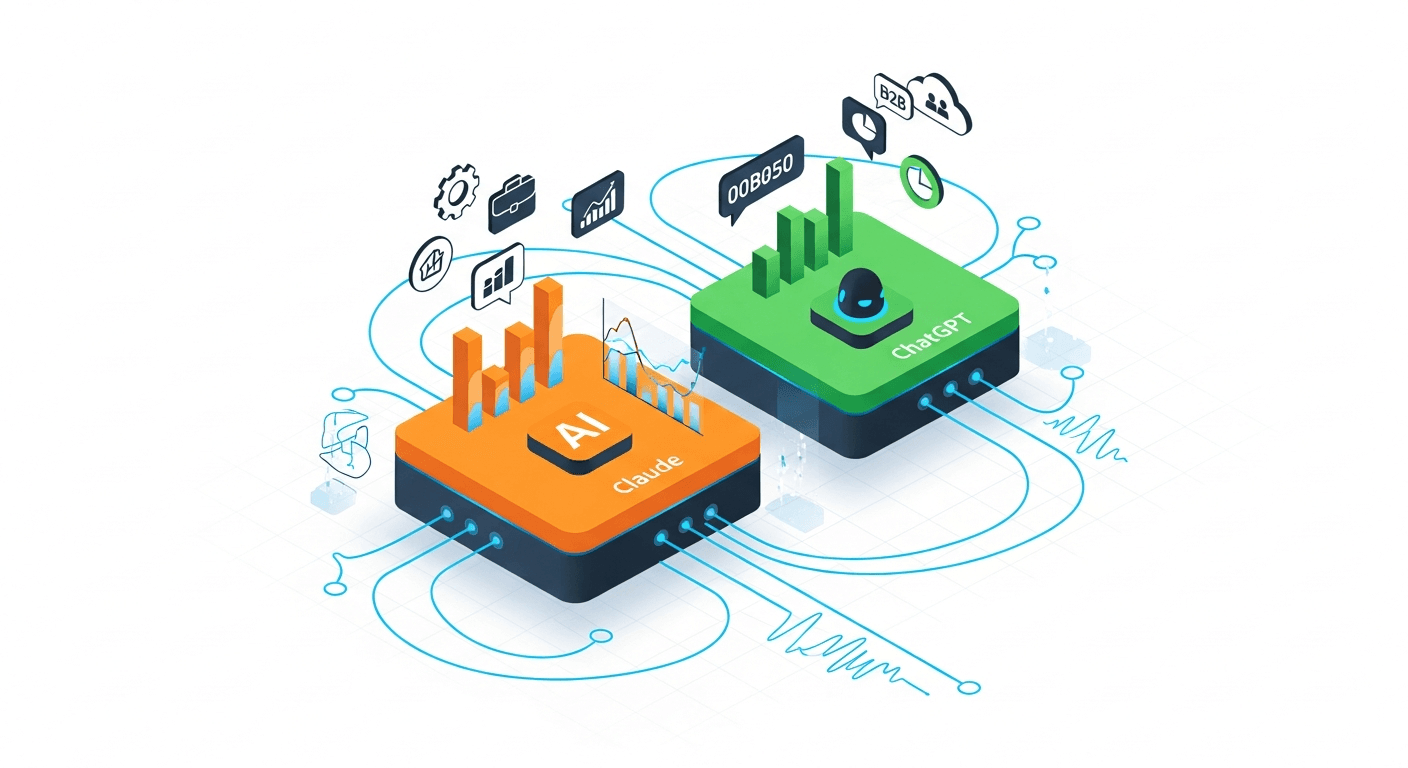
In May 2026, the data came in: Anthropic's Claude surpassed OpenAI's ChatGPT on key user engagement and retention metrics. For the first time since ChatGPT's launch in late 2022, leadership changed hands in consumer generative AI.
This reversal is significant for B2B companies that have invested in their visibility on AI answer engines. If you've optimized your presence for ChatGPT over the past two years, you now need to ask yourself a strategic question: how do you maintain your visibility as users migrate to Claude?
This article analyzes the causes of this shift, its concrete implications for your AI visibility strategy, and the actions to implement now to remain present across all generative engines, starting with Claude.
Why Claude overtook ChatGPT: the decisive factors
Technical superiority in professional use cases
Claude 3.5 and then Claude 4 widened the gap across several dimensions critical to B2B users. The extended context window of 200,000 tokens enables processing entire documents without fragmentation. Response quality on complex topics, particularly legal, financial, and technical subjects, now surpasses that of GPT-4o according to independent benchmarks.
Companies using AI for research, document analysis, and professional writing have gradually shifted to Claude. This movement accelerated in Q1 2026 with the launch of Claude Enterprise and its team collaboration features.
A more reassuring data policy
Anthropic has focused on data security and confidentiality from the start. This approach, long perceived as an innovation constraint, has become a major competitive advantage. CIOs and DPOs now recommend Claude for sensitive use cases, driving growing adoption among mid-market and enterprise accounts.
Usage statistics reflect this change: 38% of professional users declare Claude as their primary AI tool in 2026, versus 31% for ChatGPT. The gap widens each month.
The network effect of integrations
Claude is now natively integrated into tools massively used in enterprise: Notion, Slack, several productivity suites. These integrations create a pull-through effect. Users discover Claude through their daily tools and then transfer their search queries to claude.ai.
What this change means for your AI visibility
Your ChatGPT-optimized content is no longer enough
If your GEO strategy focused on ChatGPT, you've likely worked on structuring your content to match GPT-4's citation patterns. However, Claude and ChatGPT don't cite the same sources in the same way.
At AISOS, we observe significant differences in AI visibility audits: a company may appear in 70% of ChatGPT responses in their sector and only 25% of Claude responses. The reverse also exists. These gaps are explained by differences in training corpora, retrieval algorithms, and source reliability criteria.
Market fragmentation accelerates
2026 marks the end of single AI engine hegemony. The market is now structured around four major players for generative search:
- Claude: leader in professional use cases and in-depth research
- ChatGPT: remains dominant in consumer and creative use cases
- Perplexity: reference for factual search with citations
- Google AI Overview: essential for transactional intent queries
This fragmentation requires a multi-engine visibility strategy. Optimizing for a single tool means ignoring a growing portion of your target audience.
How Claude selects and cites sources
Anthropic's reliability criteria
Claude applies strict criteria to determine which sources to cite in its responses. Analysis of citation patterns reveals several determining factors:
- Domain authority: Claude favors sites recognized as references in their sector
- Content freshness: recent and regularly updated content is favored
- Clarity of statements: Claude more easily cites content that provides direct, unambiguous answers
- Consistency with consensus: verifiable information aligned with other reliable sources is prioritized
Differences with ChatGPT
ChatGPT and Claude diverge on several aspects. ChatGPT tends to synthesize multiple sources without always explicitly citing them. Claude, conversely, more systematically attributes its information, especially in web search mode.
Claude also places more importance on the argumentative structure of content. An article that presents data, analyzes it, and draws explicit conclusions will be better referenced than descriptive content without taking a position.
Practical guide: adapting your AI visibility strategy
Step 1: audit your current visibility on Claude
Before any optimization, measure your starting position. Test strategic queries in your sector on Claude and document:
- Is your company mentioned? How frequently?
- Which competitors appear in the responses?
- What sources does Claude cite on your key topics?
Compare these results with your visibility on ChatGPT, Perplexity, and Google AI Overview. This mapping reveals your gaps and opportunities.
Step 2: reformulate your content for citation
Claude more easily cites content that directly answers questions. Each strategic page on your site should contain:
- A clear definition in the first 100 words
- Direct statements rather than conditional formulations
- Quantified data with their sources
- A structure in self-sufficient sections that Claude can extract individually
Concrete example: instead of writing "Digital transformation can potentially improve productivity," write "Digital transformation improves productivity by 20 to 35% in industrial SMEs according to the 2025 Bpifrance study."
Step 3: strengthen your sector authority
Claude evaluates a source's authority through several signals. To improve your positioning:
- Publish original studies with proprietary data
- Obtain citations in sector media and publications
- Develop your presence on platforms Claude consults: LinkedIn, B2B media, institutional sites
- Maintain consistency across all your online communications
Step 4: don't abandon ChatGPT
Claude overtaking ChatGPT doesn't mean abandoning the latter. ChatGPT maintains a massive user base, particularly in international markets and for certain use cases. Your strategy must cover both platforms.
Optimizations for Claude and ChatGPT largely overlap: structured content, authority, clarity. Specific adjustments mainly concern the tone and format of expected responses.
Mistakes to avoid in this transition
Mistake 1: betting everything on one engine
Some companies react to the leadership change by abandoning their ChatGPT efforts to focus exclusively on Claude. This approach is risky. The AI market evolves rapidly and leadership can still change. A robust strategy covers all generative engines.
Mistake 2: ignoring Perplexity and Google AI Overview
Focusing on the Claude-ChatGPT duel makes people forget two major players. Perplexity captures a qualified B2B audience seeking sourced answers. Google AI Overview remains essential for purchase and comparison-related queries. A complete strategy integrates these four platforms.
Mistake 3: optimizing for AI without SEO fundamentals
AI engines still largely rely on the indexed web. A site poorly referenced on Google will be difficult to position on Claude or ChatGPT. GEO complements SEO, it doesn't replace it. Your technical fundamentals, internal linking, and content strategy remain essential.
Action plan for the next six months
To adapt your AI visibility strategy to the new context, here are the priorities to plan:
Months 1-2: complete audit of your visibility on Claude, ChatGPT, Perplexity, and Google AI Overview. Identify strategic queries and visibility gaps between platforms.
Months 3-4: optimize your pillar content for AI citation. Reformulate strategic pages according to identified criteria. Publish high-authority content: studies, sector analyses, position statements.
Months 5-6: measure results and make adjustments. Regular testing of your target queries on each platform. Iterate on content that performs.
AISOS audits show that companies engaging in this multi-engine optimization work gain an average of 40% additional visibility on AI responses in six months.
Conclusion: AI visibility becomes a multi-platform challenge
Claude overtaking ChatGPT marks a turning point for B2B companies. The era when it was enough to optimize for a single AI engine is over. In 2026, visibility on generative responses requires a strategy covering Claude, ChatGPT, Perplexity, and Google AI Overview.
This increased complexity is also an opportunity. Your competitors who don't adapt their approach will lose visibility. Those who invest now in a multi-engine GEO strategy will gain a lasting advantage.
The leadership change between ChatGPT and Claude probably won't be the last. The ability to quickly adapt to AI market evolution becomes a competitive advantage in itself. Start by auditing your current visibility on each platform, then engage priority optimizations. Your presence in tomorrow's AI responses is built today.


