ChatGPT loses top position to Claude: impact for B2B enterprises
For the first time, ChatGPT surrenders its leadership position to Anthropic's Claude. Analysis of the consequences for your AI strategy and B2B visibility.

A Historic Shift in the Generative AI Market
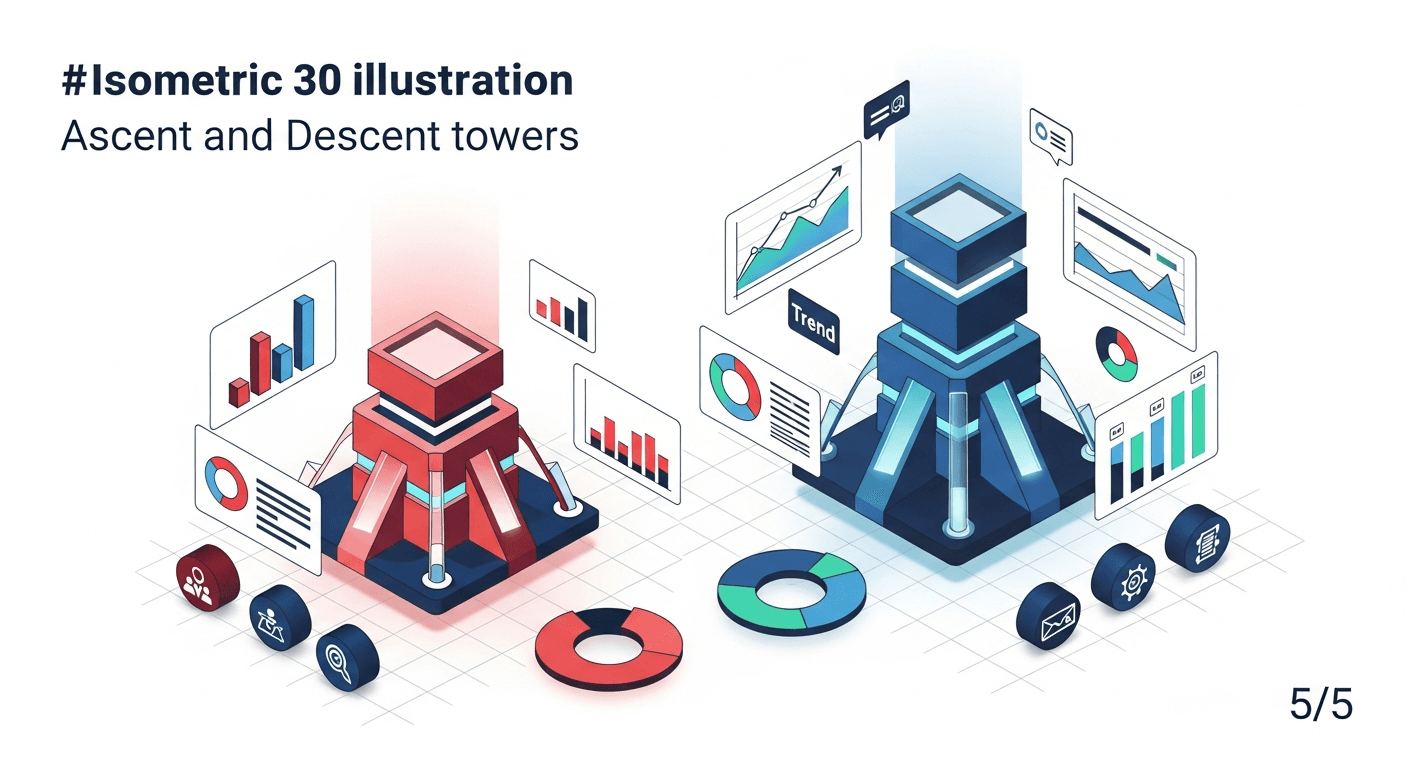
For the first time since ChatGPT's launch in November 2022, OpenAI is no longer the undisputed leader in generative AI. In May 2025, Anthropic's Claude surpassed ChatGPT in daily active users in the United States, according to Similarweb data. This reversal marks a strategic turning point for all companies that have built their digital strategy around a single tool.
The numbers speak for themselves: Claude recorded 267% audience growth over the past twelve months, while ChatGPT stagnated then declined by 8% in Q1 2025. For SME and mid-market executives, this reshuffling raises a central question: how do you adapt your strategy when the tool that seemed unshakeable begins to falter?
This article analyzes the causes of this shift, its concrete implications for B2B companies, and the strategic decisions to make now to transform this disruption into competitive advantage.
Why ChatGPT Lost Its Dominant Position
OpenAI's Aggressive Monetization Strategy
OpenAI multiplied paid offerings in 2024 and 2025: ChatGPT Plus at $20, ChatGPT Pro at $200, then enterprise packages exceeding $60 per user per month. This strategy generated $5.5 billion in revenue in 2024, but it also created a divide. Free users found themselves with a degraded product: longer wait times, less performant models, limited features.
Anthropic took the opposite approach. Claude offers generous free access with the Claude 3.5 Sonnet model, which rivals GPT-4o on most benchmarks. Result: professional users who were testing ChatGPT's free version before upgrading to paid have migrated to Claude, where the perceived value proposition is better.
The Reasoning Quality of Claude 3.5 and Claude 4
Independent benchmarks from March 2025 show that Claude 3.5 Opus outperforms GPT-4o on complex reasoning tasks, long-form writing, and document analysis. On the MMLU Pro benchmark, Claude reaches 89.4% versus 87.2% for GPT-4o. On coding tasks evaluated by HumanEval, the gap is 3 points in favor of Claude.
For B2B companies, this difference translates concretely: better structured reports, more precise financial analyses, more nuanced responses to complex questions. Legal, financial, and strategic teams have massively adopted Claude for these high-value use cases.
The Trust Crisis Around OpenAI
Internal controversies at OpenAI have weighed on brand image: co-founder departures, governance questions, concerns about model alignment with stated values. Anthropic, founded by former OpenAI executives precisely on the promise of safer AI, has capitalized on this positioning. For executive teams concerned about their CSR image, using Claude sends a different signal than ChatGPT.
Direct Consequences for B2B Companies
Your Visibility in AI Answer Engines Is Fragmenting
Until 2024, optimizing your content to be cited by ChatGPT was sufficient to cover most of the generative AI market. This is no longer the case. In May 2025, the distribution of professional queries in France stands at: Claude 34%, ChatGPT 31%, Perplexity 18%, Google AI Overview 12%, others 5%.
Concretely, if your prospects use Claude to search for a logistics provider, consulting firm, or software publisher, and Claude never cites you, you lose a third of your potential visibility in AI responses. AISOS audits reveal that 67% of French B2B companies appear in only one AI answer engine, or none at all.
Internal Tools Based on ChatGPT Must Be Reevaluated
Many SMEs and mid-market companies have deployed internal solutions using the OpenAI API: sales assistants, writing tools, customer service chatbots, contract analyzers. If these tools rely solely on GPT-4, two risks emerge.
The first is economic. OpenAI increased its API rates by 40% on average between January 2024 and January 2025. Claude offers equivalent performance with costs 25 to 30% lower depending on volumes.
The second is qualitative. For certain use cases like long document synthesis or legal analysis, Claude now produces better results. Staying with GPT out of habit may mean accepting inferior quality for a higher price.
Single-Vendor Dependence Becomes a Strategic Risk
The ChatGPT/Claude shift demonstrates that no player is immune to rapid reversal. A company that has bet everything on OpenAI now finds itself in a vulnerable position. AI vendor diversification is no longer a comfort option; it's a risk management necessity.
How to Adapt Your AI Visibility Strategy
Audit Your Presence Across All AI Answer Engines
The first step is to measure where you appear and where you're absent. Test strategic queries from your sector on ChatGPT, Claude, Perplexity, and Google AI Overview. For each query, note: do you appear in the response? In what position? With what wording?
Concrete example: an ERP software publisher should test the following queries across all four engines: "best ERP SME industrial France," "ERP SAP alternatives comparison," "cloud ERP manufacturing 2025." The result gaps between engines reveal opportunities and urgencies.
Produce Content Optimized for AI Citations
AI answer engines favor certain content formats. Here are the characteristics that maximize your chances of being cited:
- Direct and factual statements: "ISO 27001 certification ensures that..." rather than "One could consider that the standard..."
- Sourced numerical data: "The French cybersecurity market reaches 4.2 billion euros in 2024 according to the Xerfi study"
- Definition and comparison structures: "An ERP differs from a CRM through three main characteristics"
- Explicit named entities: cite product names, companies, standards rather than generic terms
Claude and ChatGPT don't have exactly the same citation biases. Claude values longer, structured content more, while ChatGPT favors recent and popular content. An effective GEO strategy must cover both profiles.
Strengthen Your Presence on Sources That AIs Consult
AI answer engines don't generate their knowledge from nothing. They rely on data corpuses that include: Wikipedia, government sites, recognized industry media, structured databases like Crunchbase or LinkedIn.
Concrete actions to undertake:
- Wikipedia page for your company: if you meet notability criteria, a well-written Wikipedia page significantly increases your AI citations
- Presence on professional directories: complete profiles on platforms like Societe.com, Infogreffe, or industry directories are indexed by AIs
- Publications in specialized media: an article in L'Usine Nouvelle or Le Journal du Net carries more weight than an unsourced blog post
- Structured data on your site: schema.org markup helps AIs understand who you are, what you do, where you operate
Recommendations for Your Internal Tools and Processes
Evaluate Claude as Alternative or Complement to ChatGPT
If you use the OpenAI API for internal tools, test the same use cases with the Anthropic API. The test protocol should include:
- Output quality: have your business teams evaluate results blindly
- Cost per query: calculate real cost including input and output tokens
- Latency: measure response time on your actual volumes
- Sensitive data handling: compare contractual commitments on confidentiality
For writing, document analysis, and synthesis use cases, Claude often presents a better quality-to-price ratio. For image generation or Microsoft ecosystem integration use cases, ChatGPT retains advantages.
Build a Multi-Model Architecture
The most resilient approach is to design your internal tools so they can switch from one vendor to another. Platforms like LangChain, LiteLLM, or orchestration solutions allow you to abstract the underlying model.
Advantages of this architecture:
- Price negotiation: you can put vendors in competition
- Service continuity: if one vendor experiences downtime, you switch to another
- Use case optimization: use the most performant model for each specific task
Train Your Teams on Both Environments
ChatGPT and Claude interfaces have significant differences. Optimal prompts are not identical. A team trained only on ChatGPT will take several weeks to reach the same productivity level on Claude.
At AISOS, we observe that companies training their teams on multiple AI tools now gain a lasting advantage. AI competency becomes a multi-platform skill, just as office productivity was with Microsoft and Google.
What This Shift Signals for 2025 and 2026
Market Concentration Will Intensify
The ChatGPT/Claude duel won't remain a duel for long. Google is pushing Gemini with the search integration advantage, Apple is preparing its entry with Apple Intelligence, and players like Mistral in Europe or Baidu in China are gaining ground in their respective markets.
For B2B companies, this means AI visibility strategy will need to cover five to seven major platforms by end of 2026, versus two or three today.
AI Responses Will Become the First Customer Contact Point
Behavioral studies show that 43% of B2B buyers under 40 start their supplier search with an AI assistant query rather than traditional Google search. This percentage reaches 61% among 25-35 year-olds.
Not appearing in AI responses increasingly amounts to not existing for a growing share of your prospects. This trend accelerates quarter by quarter.
Content Quality Becomes the Differentiating Factor
AI answer engines are designed to identify and cite the most reliable, comprehensive, and current content. Mediocre content produced en masse has no chance of being cited. Expert content that's sourced and regularly updated becomes the only kind that matters.
This evolution favors companies that invest in real editorial expertise rather than volume production. It's an opportunity for SMEs and mid-market companies versus large groups that have often prioritized quantity.
Take Action Now
The ChatGPT-to-Claude shift isn't an isolated event: it's the signal that the generative AI market is entering a phase of open competition. Companies that anticipate this fragmentation by diversifying their presence and tools will gain decisive advantage.
Three actions to launch this week:
- Audit your current visibility on ChatGPT, Claude, Perplexity, and Google AI Overview for your ten strategic queries
- Evaluate your internal tools: list all applications that depend on OpenAI and identify alternatives
- Plan a GEO content strategy: define the topics where you must be cited by AIs to capture your prospects
The window of opportunity is open. Your competitors who haven't yet understood this shift are giving you time to take position. But this window will close quickly. Contact AISOS for a complete audit of your AI visibility and a roadmap tailored to your sector.


