Claude Surpasses ChatGPT: 2028 Scenarios and New Opportunities for B2B Companies
For the first time, Anthropic's Claude overtakes ChatGPT. Analysis of 2028 scenarios and strategies to adapt your AI visibility before your competitors do.

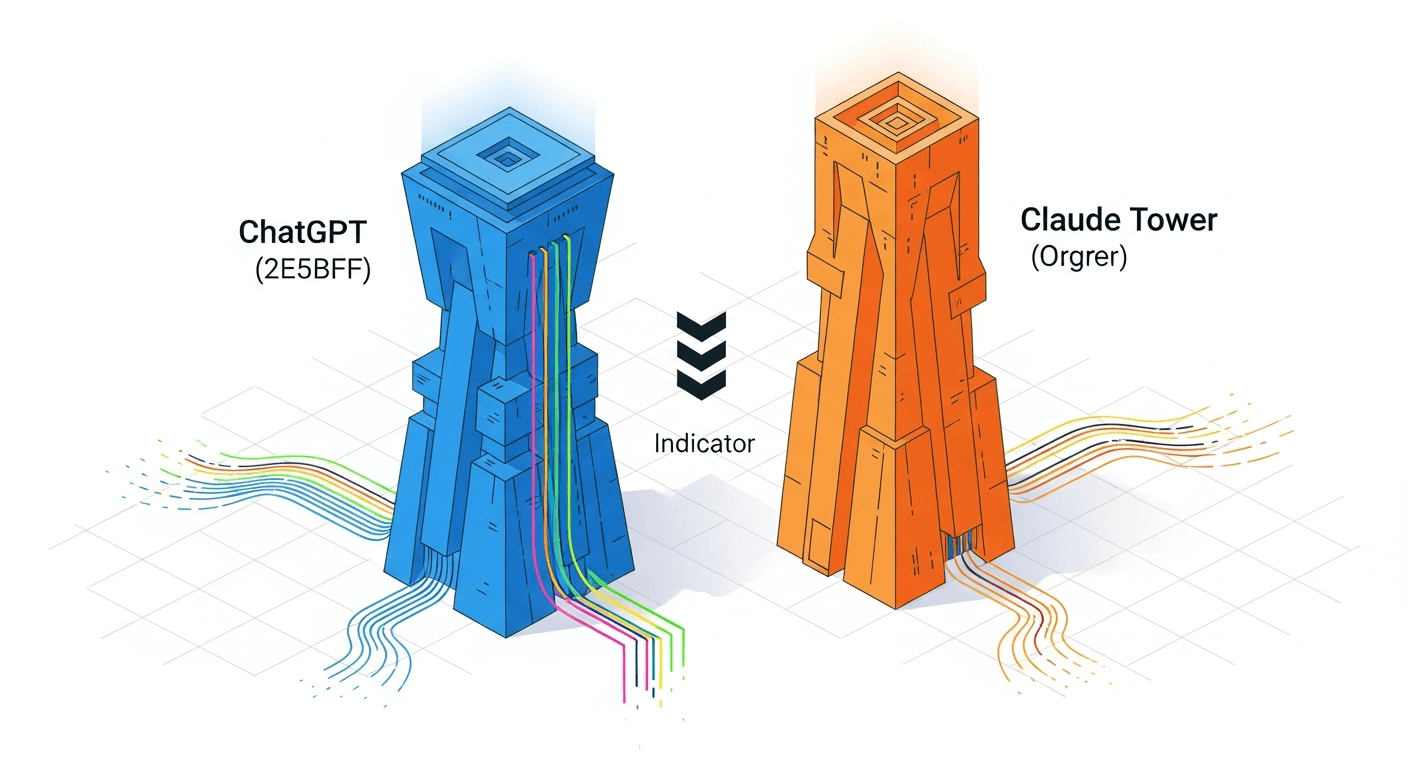
February 2025 marks a historic turning point in the generative AI industry. For the first time since ChatGPT's launch in November 2022, OpenAI has lost its dominant position. Claude, Anthropic's conversational assistant, has captured the top spot in the market. This shift, unthinkable just six months ago, completely reshapes the rules of the game for companies betting on their visibility in AI search engines.
For leaders of French and Belgian SMEs and mid-market companies, this change in leadership raises an urgent strategic question: how do you adapt your digital presence when the dominant search engine is no longer the same? Companies that optimized their content exclusively for ChatGPT are discovering today that their better-prepared competitors are capturing a growing share of recommendations generated by Claude.
This article breaks down the factors that enabled Anthropic to gain the advantage, analyzes the prospective scenarios for 2028 published by the company, and gives you concrete keys to transform this disruption into a competitive advantage.
Why Claude dethroned ChatGPT: the decisive factors
Claude's overtaking of ChatGPT doesn't result from a single event but from a convergence of strategic factors that Anthropic orchestrated with precision.
A security approach that reassures businesses
Anthropic built its differentiation on the concept of "Constitutional AI," an approach where the model integrates ethical principles from its conception. Concretely, Claude refuses legitimate requests less often while maintaining solid safeguards. For B2B companies, this reliability translates to more complete responses and fewer frustrations during professional use.
Legal and compliance teams at large enterprises have progressively favored Claude for its transparency on sources and more predictable handling of sensitive data. When a CFO queries the AI about tax regulations, they get sourced responses with clear warnings about the information's limitations.
The context window that changes everything
Claude 3 introduced a 200,000-token context window, enabling analysis of documents spanning several hundred pages in a single conversation. For consulting firms, design offices, and procurement services handling voluminous RFPs, this capability represents measurable productivity gains.
An operations director can now submit an entire 150-page supplier contract and obtain a structured analysis of critical clauses. This functionality has accelerated adoption in document-intensive sectors: manufacturing, construction, professional services.
The network effect of API integrations
Anthropic has multiplied strategic partnerships with B2B software publishers. Claude is now natively integrated into tools like Notion, Slack, and numerous sector-specific platforms. This omnipresence creates a familiarization effect: professionals use Claude without even knowing it, then consciously choose it for their direct queries.
Anthropic's 2028 scenarios: what the new leader predicts
In January 2025, Anthropic published a prospective document detailing four possible scenarios for AI evolution through 2028. This paper, which generated over 700 positive reactions in tech communities, deserves careful reading by any executive planning their digital strategy.
Scenario 1: AI as critical infrastructure
In this scenario, AI assistants become as indispensable as electricity or internet. Every commercial decision, every supplier search, every competitive analysis goes through an artificial intelligence layer. For B2B companies, this means absence of visibility in AI responses equals commercial invisibility.
Anthropic estimates this scenario's probability at 40% by 2028. Companies that haven't optimized their presence for generative engines will mechanically lose business opportunities to better-indexed competitors.
Scenario 2: usage fragmentation
This scenario predicts AI specialization by domain. Claude would dominate professional and analytical uses, ChatGPT would retain consumer and creative applications, Google's Gemini would establish itself in factual search. Estimated probability: 30%.
For SMEs and mid-market companies, this fragmentation complicates visibility strategy. It's no longer enough to optimize for a single engine: each AI favors different formats and sources. AISOS audits already reveal this trend: the same company can be strongly recommended by Perplexity and completely absent from Claude's responses.
Scenario 3: regulation as a brake
The European Union could impose constraints so strict that adoption slows significantly. Probability: 20%. This scenario would delay transformation but not cancel it. Companies having invested early in their AI visibility would maintain their advantage when the market restarts.
Scenario 4: brutal acceleration
A major technological breakthrough, like limited AGI, disrupts all equilibria. Probability: 10%, but maximum impact. In this case, early adopters of GEO strategies would be the only ones able to adapt quickly enough.
What Claude's leadership changes for your B2B visibility
Claude's move to market leadership concretely modifies visibility criteria for companies. Understanding these differences enables strategy adjustment before the gap with competitors widens.
Claude favors depth over popularity
Where ChatGPT tended to recommend the best-known players in a sector, Claude gives more weight to contextual relevance and technical content quality. An industrial mid-market company specializing in high-pressure valves can now appear ahead of a more famous generalist if its content demonstrates pointed expertise.
Concretely, pages detailing technical specifications, precise use cases, and documented methodologies gain visibility. Generic content optimized for keyword volume loses ground.
Institutional sources carry more weight
Claude grants increased trust to content published on domains with established authority: institutional sites, sector publications, official databases. For an SME, this means mentions in specialized media or recognized professional directories significantly amplify AI visibility.
An IT services company cited in a Syntec Numérique study will have better chances of being recommended than a competitor present only on their own website.
Semantic structure becomes critical
Claude excels at extracting structured information. Pages using schema.org tags, clear comparison tables, and well-hierarchized bullet lists are better understood and more often cited. Conversely, dense text blocks without structure lose readability for AI.
Practical guide: adapting your GEO strategy to the new balance
Facing the Claude-ChatGPT shift, B2B companies must adjust their AI visibility approach. Here are priority actions classified by impact and implementation ease.
Immediate actions (this week)
Test your current visibility on Claude. Ask Claude the questions your prospects would ask: "What are the best [your service] providers in [your region]?" Note if you appear, in what position, and how you're described. Do the same test on ChatGPT and Perplexity to compare.
Identify your expert content gaps. Claude favors technical depth. List complex questions in your sector that your site doesn't yet answer. Prioritize those corresponding to purchase intentions.
Short-term actions (this month)
Restructure your key pages. Add explicit subheadings, bullet lists for features, tables for comparisons. Each section must be extractable and citable autonomously by an AI.
Enrich your presence on third-party sources. Update your profiles on sector directories, contribute to professional publications, solicit customer testimonials on recognized platforms. These external signals strengthen your credibility in Claude's eyes.
Create content answering emerging questions. Queries related to AI in business are exploding. An article explaining how your sector uses generative AI positions your company on high-growth queries.
Medium-term actions (this quarter)
Develop a multi-AI strategy. Don't bet everything on Claude. Perplexity gains ground on factual queries, Google AI Overview dominates informational searches. Your content must perform across the entire ecosystem.
Measure and iterate. Implement monthly tracking of your visibility on major generative engines. At AISOS, we observe that companies regularly measuring their AI presence adjust their strategy twice as fast as those navigating blind.
Mistakes to avoid in the transition
The rush to adapt to the new AI landscape leads some companies to costly strategic errors. Here are the most frequent traps.
Abandoning classic SEO optimization
AI visibility doesn't replace natural search optimization, it adds to it. Google still processes 8.5 billion daily queries. SEO fundamentals (technical performance, internal linking, quality content) remain indispensable and actually contribute to AI visibility.
Producing content for AIs rather than humans
Generative engines are trained on content written for human readers. Text artificially optimized for AIs, stuffed with keywords or forced structures, will rank lower than naturally expert and useful content.
Ignoring the conversational dimension
Users query AIs as they would speak to an expert: with complete questions, context, reformulations. Your content must anticipate these natural formulations, not just isolated keywords.
Underestimating the speed of change
ChatGPT's overtaking by Claude occurred in less than two years. The next shift could be even faster. Companies waiting to have "all the data" before acting will systematically lag behind.
2025-2028 perspectives: preparing your company for the next disruptions
Claude's leadership is probably not definitive. Google invests massively in Gemini, Meta develops open-source Llama, and new players like Mistral (French) are gaining momentum. The market will remain volatile for several years.
What will stabilize
The importance of AI visibility for B2B business will only grow. Whatever the dominant AI, companies present in generative responses will capture a growing share of commercial opportunities. Investing in a robust and adaptable GEO strategy constitutes a durable asset.
What will evolve
AI recommendation criteria will become more sophisticated. Simple presence will no longer suffice: perceived quality, information freshness, consistency between sources, and the company's overall reputation will weigh increasingly heavily.
What remains uncertain
European regulation impact, possible emergence of specialized sector AIs, and user behavior evolution remain major variables. Agile companies capable of pivoting quickly will maintain the advantage.
Take action now
The Claude-ChatGPT shift isn't a technological curiosity: it's a strategic signal for any B2B company dependent on digital visibility. Leaders who understand this change and adapt their strategy now are building a competitive advantage that's difficult to catch up with.
Start by auditing your current presence on major generative engines. Identify gaps between your actual positioning and that of your competitors. Then build a structured action plan combining content optimization, external signal strengthening, and regular performance monitoring.
The opportunity window is open. Companies acting in the next six months will gain a head start on those waiting to see how the market evolves. In the generative AI economy, wait-and-see is the riskiest strategy.


