AI visibility for B2B companies: the 6-month action plan
A concrete action plan to make your B2B company visible in generative AI responses. From initial audit to ongoing monitoring, each step detailed with examples.

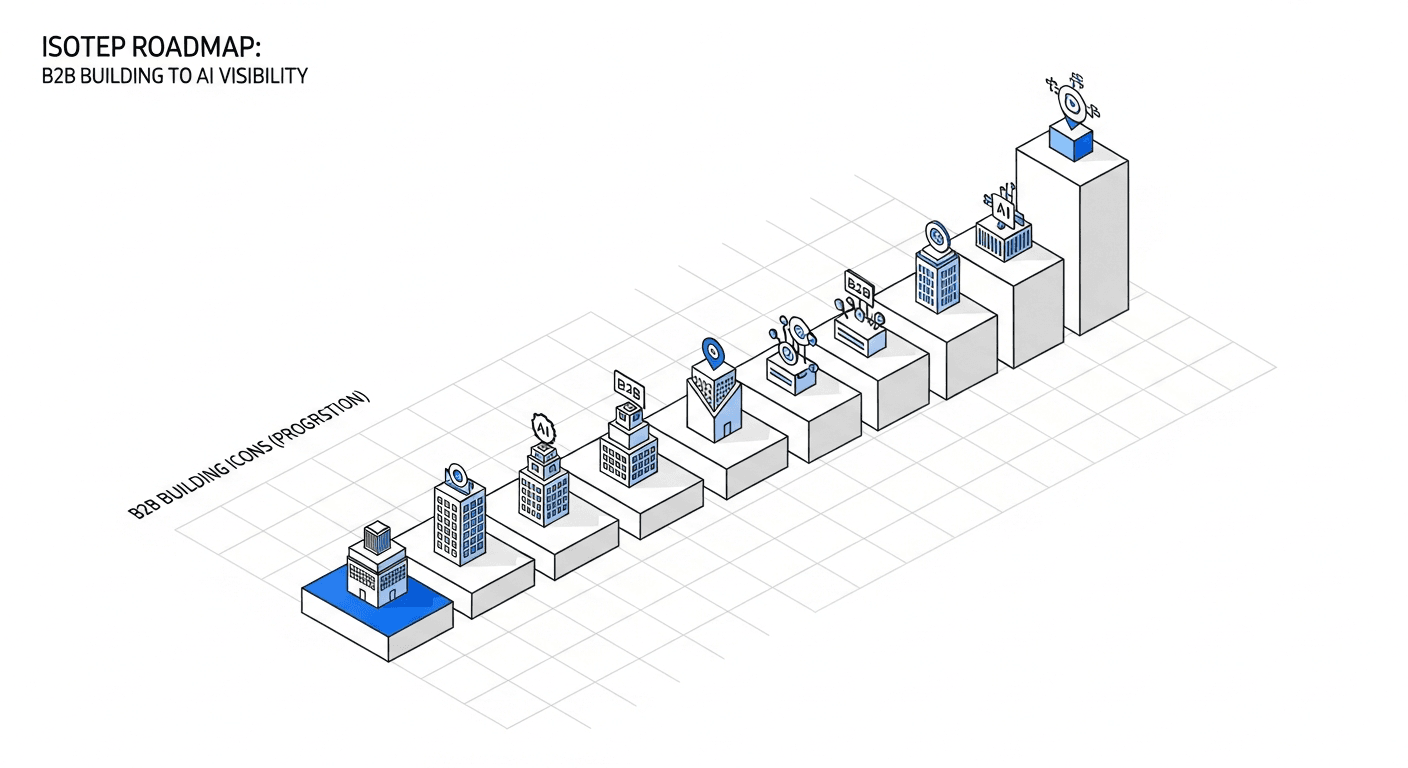
When a prospect asks ChatGPT to recommend a provider in your sector, does your name come up?
For 80% of B2B companies in Belgium, the answer is no. We know because we test. Every week, we run dozens of prompts on ChatGPT, Perplexity, and Gemini for our clients and prospects. The finding is almost always the same: absent, or mentioned in passing, without conviction.
What follows is the exact plan we apply with our B2B clients. No theory. Steps in order, with examples from real projects. Six months to go from "invisible" to "recommended."
Month 1: the AI visibility audit
Before fixing anything, you need to know where you stand. The audit covers three axes.
Axis 1: the prompt test. We identify 20 prompts your prospects might ask an AI. Questions like "best [your service] in Belgium," "how to choose a [your profession]," "alternative to [your competitor]." We test them on ChatGPT, Perplexity, and Gemini. We note: do you appear? In what position? In what context? One of our clients, an IT recruitment firm in Brussels, appeared in 0 out of 20 responses. Their main competitor: 11 out of 20.
Axis 2: the technical analysis. Is your site readable by AI crawlers? Do you have an llms.txt file? Is your structured data complete? Does your robots.txt block AI bots? We also check the consistency of your information between your website, Google Business, LinkedIn, and professional directories.
Axis 3: the digital footprint. We map all mentions of your brand outside your site. Press articles, LinkedIn posts, Reddit discussions, industry directories, client reviews. This is the footprint that LLMs use to decide if you're a reliable source.
Month 2: laying the technical foundations
Technical fixes first. They're quick and have a measurable impact within weeks.
Create the llms.txt file at the root of your site. It's the "user manual" you give LLMs to understand your company. Who you are, what you do, for whom, where. Structured format, no marketing. Facts.
Enrich your structured data. Complete Organization schema with logo, address, founders, industry. Service schema for each offering. FAQPage schema on relevant pages. Author schema on blog posts with links to the writers' LinkedIn profiles.
Check your robots.txt. Some sites block GPTBot, PerplexityBot, or ClaudeBot without knowing it. If you want to be visible in AI responses, these bots need access to your content.
Month 3: create citable content
This is where content strategy diverges from classic SEO. The content that LLMs cite has specific characteristics:
It answers questions directly. Not after a 3-paragraph introduction. The answer comes first, the context follows.
It contains original data. Case studies with real numbers, proprietary research, industry benchmarks. LLMs prioritize content that provides information unavailable elsewhere.
It's signed by a credible author. Not "Admin" or "Marketing Team." A real person with a LinkedIn profile, expertise, and a verifiable track record. E-E-A-T isn't just a Google concept anymore — LLMs evaluate author credibility too.
We typically produce 4-6 targeted articles per month for our clients during this phase. Each one designed to answer a specific prompt that their prospects ask ChatGPT.
Month 4: build your off-site presence
Your website alone isn't enough. LLMs need to see your brand mentioned by others to trust you.
Digital PR. Get mentioned in industry publications, trade media, and specialized blogs. Not through paid advertorials — through genuine editorial coverage. A mention in a respected industry publication carries enormous weight for LLMs.
Review platforms. Complete and optimize your profiles on G2, Capterra, Clutch, or whatever platforms are relevant to your industry. At least 20-30 verified reviews on one major platform.
Community participation. Reddit, Quora, industry forums, LinkedIn groups. Contribute expertise, not marketing. Every authentic contribution adds to your digital footprint.
Months 5-6: monitor and iterate
By month 5, you should start seeing results. Perplexity picks things up fastest (7-14 days for new content). ChatGPT with browsing follows within weeks. The base model of ChatGPT takes longer — sometimes months — because it depends on training data updates.
Set up monitoring. Test your 20 target prompts every two weeks on all three major LLMs. Track changes. Note which content gets cited and which doesn't. Double down on what works.
The typical trajectory we observe: month 1-2, zero or minimal mentions. Month 3-4, first citations on Perplexity and Bing Chat. Month 5-6, beginning of citations on ChatGPT and Gemini base models.
One client, a management consulting firm in Brussels, went from 0 to 14 out of 20 target prompts in 6 months. Their lead pipeline increased by 23%, with prospects explicitly mentioning they'd been recommended by AI.
The plan works. But it requires consistency and patience. There are no shortcuts in AI visibility — just methodical work that compounds over time.
Co-founder and COO of AISOS. GEO Expert, he builds the AI visibility system that turns businesses from invisible to recommended.


