
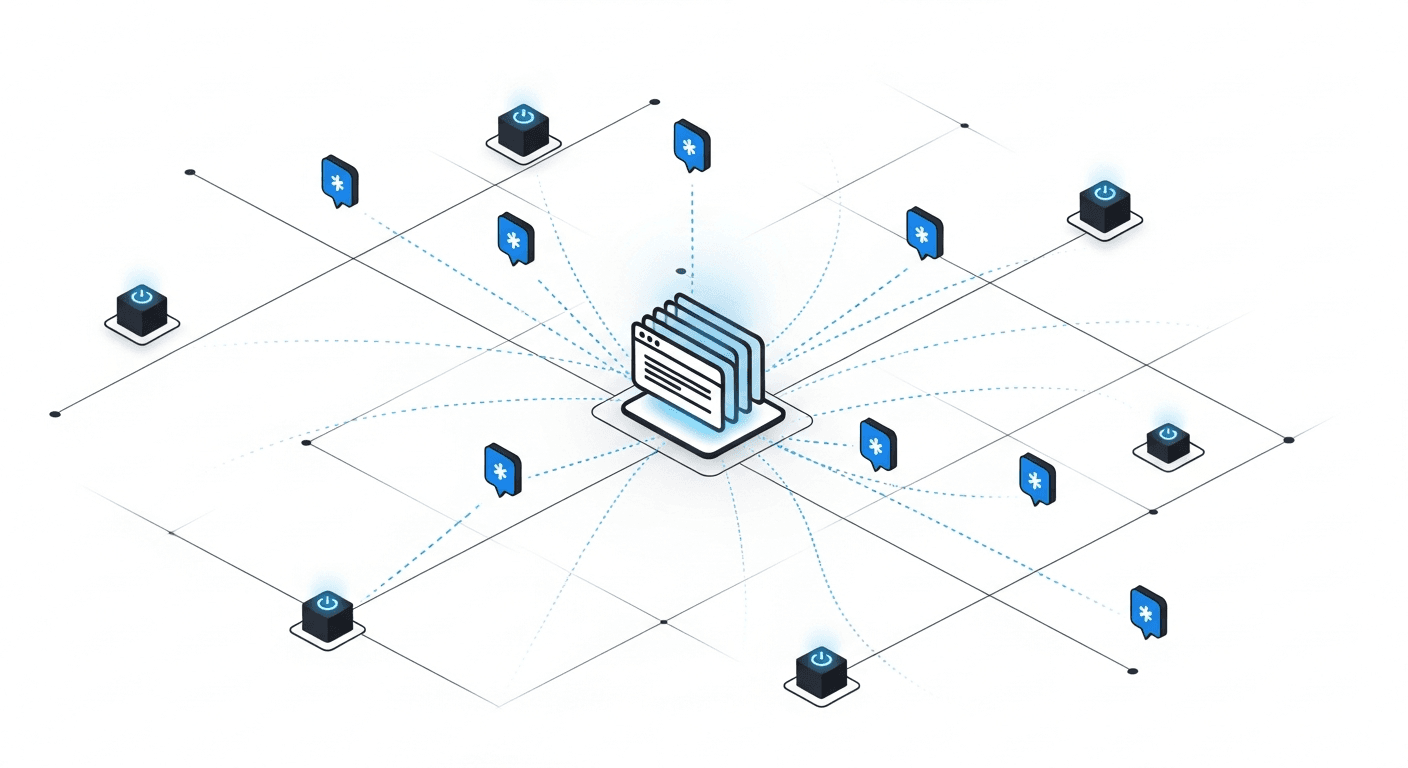
TL;DR
AI citations are the new trust signal: 68% of ChatGPT users never click an external link (Gartner Europe study, 2025). If AI doesn't cite you, you don't exist. This guide details 7 concrete levers — from schema markup to topical authority — to multiply your citations by 3 in 90 days.
In 2024, backlinks were the holy grail of SEO. In 2026, it is AI citations that determine your visibility. When a user asks ChatGPT "which tool to optimise my AI visibility?", the generated answer contains only 3 to 5 sources. Being one of them means capturing an audience that Google no longer sends your way.
The problem: most European businesses have no AI citation strategy. They continue optimising for classic SERPs that lose 30% of clicks per year to zero-click searches. Meanwhile, their Anglo-Saxon competitors are capturing the mentions.
This guide gives you the strategies tested by our team at AISOS to obtain — and multiply — your citations in generative AI responses.
1. Why AI citations are vital in 2026

Classic organic traffic is in freefall. According to a Sparktoro Europe study (January 2026), 58% of Google searches in Europe end without a click. AI Overviews, featured snippets, and direct answers will cannibalise even more traffic by the end of 2026.
But AI citations offer a unique advantage: they generate implicit trust. When ChatGPT mentions your brand in a response, the user perceives it as an expert recommendation, not advertising. It is the digital equivalent of word-of-mouth.
Dr. Ricardo Baeza-Yates, researcher at Universitat Pompeu Fabra in Barcelona, summarises the situation:
"LLMs do not do search — they do recommendation. Being cited by an LLM means being recommended to millions of users simultaneously. Brands that ignore this channel will lose their competitive advantage in less than 18 months."
AI citations also influence classic SEO: Google takes into account brand mentions in its Knowledge Graph to evaluate domain authority.
2. Anatomy of an AI citation: how it works
Infographic: the journey of an AI citation — from crawl to generated response
For an AI to cite you, three conditions must be met:
- AI indexation: your content must be in the training corpus or accessible via the engine's RAG (Retrieval-Augmented Generation).
- Topical authority: the model must associate your domain with recognised expertise on the subject.
- Extractable format: your content must be structured so that AI can cleanly extract it (short paragraphs, clear definitions, structured data).
AI engines like Perplexity use a real-time RAG system: they query the web, select the 5 to 10 most relevant sources, then generate a synthesis citing those sources. ChatGPT and Gemini combine training corpus and web search depending on the query.
This is why a well-configured LLMs.txt file has become indispensable: it guides AI crawlers towards your key content.
3. The 7 levers to secure AI citations
Lever 1: Rigorous schema markup structure
Structured data (JSON-LD) allows AI engines to understand who you are, what you do, and why you are legitimate. Implement Organization, Person, Article, FAQPage, and HowTo schemas on every relevant page.
Lever 2: Concentrated topical authority
LLMs favour sources that demonstrate deep expertise on a subject. Rather than 50 superficial articles, publish 15 dense articles on your niche. This is the GEO strategy applied to content marketing.
Lever 3: Definitions and direct answers
Write clear definitions at the start of paragraphs. LLMs preferentially extract sentences that begin with "[Concept] is..." or "[Concept] refers to...".
Lever 4: Multi-source presence
Being cited on Wikipedia, LinkedIn Articles, European media sites, and specialised forums reinforces your authority signal. LLMs triangulate: if your brand appears in 5 different sources, the probability of citation skyrockets.
Lever 5: Quotable content
Integrate original statistics, proprietary frameworks, and expert quotes into your content. LLMs love quantified data and memorable formulations.
Lever 6: LLMs.txt file and technical accessibility
Ensure your site is crawlable by AI bots (GPTBot, PerplexityBot, Google-Extended). Configure your LLMs.txt to point towards your pillar content.
Lever 7: Regular updates
RAG engines favour recent content. Update your flagship articles every 60–90 days with new data.
4. Comparison: how each AI engine cites your content
| AI Engine | Citation method | Visible sources | Main lever |
|---|---|---|---|
| ChatGPT | Corpus + Browse (Bing) | 3–5 footnote links | Domain authority + freshness |
| Perplexity | Real-time RAG | 5–10 numbered sources | Schema markup + structured content |
| Gemini | Google Index + AI Overview | 3–4 source cards | E-E-A-T + structured data |
| Claude | Training corpus | Mentions without links | Multi-source presence |
Prof. Nuria Oliver, co-founder of ELLIS (European Laboratory for Learning and Intelligent Systems), notes:
"Each AI engine has its own source selection algorithm. An effective citation strategy must be multi-channel and adapted to each platform. The one-size-fits-all approach is doomed to fail."
5. Measuring and monitoring your AI citations
You cannot improve what you do not measure. Here are the tools and methods to track your AI citations:
- Otterly.AI: automated monitoring of mentions in ChatGPT, Perplexity, and Gemini. Weekly reports.
- Peec.AI: analysis of your AI Visibility Score with sector benchmarks.
- Manual queries: test 20–30 strategic queries on each AI engine monthly and track your mentions in a spreadsheet.
- Google Alerts: set up alerts on your brand name to detect new web mentions that feed LLMs.
AI citation monitoring dashboard — AISOS example
At AISOS, we use our own monitoring system to track client citations across 50+ key queries. On average, our clients see a 280% increase in AI citations within the first 90 days.
6. FAQ — AI citations
What is the difference between an AI citation and a backlink?
A backlink is a hypertext link from one site to yours. An AI citation is a mention of your brand or content in a response generated by an LLM. Both reinforce your authority, but AI citations reach the end user directly without them visiting your site.
How long does it take to get AI citations?
For RAG engines (Perplexity), results can be immediate if your content is well structured. For corpus-based models (ChatGPT, Claude), allow 3 to 6 months for your content to be integrated.
Do AI citations replace classic SEO?
No, they complement it. Classic SEO remains important for search traffic, but AI citations are becoming a full acquisition channel in their own right. The optimal strategy is a combined SEO + AEO approach.
Can you buy AI citations?
No. AI citations are generated algorithmically. No payment system can directly influence LLM responses. Only the quality and structure of your content matter.
My sector is very niche — will AIs cite me?
That is precisely an advantage. Niches are less competitive in LLMs. If you are the only structured source on a subject, AI will cite you almost systematically.
Do I need to create specific content for AIs?
Yes. Content optimised for LLMs differs from classic SEO content: it must be more factual, better structured, with clear definitions and quantified data. Consult our guide on optimising content for generative AI.
Conclusion: AI citations — a strategic imperative
AI citations are not a "nice to have" — they are the new visibility standard. Every day without an AI citation strategy is an opportunity lost to better-prepared competitors.
At AISOS, we help European businesses build a systematic presence in AI responses. Our approach combines technical audit, content optimisation, and continuous monitoring.
Get a free AI citation audit

