
TL;DR
Zero-click search is a phenomenon where users get their answer directly in search results without clicking any link. In 2026, this affects 58% of Google searches in Europe (Sparktoro Europe). This guide analyses the concrete impact on your business and details 5 strategies to transform this threat into an opportunity.
Imagine investing 50,000 EUR per year in your SEO strategy... only for Google to display the answer to the user's question directly, without ever sending them to your site. This is not a futuristic disaster scenario — it is the reality of 2026.
Zero-click search is the silent threat eroding the ROI of traditional SEO. And with the massive deployment of Google AI Overviews, the phenomenon is accelerating. Companies that do not adapt their strategy now risk seeing their organic traffic melt by 40 to 60% by 2027.
This guide analyses the data, measures the real impact and gives you strategies to not just survive, but thrive in the zero-click era.
1. Zero-click search: definition and mechanisms

A "zero-click" search occurs when Google (or another engine) directly answers the user's query on the results page, making a click to a website unnecessary. The mechanisms include:
- Featured snippets: highlighted extracts that directly answer the question.
- AI Overviews: AI-generated syntheses at the top of Google SERPs.
- Knowledge Panels: information cards about entities (people, businesses, places).
- People Also Ask: related questions with integrated answers.
- Calculators and conversions: tools integrated directly into results.
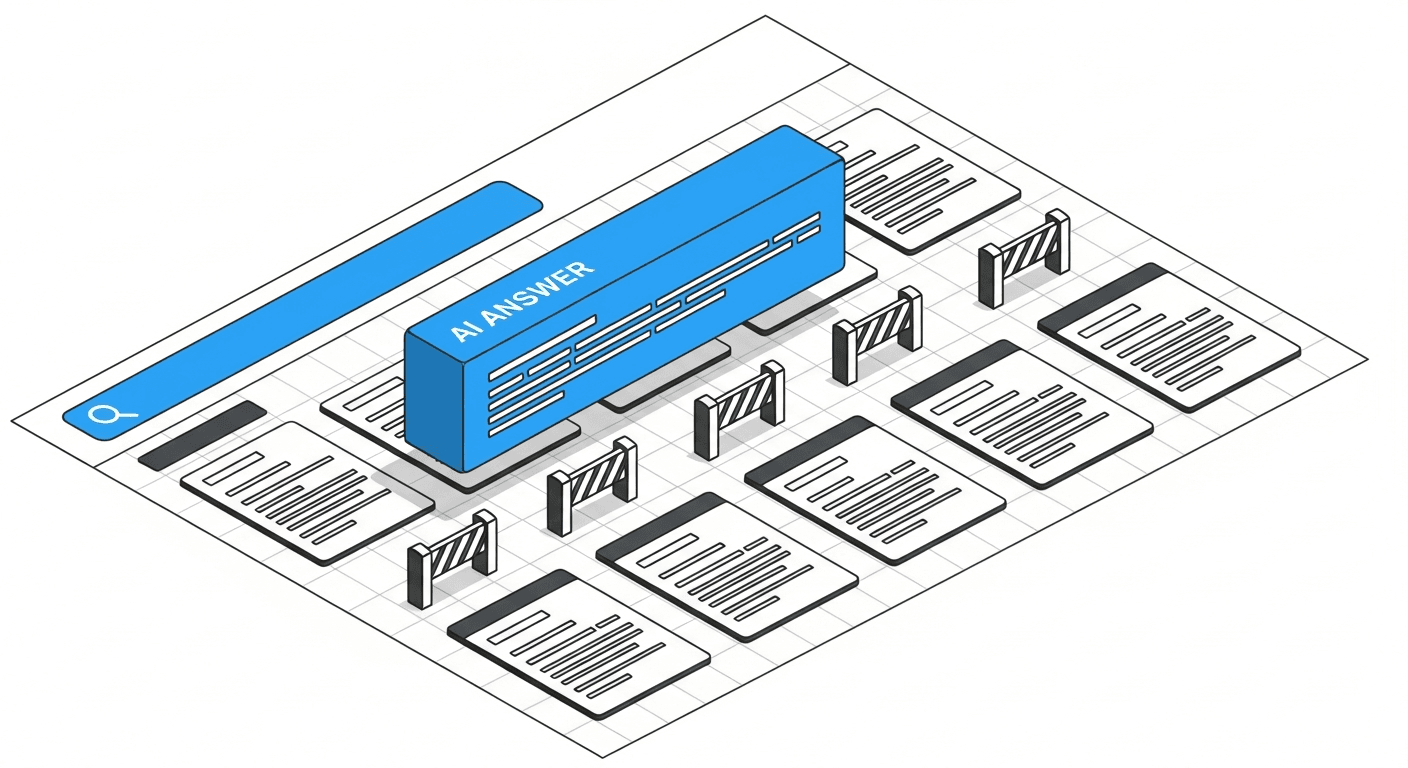
Example of a zero-click SERP: AI Overview + Featured Snippet + Knowledge Panel
Google's logic is clear: keep the user within its ecosystem as long as possible. Fewer clicks to third-party sites = more advertising impressions = more revenue. Your organic traffic is the adjustment variable.
2. The alarming figures in Europe
The European data is unequivocal:
- 58.5% of Google searches in Europe generate no organic click (Sparktoro Europe, January 2026).
- +12 percentage points increase in zero-click since the deployment of AI Overviews in Europe (October 2025).
- 73% of informational queries are now zero-click.
- -25% average CTR on position 1 results compared to 2023 (Sistrix study, March 2026).
Prof. Joost de Valk, founder of Yoast (Netherlands) and a historic European SEO figure, warns:
"SEO as we have known it for 20 years is dying. Google no longer sends you traffic — it consumes your content to fuel its own responses. Businesses need to pivot towards a multi-channel visibility strategy that includes AI citations as the primary acquisition channel."
3. Concrete impact on your business
Zero-click does not hit all businesses in the same way. Here is the impact by query type:
Informational queries (CRITICAL impact)
73% zero-click. Your blog articles, guides and FAQs are the most affected. The strategy: transform this content into AI citation machines rather than counting on the click.
Navigational queries (MODERATE impact)
Users searching for your brand still click. But beware: AI Overviews are starting to appear even on brand queries, presenting alternatives.
Transactional queries (LOW but growing impact)
Purchase searches still generate clicks, but Google Shopping and Product Snippets are encroaching. Monitor your CTRs monthly.
Chart: evolution of organic CTR by query type (2023-2026)
4. 5 strategies to adapt
Strategy 1: pivot to AEO
Answer Engine Optimization is the strategic response to zero-click. If Google displays your content directly, ensure your brand is visible and the user identifies you as the source.
Strategy 2: target high-click-potential queries
Identify queries that still generate clicks: complex queries, commercial queries, purchase-intent queries. Focus your SEO efforts on those.
Strategy 3: dominate AI Overviews
If Google is going to display an AI Overview, make sure it is your content feeding it. Optimise to be the cited source in AI Overviews.
Strategy 4: build a memorable brand
Zero-click reinforces the importance of brand. If the user sees your name in a snippet, they must remember you and return directly later. Invest in branding.
Strategy 5: diversify your acquisition channels
Stop betting everything on Google. AI mentions in ChatGPT and Perplexity are complementary acquisition channels that do not suffer from zero-click in the same way.
5. Comparison: impact by sector
| Sector | Zero-click rate | Organic traffic impact | AEO urgency |
|---|---|---|---|
| Health / Medical | 71% | -35% in 12 months | Critical |
| Finance / Insurance | 65% | -28% in 12 months | Critical |
| B2B SaaS | 52% | -20% in 12 months | High |
| E-commerce | 44% | -15% in 12 months | High |
| Real estate | 48% | -22% in 12 months | High |
| Legal | 62% | -30% in 12 months | Critical |
Dr. Marie-Claire Forgue, Research Director at INRIA (France), comments:
"Sectors with a high informational component — health, finance, legal — are the first affected by zero-click. But all sectors will follow. It is a matter of time, not probability."
6. FAQ — Zero-click search
Does zero-click mean the death of SEO?
No, but it means the death of "old generation" SEO focused solely on ranking. Modern SEO must integrate AEO, branding and AI visibility to remain profitable.
How do I know if my site is affected by zero-click?
Compare your Google Search Console impressions with your clicks. If the impressions/clicks ratio deteriorates month after month, zero-click is impacting you. A healthy ratio is above 3% average CTR.
Will AI Overviews make the situation worse?
Yes. Data shows that the deployment of AI Overviews in Europe increased zero-click by 12 percentage points on average. And Google continues to extend this feature to new query categories.
Should you stop creating informational content?
Absolutely not. Informational content feeds your AI citations and strengthens your topical authority. But the objective changes: instead of generating clicks, it must generate mentions and brand recognition.
Can you block Google to prevent zero-click?
Technically, you can block AI bots. But this is counterproductive: you would also lose visibility in AI Overviews and AI citations. The winning strategy is optimisation, not blocking.
What budget should be set aside to adapt to zero-click?
Not necessarily more budget, but a reallocation. Reduce investment in generic content creation and redirect towards AEO optimisation, schema markup and AI monitoring.
Does zero-click affect Bing and other engines too?
Yes. Bing with Copilot and other engines follow the same trend. Zero-click is a systemic phenomenon, not limited to Google.
Conclusion: adapt or disappear
Zero-click is not a temporary problem — it is the new norm. Companies that continue to measure their success solely in organic clicks are heading for trouble.
At AISOS, we help European businesses pivot towards a visibility strategy that integrates classic SEO, AEO and AI citations. Contact us for a complete audit of your zero-click exposure.
Request a free zero-click audit

