
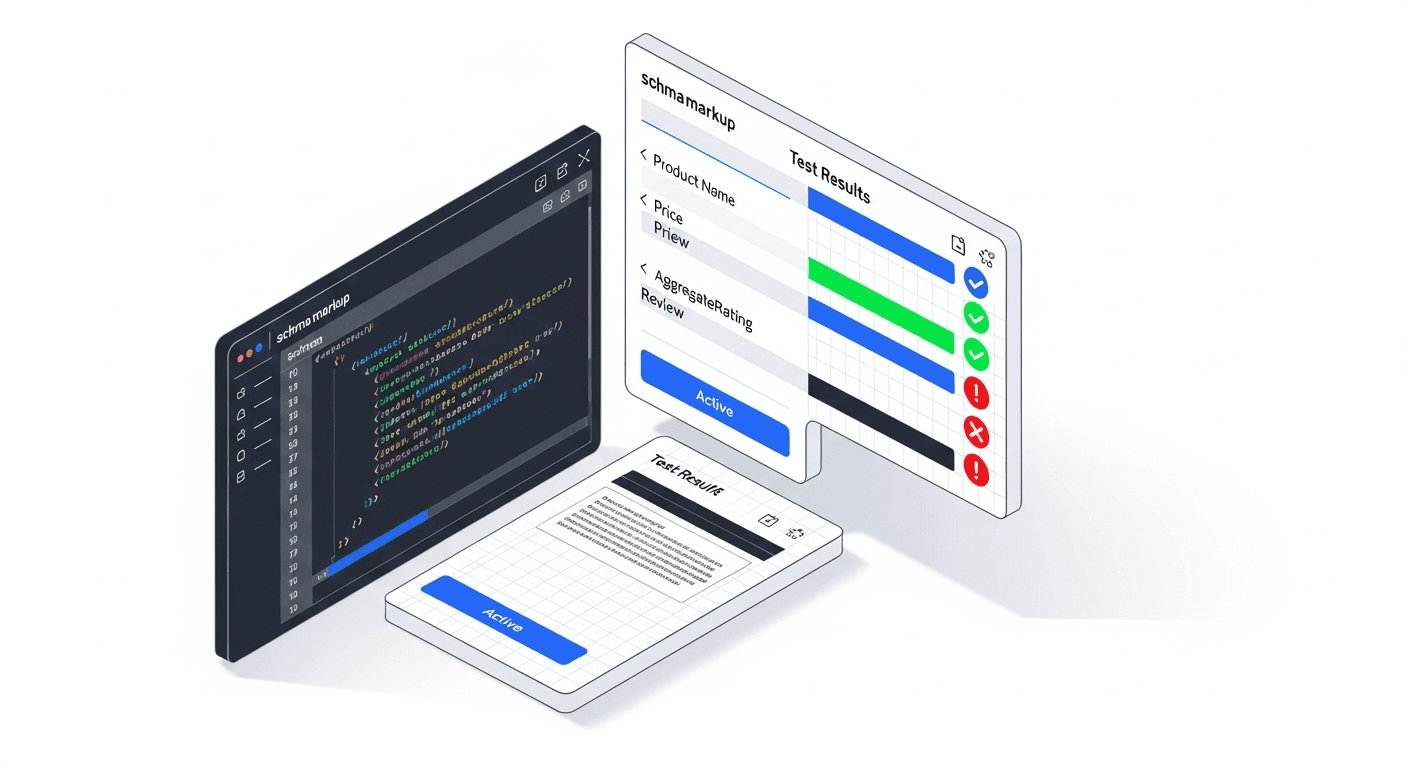
Implementing structured data without testing it is like sending a CV without proofreading it. You think you have done the work, but a typo in the JSON-LD can invalidate the entire thing. And unlike a CV, schema markup errors are not visible to the naked eye — dedicated tools are needed to detect them.
In 2026, the stakes are amplified. Structured data no longer serves only to obtain rich snippets in Google. It is consumed directly by LLMs as a reliability signal and a source of structured data. A well-implemented FAQPage schema has a better chance of being cited in an AI response than an unstructured Q&A text.
Why testing is as important as implementing
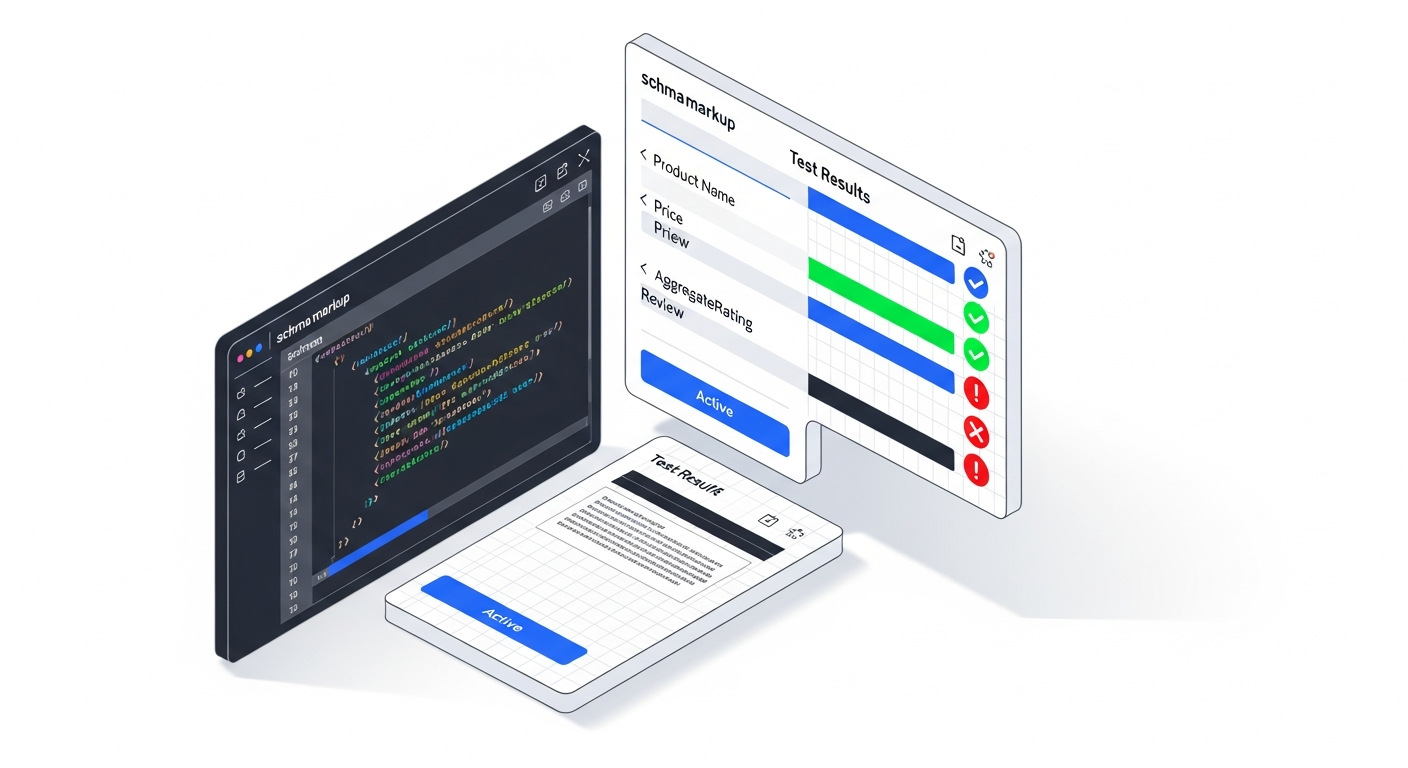
Structured data follows a rigorous schema defined by Schema.org. Each type (Article, FAQPage, Product, Organization) has mandatory and optional properties, specific value formats, and nesting rules. A single error can invalidate the entire schema.
The consequences of invalid schema: Google ignores the data (no rich snippets), Search Console displays warnings or errors in the "Enhancements" report, and LLMs cannot parse the structured information on your page.
According to Dan Brickley, co-founder of Schema.org, based in London: "Schema markup is a contract between your site and the machines that read it. If you do not respect the terms of the contract — missing properties, incorrect types, invalid values — the machines cannot trust your data."
The 5 essential testing tools
| Tool | What it tests | When to use it | Price |
|---|---|---|---|
| Schema Markup Validator (schema.org) | Syntactic validity of the schema | At each implementation | Free |
| Google Rich Results Test | Eligibility for Google rich snippets | After syntactic validation | Free |
| Google Search Console (Enhancements report) | Production errors across the entire site | Continuous monitoring | Free |
| Screaming Frog (schema extraction) | Crawl of all pages with schema extraction | Periodic audits | 199 EUR/year |
| Schema App (or equivalent) | Generation + validation + advanced monitoring | Large sites with complex schemas | From 50 EUR/month |
4-step validation methodology
Step 1: syntactic validation
Paste your JSON-LD into the Schema Markup Validator. It checks that the JSON syntax is correct, that the types exist in Schema.org, and that the properties are valid for the type used. Fix all errors before moving to the next step.
Step 2: Rich Results test
Use the Google Rich Results Test with the URL of your page (not just the code — the full URL, so that the tool tests the real render). Check that your schema is eligible for rich snippets and that no mandatory property is missing.
Step 3: production verification
After deployment, check in Google Search Console that the "Enhancements" report does not flag new errors. Allow 48-72 hours for Google to crawl and process the changes.
Step 4: impact tracking
Measure the appearance of rich snippets in SERPs for your pages (use Search Console performance reports with the "Appearance in results" filter). Compare CTR before and after schema implementation.
Frequent errors by schema type
Article / BlogPosting
datePublishedabsent or in the wrong format (use ISO 8601: YYYY-MM-DD)authorwithout@type: PersonorOrganizationimagemandatory since 2023 — no rich snippet without an image
FAQPage
- Questions and answers not visible on the page (violation of Google guidelines)
- More than 2 FAQs per page (Google may ignore the additional ones)
- Answers too short (less than 50 characters) or too long (more than 350 words)
Product
offerswithoutpriceorpriceCurrencyaggregateRatingwith values outside the declared scaleavailabilitywith a non-standard value (use official schema.org values)
Organization / LocalBusiness
logoin the wrong format or too small (minimum 112x112px)addressincomplete (often missingaddressCountry)sameAspointing to inactive or deleted social profiles
For a complete implementation guide for these schemas, see our detailed article on schema markup.
Testing the impact on AI visibility
Beyond technical validation, test whether your structured data is actually being used by LLMs. The method: ask ChatGPT, Perplexity and Gemini questions that your FAQ schema should answer. Observe whether the LLM responses reproduce your structured formulations.
Well-implemented structured data has an advantage: it is more easily extractable by RAG systems. An LLM parsing your page can instantly identify a FAQ structured in JSON-LD and extract the relevant Q&As, rather than trying to guess them from prose text.
As Jono Alderson, Head of Technical SEO at Yoast (Netherlands), points out: "Structured data is the language that machines understand best. In 2026, with the proliferation of AI interfaces, schema markup has become the most effective way to communicate verifiable facts to automated systems."
Setting up continuous monitoring
Structured data is not a "set and forget" matter. It can break during CMS updates, template modifications, or content changes. Set up:
- A weekly check of the "Enhancements" report in Search Console
- A monthly crawl with Screaming Frog, filtered on JSON-LD extraction
- Automated alerts via tools like ContentKing or Lumar that detect schema changes in real time
- A systematic post-deployment test: each production release triggers a Rich Results test on modified pages
For a comprehensive approach to technical monitoring, see our technical SEO audit guide and our article on FAQ structured data.
FAQ
Do the Rich Results Test and the Schema Markup Validator give the same results?
No, they test different things. The Schema Markup Validator checks syntactic validity according to Schema.org. The Rich Results Test checks eligibility for rich snippets according to Google's specific criteria (which are more restrictive than Schema.org). Use both: first the Validator for syntax, then the Rich Results Test for Google eligibility.
Are warnings in the Rich Results Test serious?
Errors (red) prevent rich snippets from being displayed and must be fixed. Warnings (yellow) do not prevent display but indicate missing recommended properties. Fix errors first, then address warnings to maximise the quality of the rich snippet displayed.
How many schema types can there be on the same page?
There is no technical limit. An article page can have BlogPosting, FAQPage, BreadcrumbList and Organization. However, Google recommends not overloading: each schema must reflect content actually present on the page. An FAQPage schema without a visible FAQ is a violation of the guidelines.
JSON-LD, Microdata or RDFa: which format to choose?
JSON-LD is recommended by Google and is the most widely used format in 2026. It is easier to implement (no need to modify the HTML), easier to test, and easier to maintain. Microdata and RDFa still work but are progressively being abandoned in favour of JSON-LD.
Does structured data directly improve rankings?
Google has always stated that structured data is not a direct ranking factor. However, the rich snippets they generate increase CTR, and a high CTR is correlated with better rankings. The indirect impact is therefore real and measurable, typically between +15% and +30% CTR for pages with rich snippets versus without.
How do I test a competitor's structured data?
Enter the competitor's URL in the Schema Markup Validator or the Rich Results Test. You will see exactly which schemas they use, which properties they fill in, and whether their implementation is valid. It is an excellent way to benchmark your own implementation.
Is your structured data valid?
Our experts audit and correct your schema markup to maximise your rich snippets and AI visibility.
Audit my structured data

