Appearing in AI responses: how long does it actually take?
Your executives want results yesterday. AI responses take time. Here's a realistic timeline based on what we observe across our Belgian and European clients.

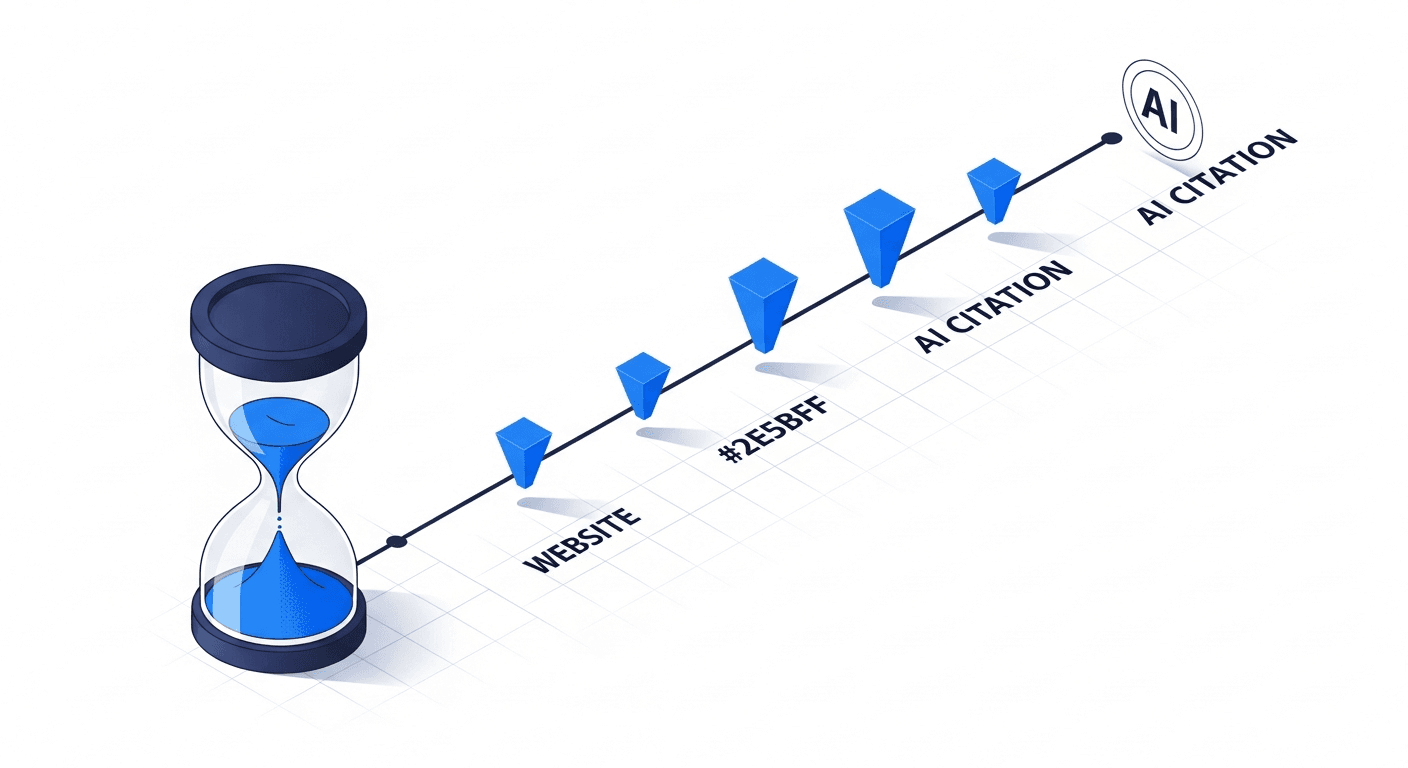
"We launched the project three weeks ago. Why doesn't ChatGPT cite us yet?"
We get this question at least once a week. And it's legitimate. When you invest in AI visibility, you want to know when results arrive. The problem is that most providers answer "it depends" and change the subject.
We'll do better than that. We'll give you numbers.
Why it's slower than classic SEO
In SEO, your page can be indexed by Google in a few hours and start ranking in a few days. The cycle is fast because Google crawls constantly and updates its index in real time.
LLMs are different. Models like GPT-4 are trained on snapshots of the web. They don't "see" your changes in real time. There's a lag between when you publish something and when the model integrates it. This lag varies from a few days (for systems with RAG like Perplexity) to several months (for models with periodic training).
This is the first thing to explain to your decision-makers: AI visibility has a structural latency.
Week 1 to 4: the foundations
The first weeks, we work on what we call "baseline signals." The Organization, FAQPage, HowTo schema markup. Profile alignment across platforms. Creating or updating the llms.txt file. Metadata cleanup.
Visible results at this stage? Almost none on fixed-training LLMs. However, Perplexity and RAG-based tools start picking up your structured content within 7 to 14 days. If your site is already well-crawled, you can see your first mentions on Perplexity by the end of the first month.
A client in the legal sector in Brussels saw their first Perplexity citation 11 days after implementing their structured FAQs. That's fast, but it's the exception, not the rule.
Months 2 to 3: content starts working
This is the phase where your articles, service pages, and FAQs start circulating. LLM crawlers visit more frequently if your site shows regular editorial activity. We recommend a pace of 2 to 4 pieces of content per month, targeted at the questions people actually ask AI in your sector.
At this stage, RAG systems cite you increasingly. Bing Chat (Copilot) starts including you in certain responses, because it relies on the Bing index, which is updated frequently.
ChatGPT with browsing enabled can also find you, but it's hit or miss. The "pure" version of the model, the one the majority of people use, doesn't budge yet.
Months 4 to 6: the tipping point
It's generally between the fourth and sixth month that we see a real shift on the base models. OpenAI updates GPT-4's training data periodically. When a new version incorporates recent web data, the work you did in months 1-3 suddenly becomes visible.
This is the most frustrating phase for clients because the progress isn't linear. You can go from 2 citations to 8 overnight after a model update, then nothing for weeks. It takes patience and trust in the process.
For our clients who started in January 2026, the typical numbers look like this: end of month 1, 0-2 mentions across all LLMs. End of month 3, 4-8 mentions (mostly Perplexity). End of month 6, 10-16 mentions across ChatGPT, Perplexity, and Gemini combined.
The factors that speed things up
Existing brand authority. If you already have press coverage, strong backlinks, and industry recognition, LLMs pick you up faster. You're starting from a higher baseline.
Niche specificity. A company targeting "AI audit for Belgian law firms" will appear faster than one targeting "business consulting." Less competition, clearer entity definition.
Content velocity. Publishing 4 articles per month gets results faster than 1. The LLM crawlers notice active sites.
Third-party mentions. A single Reddit thread mentioning you can trigger a Perplexity citation within days. A press article can influence ChatGPT within weeks.
What to tell your management
Here's the slide we use in client presentations:
Month 1-2: setup and foundation work. No visible results yet. This is normal.
Month 3-4: first citations on Perplexity and Bing Chat. Small numbers, clear trajectory.
Month 5-6: citations begin on ChatGPT and Gemini base models. Compound effect kicks in.
Month 7+: ongoing growth. Each new content piece and mention reinforces the previous ones.
The key message: AI visibility is an investment with a 3-6 month payback period. Not a quick fix. Companies that want instant results will be disappointed. Companies that commit to 6 months will build an asset that competitors can't easily replicate.
It's the same story as SEO in its early days. The companies that started early built advantages that lasted a decade. AI visibility is following the same trajectory — just faster.
Co-founder and COO of AISOS. GEO Expert, he builds the AI visibility system that turns businesses from invisible to recommended.


