80% of Employees Reject AI: How to Successfully Drive Enterprise Adoption
Practical guide to overcoming team resistance to AI tools, featuring change management methodologies and measurable ROI strategies.

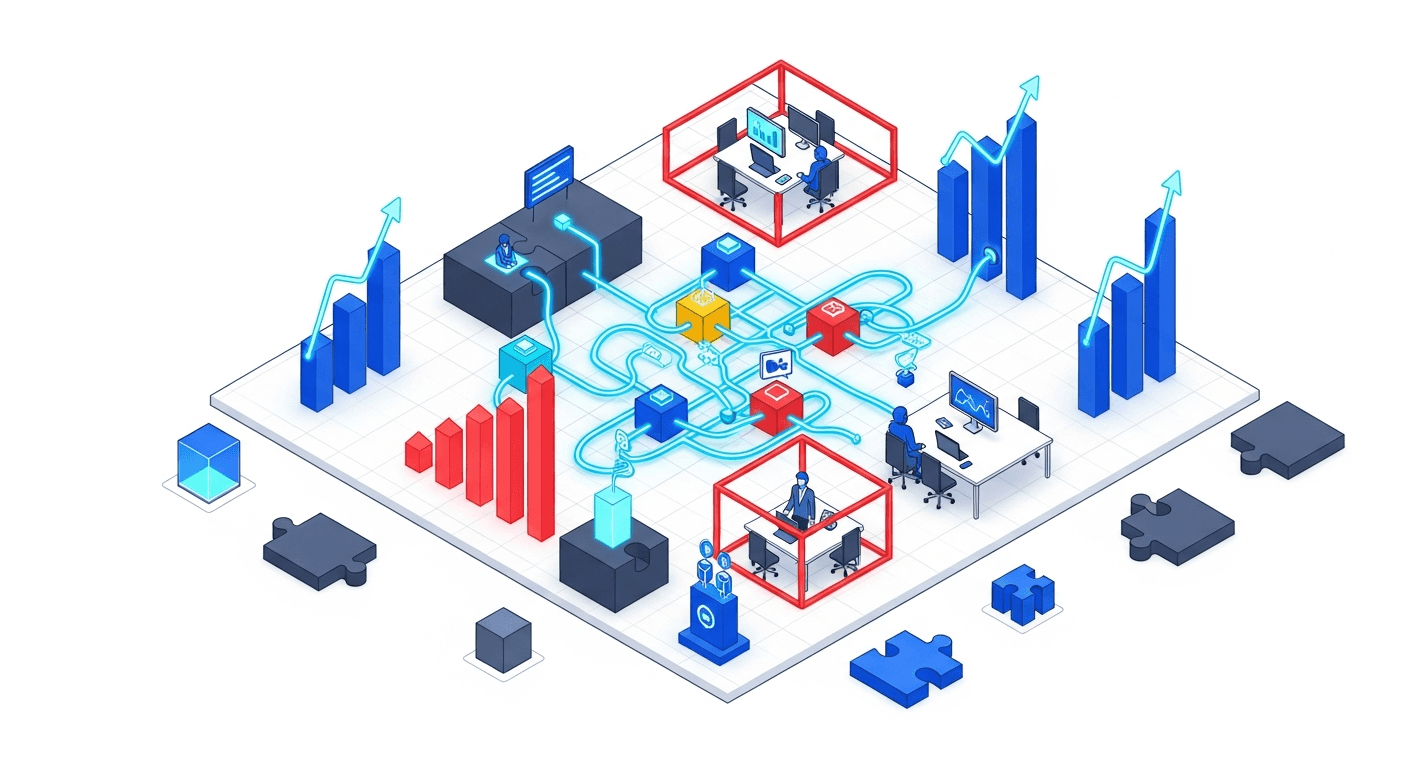
You've just invested in ChatGPT Enterprise or Microsoft Copilot licenses. Three months later, the reality is harsh: only 15% of your teams are actually using these tools. The rest? They continue as before, or even quietly sabotage the initiatives.
This scenario is far from exceptional. A recent study shared on Reddit reveals that 80% of white-collar workers actively resist AI adoption mandates. This silent resistance costs millions to companies that have bet on artificial intelligence without preparing the human groundwork.
This guide gives you the keys to transform this resistance into buy-in. No abstract theory: tested methods, mistakes to avoid, and a framework to measure the ROI of your adoption strategy.
Why your employees resist AI: the real reasons
Resistance to AI isn't a generational whim or lack of technical skills. It's rooted in legitimate concerns that leaders systematically underestimate.
Fear of professional obsolescence
According to a 2024 Gallup survey, 22% of American employees fear their job will be eliminated because of AI. In France, this figure reaches 27% according to IFOP. This fear isn't irrational: Goldman Sachs estimates that 300 million jobs could be automated worldwide.
When an employee perceives AI as an existential threat, asking them to adopt it is like asking them to dig their own grave. No amount of training will overcome this psychological block until it's addressed head-on.
Loss of meaning and expertise
An experienced writer who has spent 15 years refining their style doesn't see ChatGPT as an assistant. They perceive it as a devaluation of their expertise. Same goes for financial analysts, lawyers, marketers: AI commoditizes skills that constituted their added value.
At AISOS, we observe that this resistance is often strongest among senior profiles, precisely those the company needs to guide adoption.
Past failures and change fatigue
Your teams have already lived through the failed implementation of a CRM, the chaotic migration to the cloud, or the silent abandonment of a collaborative tool. Each new technology project comes with its share of unmet promises. AI inherits this trust debt.
Real ethical concerns
LLM hallucinations, algorithmic bias, intellectual property questions: these topics aren't excuses to resist. They're documented risks that your most rigorous employees identify before you do. Ignoring these concerns pushes them toward rejection.
The mistakes that sabotage AI adoption in companies
Before building your strategy, identify the traps that 90% of companies fall into.
Mistake #1: imposing without explaining
"Starting January 1st, all reports must be generated with Copilot." This type of directive creates surface-level compliance. Employees use the tool to check the box, then rework everything manually. Result: double work, frustration, and artificially inflated adoption statistics.
Mistake #2: training on the tool rather than usage
A day of training on ChatGPT features solves nothing if the employee doesn't know how to integrate it into their daily workflow. The question isn't "how to write a prompt" but "how AI helps me handle my 50 daily emails more efficiently."
Mistake #3: deploying everywhere at once
The big bang approach is tempting to maximize license ROI. It's also the best way to multiply friction points. Mass deployment overwhelms support, generates cross-departmental frustrations, and doesn't allow you to identify what works.
Mistake #4: ignoring middle managers
Leadership decides, employees endure, and middle managers find themselves defending a strategy they didn't build. Yet they're the ones who determine actual daily adoption. One skeptical manager contaminates their entire team.
The 5-step method to get your teams to accept AI
This approach has been validated by companies from 50 to 5000 employees. It's based on a simple principle: treat AI adoption as a human transformation project, not as a software deployment.
Step 1: diagnose before prescribing
Start by mapping perceptions. An anonymous 10-question survey is enough:
- What is your level of familiarity with generative AI tools?
- Which tasks in your daily work could benefit from AI assistance?
- What are your main concerns about AI at work?
- Have you already used AI for personal tasks?
The results often reveal surprises. One industrial SME discovered that their sales team was already using Claude to prepare proposals, while marketing, supposedly more "digital," had never tested these tools.
Step 2: create a coalition of champions
Identify 5 to 10% of your workforce who show natural curiosity about AI. These aren't necessarily the youngest or most technical. Look for those who are already experimenting, asking questions, sharing tips.
These champions become your ambassadors. Their mission:
- Test tools in real conditions for 4 to 6 weeks
- Document concrete time savings on their tasks
- Identify limitations and risks
- Share their discoveries with peers
Horizontal influence is three times more effective than vertical directives for technology adoption.
Step 3: guarantee job security
No adoption strategy works as long as fear of layoffs persists. Leaders must commit publicly and specifically:
"AI will not eliminate any positions in the next 24 months. Productivity gains will be reinvested in new projects and skill development."
This commitment must be written, communicated at all levels, and respected. One violation destroys trust for years.
Step 4: train through usage, not theory
Forget generic training. Build job-specific paths:
For sales teams: how to use AI to qualify prospects, personalize prospecting emails, and prepare for objections.
For HR: how to write job descriptions, analyze resumes, and structure interviews.
For finance: how to automate variance analysis, generate management commentary, and detect anomalies.
Each training must include a practical case that the employee completes with their own data, with an immediately usable result.
Step 5: measure and celebrate victories
Define simple indicators from the start:
- Active usage rate (weekly connections)
- Time saved as reported by users
- Number of documented use cases
- Team satisfaction (internal NPS)
Share results monthly. Highlight individual successes: "Marie reduced her reporting time by 3 hours per week thanks to analysis automation." These concrete testimonials are worth all the PowerPoint presentations.
Building the business case to convince your leadership
AI adoption requires resources: licenses, training, transition time. Here's how to structure your financial argument.
Calculate the cost of non-adoption
Your competitors adopting AI are gaining 20 to 40% productivity on certain tasks. This differential translates to:
- Longer response times to clients
- Higher production costs
- Loss of attractiveness for talent (the best want to work with modern tools)
- Delayed innovation capacity
Quantify realistic gains
Avoid fantasy projections. Base them on solid studies:
- McKinsey estimates that generative AI can automate 60 to 70% of tasks in certain administrative roles
- An MIT study shows a 37% productivity gain for professional writing tasks
- Boston Consulting Group measures a 40% improvement in strategic analysis quality with AI assistance
Apply these percentages to your own data. If your salespeople spend 10 hours per week writing proposals, a 30% gain represents 3 hours recovered for prospecting.
Budget for change management
Plan for 30 to 50% of the software budget for human support. This ratio seems high but it determines project success or failure. A EUR 50,000 per year tool that isn't adopted costs infinitely more than a EUR 50,000 tool with EUR 25,000 in support that truly transforms practices.
Signs that your strategy is working
How do you know if you're on the right track? Watch for these qualitative indicators:
Questions change in nature. At the beginning: "Why do we have to use this?" After a few weeks: "How can I do this with AI?" This shift indicates that resistance is giving way to curiosity.
Unforeseen use cases emerge. An accountant using AI to rephrase difficult emails. A project manager creating training quizzes for their team. These creative adaptations signal real ownership.
Skeptics become advocates. The person who criticized most loudly at first now shares their prompts with colleagues. This conversion has more impact than ten leadership communications.
Requests for additional licenses arrive. When teams demand access rather than endure it, you've crossed the tipping point.
Managing holdouts: when resistance persists
Despite all your efforts, 10 to 15% of your workforce will remain resistant. How do you manage this minority?
Distinguish profiles. Some have legitimate objections you haven't addressed. Others resist any change on principle. The treatment differs radically.
Offer temporary alternatives. Allow holdouts to continue their current methods for a defined period, provided they achieve the same objectives as their AI-augmented colleagues. Results pressure often shifts positions.
Don't force beyond reason. An employee who categorically refuses AI after 6 months of support poses an alignment problem with company strategy. This is no longer a technology adoption issue but a management one.
Taking action: your roadmap for the next 90 days
AI adoption isn't decreed, it's built. Companies that succeed share one characteristic: they treat resistance as valuable feedback rather than an obstacle to crush.
Weeks 1-2: Launch your internal diagnostic. Understand where your teams really stand.
Weeks 3-4: Identify and equip your champions. Give them the means to experiment.
Weeks 5-8: Communicate your employment commitments. Launch the first targeted training.
Weeks 9-12: Measure initial results. Adjust your approach based on feedback.
AISOS audits reveal that companies following this methodical progression achieve a 60% active adoption rate in three months, versus 15% for unaccompanied deployments.
The question is no longer whether your teams will use AI, but how you'll support them in this transition. Leaders who invest today in human adoption are building tomorrow's competitive advantage.


