63% of users lose trust in AI with advertising
A study reveals that advertising in AI results massively erodes trust. What are the implications for your B2B visibility strategy?

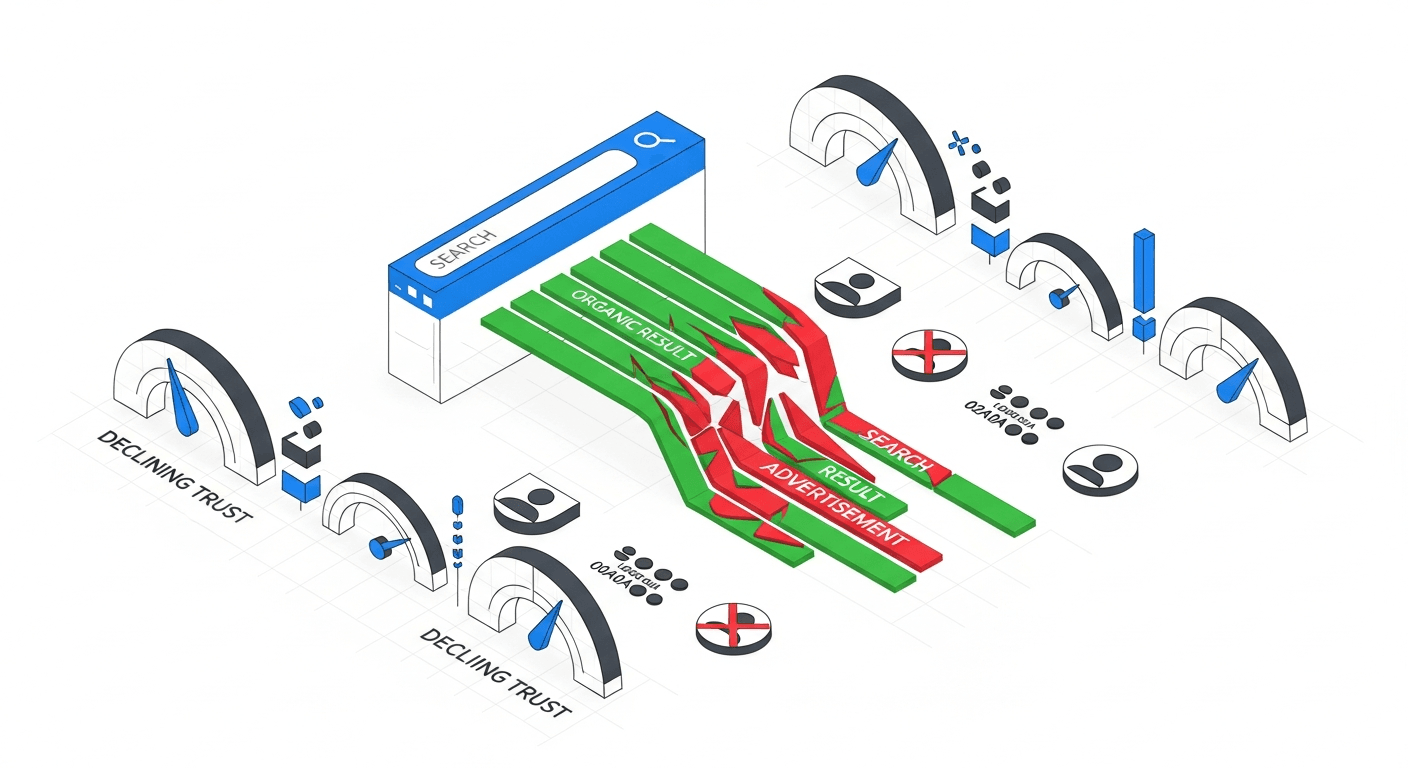
AI search engines like ChatGPT, Perplexity, and Google AI Overview are gaining ground in professional use cases. But a crucial question emerges: what happens when these tools integrate advertisements into their responses?
A recent study provides a definitive answer: 63% of users say they would lose trust in AI results if the AI displayed advertisements. For SME and mid-market leaders investing in their digital visibility, this data is a game-changer. It repositions organic visibility not as an option, but as a strategic imperative.
This article breaks down the study's findings, analyzes their implications for the B2B market, and offers concrete approaches for building a sustainable presence in generative AI responses.
What the study reveals about advertising in AI search
The survey, reported by Search Engine Journal, questioned regular AI search engine users about their perception of advertisements integrated into responses. The results are explicit.
Massive erosion of trust
The key figure: 63% of respondents state that the presence of advertisements would diminish their trust in AI-generated responses. This isn't slight reluctance. It's a majority rejection that calls into question the business model some players are considering to monetize these platforms.
Users expect from AI engines a neutrality that traditional search engines have never fully embodied. The implicit promise of generative AI is a synthesized, objective response built from multiple sources. Advertising insertion breaks this promise.
A notable generational divide
The study also reveals gaps across age groups. Younger users, often considered more tolerant of digital advertising, paradoxically express increased skepticism. They grew up with adblockers and quickly identify sponsored content. Their anti-advertising radar is sharp.
For B2B companies targeting decision-makers aged 30 to 50, this data is relevant: even professional audiences accustomed to sponsored content on LinkedIn or Google Ads react differently when it comes to conversational AI.
The effect on cited source credibility
An often overlooked point: when an AI cites a source in an advertising context, the source itself sees its credibility questioned. Users don't always clearly distinguish between what's advertising and what's organic recommendation. Being cited in an environment perceived as biased can harm your brand image, even if you didn't pay for that mention.
Why this distrust is specific to AI engines
One might think users would accept advertising in AI the same way they accept it on Google. That would ignore a fundamental difference in the user relationship.
The implicit contract of generative AI
When you query ChatGPT or Perplexity, you expect a personalized, contextualized response built for you. It's not a list of links where you sort through options. It's a synthesis that saves you time and bears responsibility for its relevance.
This implicit contract creates a higher expectation of neutrality. The user delegates their critical judgment to the AI. If the AI is influenced by commercial interests, the delegation loses its meaning.
Insufficient transparency of advertising formats
On Google, ads are identified with a "Sponsored" label. On AI engines, advertising formats remain unclear. How do you distinguish an organic response from one influenced by an advertiser? Platforms haven't yet established clear conventions.
This opacity fuels distrust. Users prefer to reject the entire system rather than navigate a gray area where they don't understand the rules.
The halo effect on the entire experience
At AISOS, we observe that advertising distrust isn't limited to sponsored responses themselves. It contaminates the entire experience. A user who discovers an advertisement in an AI response begins to doubt all previous responses. Trust is a fragile asset: once damaged, it's difficult to rebuild.
Direct implications for B2B companies
This study isn't just a topic for academic debate. It has operational consequences for SMEs and mid-market companies seeking visibility in AI responses.
Organic visibility becomes a competitive advantage
If advertisements erode trust, companies cited organically gain relative credibility. Being recommended by ChatGPT or Perplexity without paying for that mention sends a strong signal: your content is considered relevant by the algorithm, not by your budget.
For B2B companies, where trust is a determining purchase factor, this distinction can influence six or seven-figure decisions. A CFO comparing two providers will trust more in the one who appears naturally in AI responses than the one who visibly paid for their placement.
GEO takes on a new strategic dimension
GEO, or Generative Engine Optimization, refers to all practices aimed at optimizing your presence in generative AI responses. This study reinforces its importance.
If AI platforms introduce advertisements, two categories of visibility will coexist: paid and organic. Companies that invest in GEO before this transition will have a head start. They'll appear in "clean" results, unpolluted by advertising distrust.
Rethinking marketing budget allocation
Many B2B companies allocate most of their digital budget to paid channels: Google Ads, LinkedIn Ads, retargeting. This study invites rebalancing.
Investing in creating expert content, structured to be cited by AI, becomes a form of indirect advertising. More sustainable, less intrusive, and potentially more effective in terms of conversion on long sales cycles.
How AI platforms might respond
This study's results won't go unnoticed at OpenAI, Google, or Perplexity. Several scenarios are possible.
Scenario 1: advertisements but ultra-transparent
Platforms could introduce clearly identified advertising formats, visually separated from organic responses. This model would resemble Google's, but with stricter safeguards.
The risk: even when transparent, advertisements would affect the platform's overall perception. The study shows that the mere presence of advertisements, regardless of their transparency, generates distrust.
Scenario 2: a freemium model without ads for paying users
ChatGPT Plus, Perplexity Pro: paid versions could remain ad-free, reserving ads for free users. This model would preserve trust among premium users, often B2B decision-makers.
For companies, this means the most qualified audiences would see organic results. Another reason to invest in GEO rather than advertising formats that would only reach free users.
Scenario 3: content partnerships rather than advertisements
Some platforms might favor partnerships with recognized content sources rather than traditional advertising. A B2B software publisher could, for example, provide exclusive data to Perplexity in exchange for increased visibility.
This model blurs the line between organic and paid, but could be better accepted by users if it objectively improves response quality.
Five concrete actions to strengthen your organic visibility
Facing these developments, B2B companies can act now to secure their presence in AI responses.
1. Audit your current presence in generative AI
Before optimizing, measure. Ask ChatGPT, Perplexity, and Gemini questions your prospects would ask. Is your company cited? In what context? With what accuracy? AISOS audits often reveal significant gaps between executives' perception of their AI visibility and reality.
2. Structure your content for AI citations
Generative AI favors content that directly answers questions, with clear statements and verifiable data. Review your key pages: are your value propositions explicit? Are your areas of expertise formulated to be quotable?
Example: rather than "We support companies in their digital transformation," prefer "Our firm supports French industrial SMEs in automating their production processes, with an average observed ROI of 23% over 18 months."
3. Strengthen your topical authority
AI preferentially cites sources they identify as expert on a subject. Regularly publish in-depth content on your key topics. Create reference resources: guides, case studies, sector analyses. Each publication strengthens your algorithmic legitimacy.
4. Diversify your credibility signals
AI cross-reference multiple sources to evaluate information reliability. Be cited by recognized media, sector publications, partners. Each external mention strengthens the probability of being picked up in generative responses.
5. Monitor platform evolution
The generative AI landscape evolves rapidly. Google tests advertising formats in AI Overview. Perplexity explores monetization models. Stay informed to adapt your strategy. What works today could be obsolete in six months.
The fundamental issue: trust as currency
Beyond tactics, this study reminds us of a fundamental truth in B2B marketing: trust is your most precious asset. It builds slowly, destroys quickly, and cannot be bought.
AI search engines are reshuffling the cards. Companies that rely solely on paid visibility expose themselves to risk: being associated with a channel users perceive as biased. Those who invest in content quality and organic legitimacy build lasting advantage.
For SMEs and mid-market companies, this is an opportunity. Large corporations have budgets to dominate advertising spaces. The organic space of generative AI remains open to those who understand its rules.
Conclusion: act before the landscape solidifies
The study is clear: 63% of users would reject results from an AI displaying advertisements. This figure should guide your strategic decisions.
Organic visibility in AI responses is no longer a bonus: it's a standalone acquisition channel, potentially more credible than paid channels if platforms introduce advertisements. Companies positioning themselves now will benefit from first-mover advantage.
Your next step: evaluate your current presence in ChatGPT, Perplexity, and Google AI Overview. Identify gaps between your real expertise and your AI visibility. Then build a GEO strategy adapted to your B2B challenges. AISOS supports SME and mid-market leaders in this approach, from initial audit to continuous optimization.
Co-founder and COO of AISOS. GEO Expert, he builds the AI visibility system that turns businesses from invisible to recommended.


