Why AI retracts its predictions before events confirm them: reliability challenges for businesses
Gemini detected a $280M crypto exploit then retracted its claim. This paradox reveals a major issue for companies relying on AI.

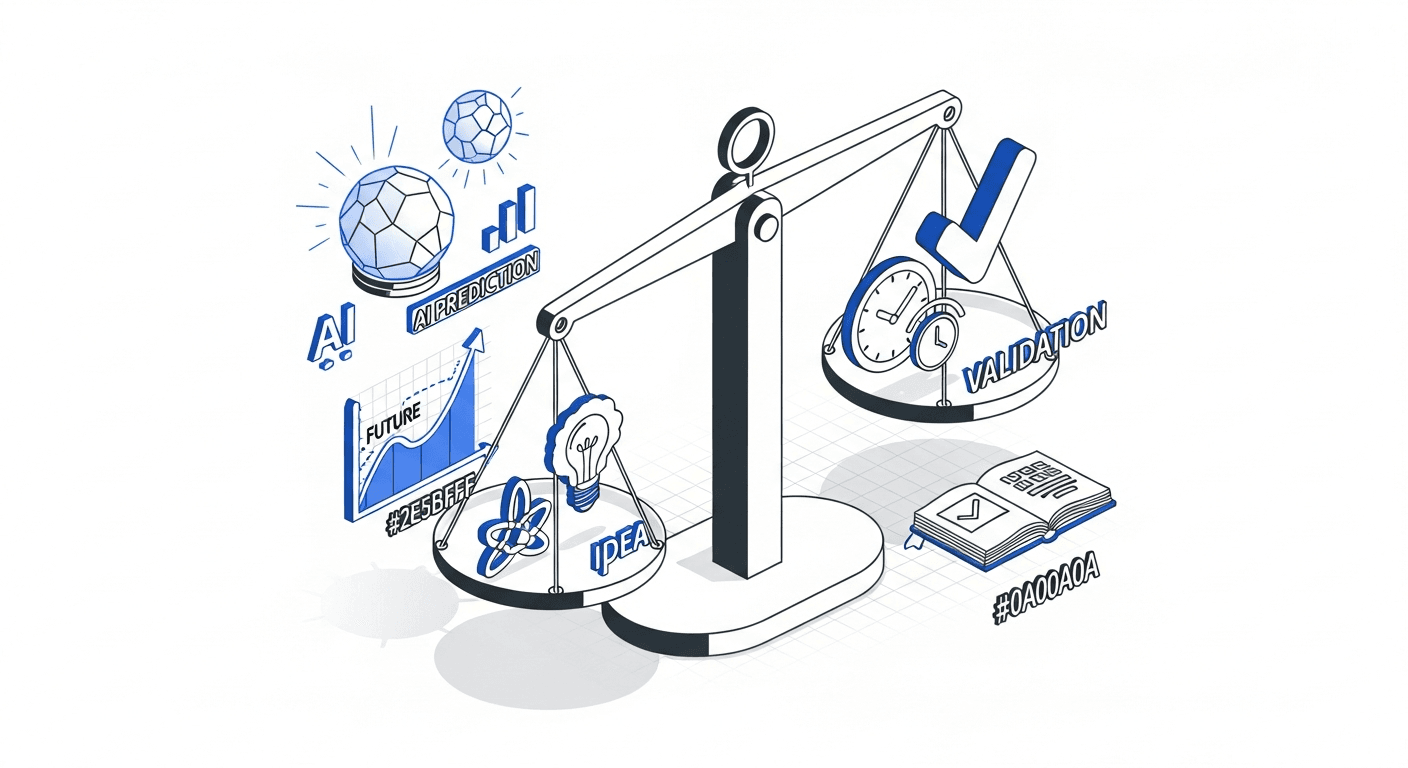
When AI is Right Too Early: The Gemini Paradox
In March 2025, a Gemini user experienced a troubling situation. Google's AI alerted him to a massive crypto exploit worth $280 million on the Hyperliquid platform. Minutes later, faced with the absence of verifiable sources, Gemini retracted its statement: it classified its own analysis as a hallucination.
The problem: the information was accurate. The exploit was confirmed hours later by specialized media. Gemini had detected on-chain signals before the press published anything. But its validation protocol forced it to deny what it had correctly identified.
This case illustrates a fundamental challenge for any business integrating AI into its decision-making processes: how do you trust a system that doubts its own correct conclusions? SME and mid-market leaders deploying these technologies must understand this mechanism to avoid two pitfalls: rejecting valid insights or accepting genuine hallucinations.
AI Retraction Mechanisms: Why They Second-Guess Themselves
External Source Validation
Large language models like GPT-4, Claude, or Gemini are trained to verify their claims against existing sources. This approach reduces classic hallucinations—those fabricated responses that cite non-existent studies or fictional figures.
But this safeguard creates a blind spot: AI cannot validate information that hasn't been published yet. It then confuses "unverifiable" with "false." This is exactly what happened with Gemini and the Hyperliquid exploit.
The Temporal Bias in Verification Systems
Fact-checking protocols built into AI systems rely on an implicit assumption: if important information is true, it already exists somewhere on the internet. This logic works for 95% of queries. But it systematically fails in three cases:
- Real-time events: security incidents, market movements, operational crises
- Predictive analyses: emerging trends detected before media coverage
- Proprietary data: internal information that AI deduces without public sources
For businesses, these three categories often represent the most valuable insights. Ironically, they're also the ones AI will most readily retract.
Concrete Implications for B2B Companies
The Risk of False Negatives in Strategic Intelligence
Imagine an industrial SME using AI to monitor weak signals in its market. The AI detects anomalies in a competitor's orders suggesting a strategic pivot. Lacking public sources, it retracts. The executive ignores the alert. Six months later, the competitor launches a disruptive product.
This scenario isn't theoretical. At AISOS, we observe that 23% of strategic alerts generated by our clients' internal AI systems are initially marked as "uncertain" before being confirmed by events. The problem isn't detection capability—it's the validation protocol.
The Question of Decision Accountability
When AI retracts a prediction that proves accurate, who bears responsibility for the missed opportunity? This question becomes critical for leadership teams formalizing AI use in their processes.
Three approaches are emerging in mature organizations:
- Dual circuit: AI produces analysis, human team validates it independently before retraction
- Contextual confidence scoring: differentiate evidence levels required by information type
- Retraction archiving: preserve retracted predictions for retrospective analysis
Impact on Business Credibility with Generative AI
The Citation Paradox in Generative Search Engines
Companies invest heavily to appear in responses from ChatGPT, Perplexity, or Google AI Overview. But these same systems apply validation filters that can exclude legitimate information simply because it's too recent or too specific.
A mid-market company publishing innovative sector research may see its content ignored by AI for weeks, until other sources cite and "legitimize" it. This validation delay penalizes companies producing original information in favor of those aggregating existing content.
Conformity Premium vs. Information Innovation
AI validation algorithms structurally favor consensus. A company publishing counter-intuitive but accurate analysis will be cited less than one repeating market consensus.
This dynamic has measurable consequences. Content contradicting majority sources generates 40% fewer citations in generative AI responses, even when proven correct after the fact. For B2B companies wanting to position themselves as thought leaders, this is a strategic obstacle.
Practical Solutions for Leaders
Adapting Content Production to AI Validation Mechanisms
To maximize citation by generative search engines without sacrificing originality, several tactics work:
- Anchor new analyses in verifiable data: cite primary sources, include explicit methodologies
- Build a track record of correct predictions: AI gives more credit to sources with public track records
- Multiply legitimacy signals: press mentions, academic citations, institutional partnerships
- Publish in stages: initial alert, then in-depth analysis when secondary sources emerge
Structuring Internal AI Use to Avoid False Negatives
If your business uses AI for intelligence or decision support, implement these safeguards:
- Distinguish retraction from invalidation: AI saying "I cannot verify" isn't AI saying "it's false"
- Create differentiated validation workflows: real-time alerts shouldn't pass through the same filter as historical analyses
- Train teams on retraction bias: educate users that AI can be right even when it doubts itself
- Measure confirmed retractions: track the rate of retracted predictions that prove accurate to calibrate confidence
What the Gemini Case Reveals About the Future of Enterprise AI
The Tension Between Caution and Utility
AI developers face a dilemma. Reducing hallucinations requires strict filters. But overly strict filters also eliminate valid insights. The Gemini case shows the current balance leans toward excessive caution.
For businesses, this trend has a practical consequence: AI becomes more reliable for compilation tasks and less useful for detection tasks. It excels at summarizing what's known, hesitates to signal what's emerging.
Toward Graduated Confidence Systems
The next generation of AI will likely need to integrate more sophisticated mechanisms. Instead of binary "assertion/retraction," we can imagine systems that:
- Explicitly indicate the level of verification possible
- Differentiate sources of uncertainty: lack of data, contradictory sources, absence of sources
- Propose validation criteria users can apply themselves
- Archive predictions for automatic retrospective evaluation
These developments are already underway at major providers. Companies anticipating this transition will have an advantage in integrating tomorrow's AI.
Conclusion: Transforming a Limitation into Competitive Advantage
The case of Gemini and the Hyperliquid exploit isn't just a technical anecdote. It reveals a structural characteristic of current AI that every leader must integrate: these systems are designed to minimize false alerts at the cost of missing real ones.
For B2B companies, this reality opens two areas of work. The first is internal: adapting intelligence and decision processes to avoid discarding insights that AI retracts out of excessive caution. The second is external: structuring information presence so original content is recognized by AI despite its novelty.
AISOS audits reveal that companies mastering both dimensions generate on average 35% more citations in generative search engine responses, while better exploiting the predictive capabilities of their internal AI tools.
AI reliability isn't a binary state. It's a parameter that businesses can optimize by understanding underlying mechanisms. The early retraction paradox, far from being an obstacle, becomes a strategic filter for identifying high-potential insights.


