6 Months of AI at Work: Complete Assessment Between Promises and Reality
Real-world experience with AI in business: measurable gains achieved, costly pitfalls identified, and recommendations to optimize your investment.

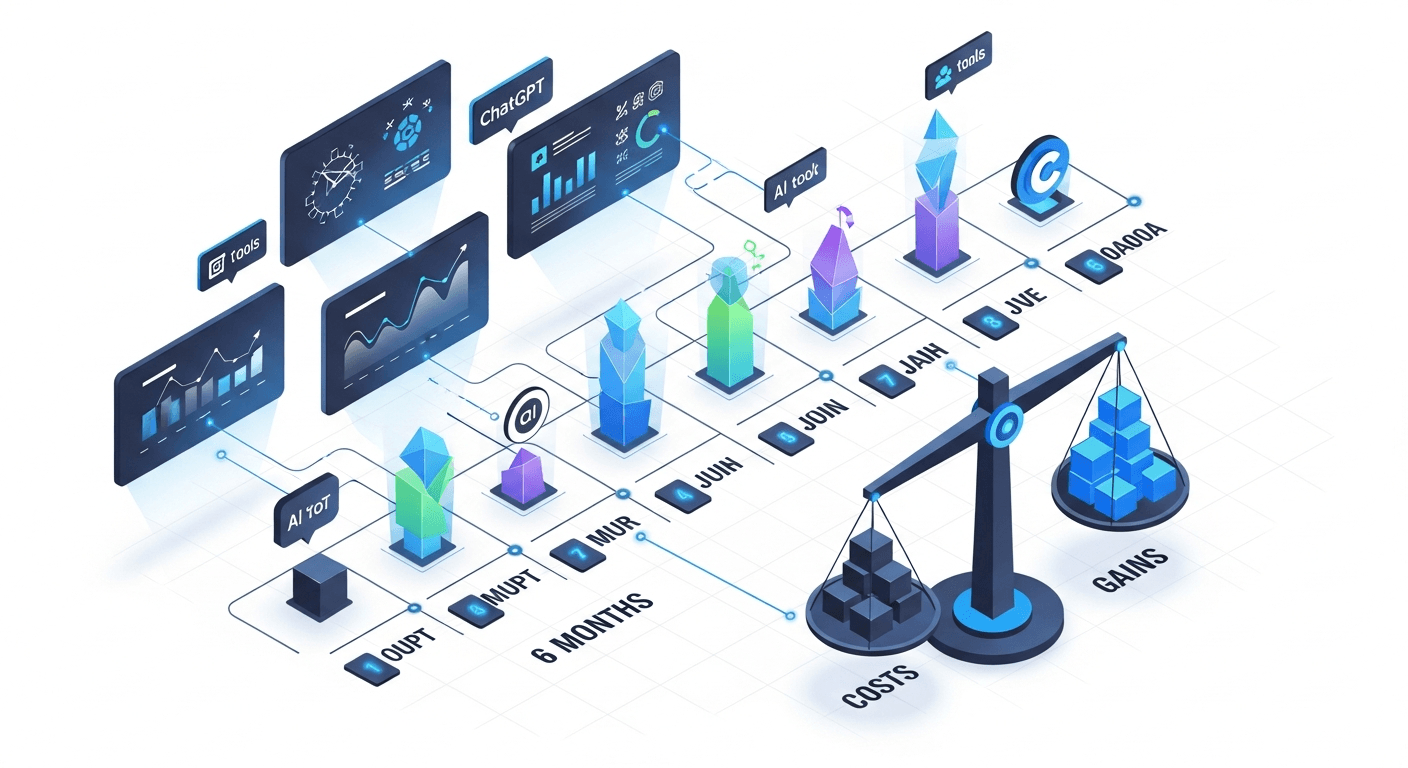
January 2024, you deployed ChatGPT Enterprise, Microsoft Copilot or Claude in your company. Six months later, the results are mixed: some teams have transformed their productivity, others abandoned the tool after three weeks. The gap between vendor promises and field reality can be brutal.
This assessment is based on feedback from SME and mid-market company leaders who took the plunge. No theory here: just numbers, concrete cases, and above all, the mistakes not to repeat. The objective is simple: to help you maximize the return on investment of your AI tools, or better prepare their deployment if you're still hesitating.
Here's what really works, what's just marketing hype, and what can silently put your company at risk.
Real productivity gains after 6 months of use
McKinsey studies promised 30 to 40% productivity gains. The field reality is more modest, but very real for certain roles.
Writing and communication: the most mature use case
This is the domain where generative AI delivers on its promises. Marketing and sales teams report measurable gains:
- Sales emails: writing time reduced by 2 to 3 times, with higher personalization rates
- Meeting reports: from 45 minutes to 10 minutes with proofreading
- Commercial proposals: first draft generated in 20 minutes instead of 2 hours
- Translations and adaptations: sufficient quality for 80% of internal uses
A sales director from an industrial mid-market company shares: "My sales reps were spending 30% of their time on administrative tasks. Today, it's 15%. The rest, they dedicate to client meetings."
Data analysis: results conditional on prompt quality
Analysis of long documents, contracts or reports works, but with important nuances. Gains are real when:
- Documents are structured and in exploitable text format
- Questions asked are precise and contextualized
- A human systematically verifies critical extractions
Legal teams using AI for contract analysis report 40 to 60% time savings on the initial reading phase. But beware: the error rate on technical clauses remains at 5 to 8%, requiring systematic human review.
Software development: the skills multiplier
For technical teams, GitHub Copilot and code assistants transform developer productivity. Internal measurements show:
- 20 to 30% of code generated by AI and kept after review
- Significant reduction in time spent on documentation
- Accelerated onboarding of new developers
The trap: junior developers who accept generated code without understanding it. Six months later, technical debt accumulates.
What's clearly overrated in AI promises
Some expectations created by vendor marketing don't survive field testing. Better to know this before investing.
Complete autonomy: a costly myth
The idea that AI can "handle alone" a business process remains science fiction in 2024. Every successful use case involves:
- A human who formulates the request precisely
- A human who verifies and validates the result
- A human who corrects and refines
The time saved versus time invested in supervision ratio hovers around 3:1 in the best cases. Not 10:1 as some promise.
AI creativity: useful for brainstorming, insufficient for production
Creative teams appreciate AI for generating ideas, exploring angles, overcoming writer's block. But final deliverables remain massively reworked:
- Visuals: 90% of generated images require retouching or are abandoned
- Creative texts: AI's generic tone is immediately recognizable
- Marketing concepts: useful as starting points, rarely as deliverables
Replacing business expertise: a dangerous illusion
Some executives believed they could reduce their teams by relying on AI. Six months later, the finding is bitter: AI amplifies existing skills, it doesn't replace them.
An HR manager who uses AI to filter resumes without understanding technical roles will miss good profiles. A salesperson who has proposals written without mastering their offering will send incoherent documents.
Silent dangers identified in the field
Beyond unfulfilled promises, certain risks emerge after several months of use. At AISOS, we observe that these problems are rarely anticipated during initial deployment.
Confidential data leakage
The most documented risk, yet the most neglected. After 6 months, teams have developed habits: copy-pasting a client contract into ChatGPT, sharing an Excel file of prospects with Claude, requesting analysis of sensitive HR data.
Enterprise versions with data not used for training limit this risk, but don't eliminate it. A clear, communicated and controlled policy remains essential.
Erosion of basic skills
A less visible but concerning phenomenon: employees who systematically delegate to AI gradually lose certain skills.
- Ability to structure an argument from scratch
- Mastery of spelling and syntax
- Critical thinking about sources and data
An HR director from a services SME shares: "Our new hires from the past year write worse without AI than their predecessors. It's a real issue for their development."
Dependency on a tool and vendor
Processes built around a specific tool create dependency. When OpenAI changes its pricing conditions or Microsoft modifies Copilot's features, adaptation can be brutal.
Companies that have diversified their tools or built transferable processes fare better than those that bet on a single supplier.
Impact on online visibility
A rarely anticipated side effect: the multiplication of AI-generated content degrades everyone's visibility. Google and generative engines increasingly penalize content without human added value.
AISOS audits reveal that companies that massively published unrefined AI content see their natural search rankings stagnate or decline after 6 months.
Key success factors observed
Some companies extract significantly more value from their AI tools. Here are the common points identified.
Serious initial and ongoing training
Companies that invested in training achieve results 2 to 3 times superior to those that simply "made the tool available."
Effective training covers:
- Prompting basics: structure, context, examples, constraints
- Tool limitations: hallucinations, bias, confidentiality
- Validated use cases: what works in their business context
- Verification processes: when and how to validate outputs
Targeted use cases rather than general deployment
"Everyone, for everything" deployments generate confusion and disengagement. Successful companies identify 3 to 5 priority use cases, master them, then gradually expand.
Examples of effective prioritization:
- Phase 1: writing emails and reports
- Phase 2: document analysis and summaries
- Phase 3: content creation support
- Phase 4: automation of repetitive tasks
Usage and results monitoring
Without measurement, no improvement. High-performing companies track:
- Adoption rate by team and profile
- Use cases actually practiced
- Declared and measured time savings
- Confidentiality or quality incidents
A monthly dashboard helps identify struggling teams and best practices to share.
Practical recommendations for the next 6 months
Based on these experience reports, here are the priority actions to optimize your AI investment.
Audit your current usage
Before investing further, understand what's really happening. Ask your teams:
- Who uses which tools, for what purposes?
- What are the perceived gains and frustrations?
- What data is shared with AI tools?
- What processes have been created or modified?
Strengthen governance
If not already done, formalize:
- A clear data policy on what can be shared with AI
- Verification guidelines by type of content produced
- A process for reporting incidents and best practices
Invest in prompting skills
Prompting is a skill that can be learned and perfected. Employees who master the art of formulating precise requests achieve radically superior results.
Plan best practice sharing sessions, validated prompt libraries, and dedicated time for experimentation.
Anticipate the evolution of your digital visibility
AI also transforms how your customers find you. Generative search engines, ChatGPT, Perplexity, Google AI Overview, are becoming major information sources in B2B.
Your content strategy must integrate these new channels: this is the challenge of GEO, Generative Engine Optimization.
Conclusion: a profitable investment under conditions
Six months of AI use in business allow clear conclusions to be drawn. Yes, productivity gains are real, measurable, and significant for certain roles. No, AI doesn't magically transform any employee into an expert, and doesn't replace business expertise.
Companies that succeed in their AI transition share three characteristics: they invest in training, they target their use cases, and they measure their results. Those that fail deploy tools without support and expect miracles.
AI is a skills amplifier, not a substitute. It's also a differentiation factor for your online visibility, provided you adapt your content strategy to new generative engines.
Want to evaluate your AI maturity and optimize your presence in generative engine responses? Contact AISOS for a personalized audit of your situation.


