6% of users seek AI advice for life decisions: marketing opportunity
Anthropic's study reveals that 6% of Claude conversations involve major personal decisions. An untapped opportunity for B2B brands.

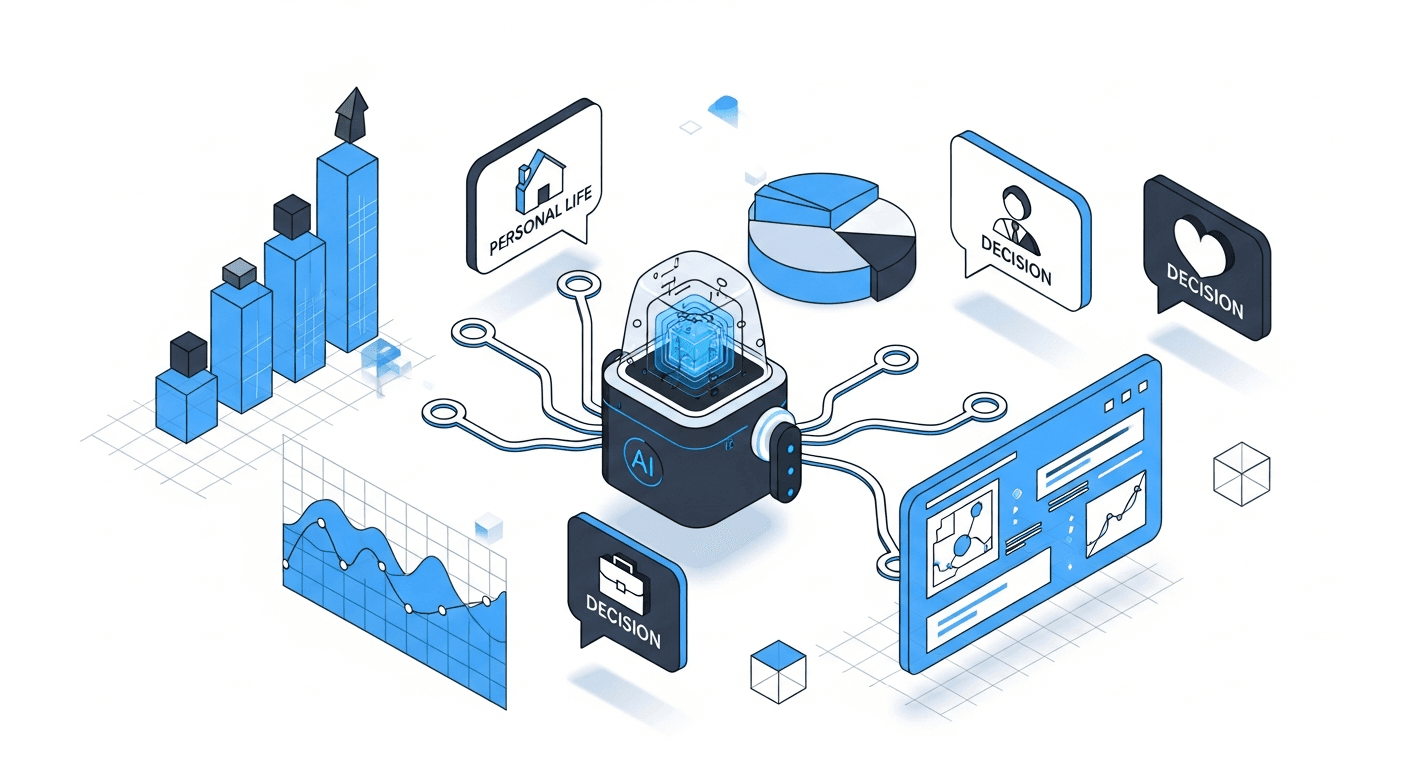
Anthropic has just published an unprecedented analysis of one million conversations with Claude, its AI assistant. The most surprising finding: 6% of users consult AI for major personal decisions. Quitting their job, moving to a new country, ending a relationship. These moments of existential questioning now unfold in front of a screen, not in a counselor's office.
For a small or mid-sized business leader, this statistic might seem trivial. It isn't. That 6% represents millions of daily conversations where professionals in transition seek answers. And among those answers, they discover solutions, tools, companies. Yours could be among them.
This article decodes this emerging phenomenon and shows you how to position your B2B brand in these high-stakes decision-making conversations, where your future clients and talent are already present.
What Anthropic's one million conversation study really reveals
In March 2025, Anthropic analyzed a massive sample of anonymized conversations with Claude. The initial objective was to understand the real-world uses of generative AI beyond typical marketing use cases.
Usage breakdown that challenges conventional wisdom
The results contradict the image of AI confined to office productivity:
- 29% of conversations involve programming and development
- 21% focus on professional content creation
- 11% involve research and analysis
- 6% are requests for personal advice on life decisions
- 5% relate to education and learning
These 6% of personal conversations represent approximately 60,000 exchanges in the analyzed sample. Extrapolated to the millions of daily users of Claude, ChatGPT, Perplexity and Gemini, this figure becomes staggering.
What decisions users submit to AI
The study details the nature of these personal consultations:
- Career: resigning, negotiating a raise, changing sectors, starting a business
- Mobility: moving to another city, relocating abroad, returning to their home country
- Relationships: breaking up, getting married, managing family conflicts
- Personal finance: investing, buying real estate, retirement planning
- Health and wellness: lifestyle changes, consulting specialists, stress management
The common thread: these are moments of transition where individuals are particularly receptive to new information, solutions and partners.
Why professionals prefer AI over their network for these decisions
This behavior may surprise. Why entrust intimate questions to a machine rather than to a friend, mentor or coach?
Absence of judgment as a decisive factor
Users interviewed in complementary qualitative studies cite several motivations:
- Perceived neutrality: AI doesn't judge, grimace, or compare to its own experience
- Immediate availability: at 3 AM, after a difficult meeting, during transit
- Comprehensiveness: ability to explore multiple scenarios without fatigue or impatience
- Confidentiality: no risk of information circulating in their professional network
A sales director considering leaving their position won't discuss it with colleagues. They also don't want to worry their family before clarifying their thinking. AI becomes a preliminary reflection space before any human discussion.
The typical profile of these users
Contrary to stereotypes, these aren't isolated tech enthusiasts. Demographic data shows an overrepresentation of:
- Executives and managers between 30 and 50 years old
- Entrepreneurs and freelancers
- Professionals in career transition
- Expats or people considering international mobility
In other words: your clients, your prospects, your future collaborators.
The marketing opportunity most B2B brands are ignoring
These conversations represent virtually untapped territory for B2B marketing. Here's why.
Moments of maximum attention
When a user asks AI whether they should start their own business, they're in a state of exceptional receptivity. They're actively seeking information about:
- Business creation steps
- Necessary tools and services
- Entrepreneur testimonials
- Available training programs
- Potential service providers
If your brand appears in the AI's response as a relevant resource, you capture a prospect at the exact moment they need you. Not before, when they're not ready. Not after, when they've already chosen.
The difference between traditional SEO and GEO for these queries
Traditional search engine optimization targets explicit transactional or informational queries. GEO, or Generative Engine Optimization, aims to make your brand appear in the synthesized responses of generative AIs.
At AISOS, we observe that brands present in these responses benefit from a significantly higher consideration rate. Users perceive the mention as an impartial recommendation, not as advertising.
B2B sectors directly concerned
Several sectors can position themselves in these personal transition conversations:
- HR consulting and recruitment firms: career guidance, skills assessments
- Software publishers: management tools for entrepreneurs, productivity solutions
- Financial services: insurance, savings, business credit
- Professional training: certifications, MBAs, online courses
- Commercial real estate: coworking spaces, flexible offices
- Legal services: company formation, employment law, expatriation
How to position your brand in these AI conversations
GEO applied to personal decisions requires a specific approach.
Create content that addresses transition concerns
Generative AIs synthesize sources they judge reliable and relevant. To be included, your content must:
- Directly answer questions that users in transition ask themselves
- Adopt a consultative tone, not commercial
- Include quantified data and concrete examples
- Cover multiple scenarios without imposing a single solution
- Explicitly mention relevant entities: your brand, your services, your expertise
An article titled "Leaving your job to start a business: complete 2025 guide" has better chances of being cited than a product page promoting your advisory services.
Structure information for LLMs
Language models favor well-structured content:
- Direct and unambiguous statements
- Bullet points for steps and criteria
- Self-sufficient sections that can be extracted independently
- Clear definitions of technical terms
Each section of your content should be quotable alone while remaining comprehensible.
Build thematic authority on professional transitions
AIs don't cite brands randomly. They favor sources perceived as expert and reliable. To acquire this authority:
- Publish regularly on transition topics relevant to your target audience
- Gain mentions in recognized media outlets
- Create downloadable resources cited by other sites
- Develop presence on platforms where transitioning professionals seek information
Measuring your presence in AI responses on these topics
Unlike traditional SEO, GEO doesn't yet have standardized measurement tools. Here's how to evaluate your visibility.
Manual audit of AI responses
The most direct method is to question the main generative AIs yourself:
- Ask questions your prospects would ask
- Vary formulations and contexts
- Test on ChatGPT, Claude, Perplexity and Gemini
- Note whether your brand appears, and in what context
AISOS audits reveal that most B2B companies are completely absent from these responses, even on their core expertise.
Indirect indicators to monitor
Certain signals can indicate progress:
- Increased direct traffic and brand traffic
- Growth in "your brand + reviews" or "your brand + recommendation" queries
- Spontaneous mentions on social networks and forums
- Incoming questions referencing content you haven't directly promoted
Mistakes to avoid in this strategy
Several traps await companies wanting to invest in this territory.
Confusing useful content with promotional content
Generative AIs detect and avoid overly commercial content. An article that concludes each paragraph with a call to buy your services will be ignored. Favor an editorial approach where your expertise emerges naturally.
Neglecting the emotional dimension
Life decisions are emotionally charged. Cold, technical content will miss the point. Integrate testimonials, case studies, empathetic formulations that show you understand what your reader is experiencing.
Targeting too broadly
Better to dominate a niche than be invisible on a broad topic. If you're expert in helping executives transition to entrepreneurship, focus on this segment rather than trying to cover all professional transitions.
2026 projections: a phenomenon that will accelerate
Current trends suggest an acceleration of this behavior.
Amplification factors
- Improved conversational capabilities of AIs, making exchanges more natural
- AI integration into daily tools: browsers, smartphones, voice assistants
- Social normalization: consulting AI becomes as commonplace as doing a Google search
- Increasing personalization: AIs retain context and adapt their responses
What this means for your strategy
Companies that invest now in GEO applied to personal decisions will gain a hard-to-catch advantage. Thematic authority builds over months, even years. Waiting until 2026 to start means letting your competitors occupy the field.
Summary: turning a statistic into competitive advantage
The Anthropic study reveals an emerging but already massive behavior: millions of professionals consult AI for their most important life decisions. These transition moments are marketing opportunities unexploited by virtually all B2B companies.
To benefit from them, three priorities:
- Create expert content on transitions relevant to your target audience
- Structure this content to be cited by generative AIs
- Build thematic authority that positions you as a reference
AISOS supports small and mid-sized business leaders in this transition to GEO. Our audits identify your visibility opportunities in AI responses, and our methodologies allow you to appear there sustainably and measurably.
These 6% of conversations aren't a statistical curiosity. They're your future clients, at the precise moment they need you.


