Google becomes an 'agent manager': impact on business visibility
Sundar Pichai announces that Google is evolving toward an AI agent system. Discover what this means for your B2B visibility strategy.

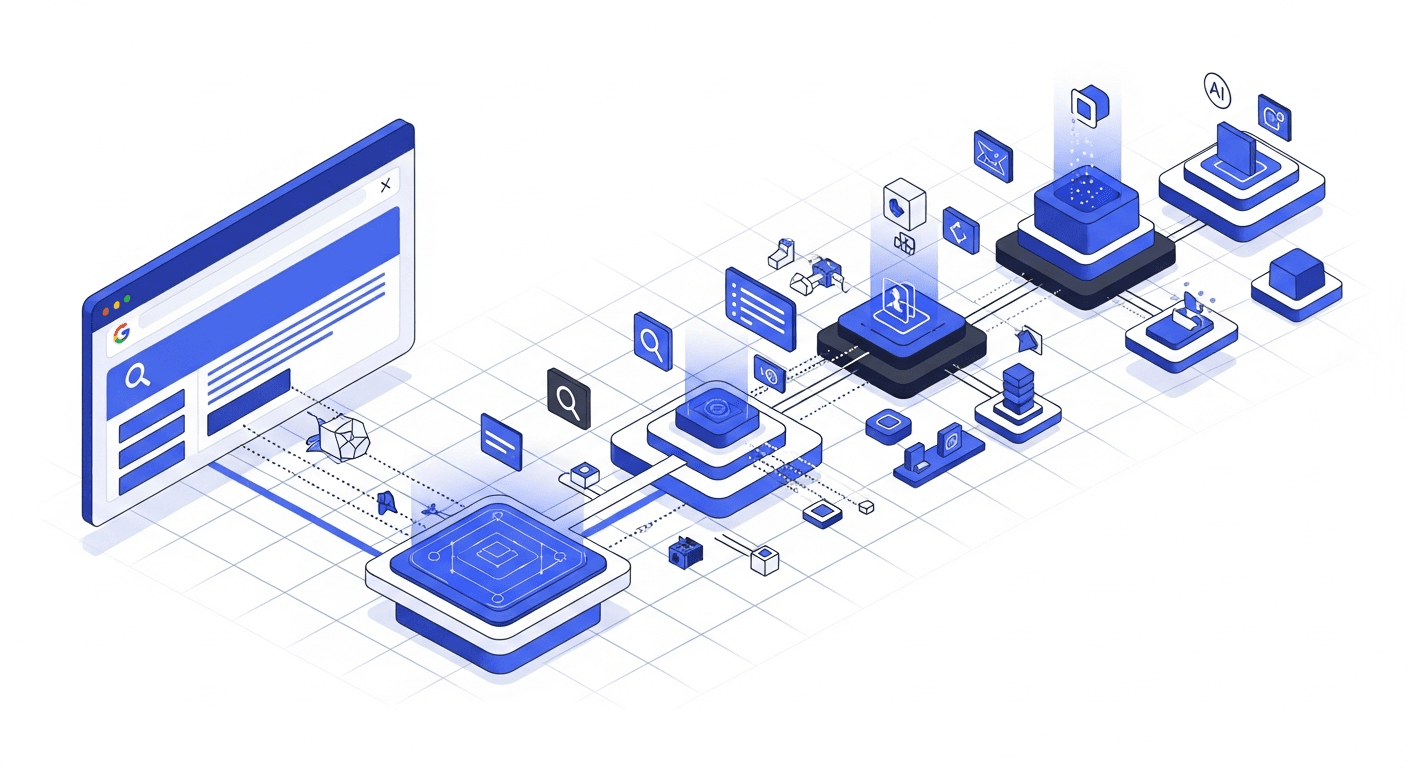
Google will no longer be a search engine: what Pichai really announced
In a recent interview, Sundar Pichai, Google's CEO, stated that the company is evolving toward a role as an "agent manager" rather than a simple search engine. This statement marks a major strategic shift for the company that has dominated 91% of the online search market for two decades.
Concretely, Google no longer wants to simply show you links to web pages. The goal is to become a platform where autonomous AI agents execute tasks for you: booking a restaurant, comparing suppliers, negotiating a contract, analyzing a market. The traditional search engine becomes an orchestrator of specialized artificial intelligences.
For SME and mid-market company leaders, this evolution raises a fundamental question: how will your business be represented, recommended, or ignored by these agents? The answer will determine your visibility over the next 3 to 5 years.
From blue links to agentic systems: understanding the transformation
The historical model: indexing and ranking pages
Since 1998, Google has operated on a simple principle: crawl the web, index pages, rank them according to their relevance and authority. Users type a query, get a list of links, click, visit the site. This model generated $307 billion in advertising revenue for Google in 2023.
In this system, companies optimize their pages to appear in the top results. Traditional SEO consists of:
- Targeting strategic keywords
- Creating quality content around these terms
- Obtaining backlinks from authoritative sites
- Optimizing site technical aspects for indexation
The new model: orchestrating agents that act
The agentic system works differently. An AI agent is an autonomous program capable of understanding an objective, breaking down necessary steps, using external tools, and providing concrete results. Google becomes the conductor coordinating these agents.
Concrete example: a procurement director asks "find me three eco-friendly packaging suppliers in Belgium with FSC certification and delivery under 15 days." In the classic model, Google displays links to directories or supplier sites. In the agentic model, an agent analyzes databases, verifies certifications, compares delivery times, potentially contacts suppliers, and presents a qualified shortlist.
The difference is radical: users no longer need to visit your site. The agent does it for them, extracts relevant information, and makes a decision or formulates a recommendation.
What AI agents will look for: the new visibility criteria
Structured data becomes critical
AI agents don't "read" your pages like humans. They extract structured data: prices, delivery times, certifications, contact details, geographic areas served, payment terms. If this information isn't explicitly tagged in your HTML code, the agent won't find it or will misinterpret it.
At AISOS, we observe that less than 15% of French B2B sites correctly use Schema.org markup for their commercial offerings. This technical gap becomes a major handicap in an agentic environment.
Priority actions:
- Implement Organization markup with all legal and commercial information
- Use Product or Service with detailed attributes for each offering
- Add structured FAQs answering buyers' frequent questions
- Declare certifications and accreditations in machine-readable format
Topical authority replaces domain authority
AI agents evaluate the credibility of a source on a specific topic, not a site's general reputation. A company blog with 50 in-depth articles on green logistics will be considered more reliable on this subject than a major generalist media outlet.
This logic favors companies that develop documented expertise in their field. Agents look for:
- Clear definitions and technical explanations
- Case studies with quantified data
- Objective comparisons between solutions
- Regular updates proving active monitoring
Multi-platform reputation becomes a signal
Agents don't limit themselves to your site. They cross-reference information with Google Business reviews, LinkedIn profiles, trade press mentions, professional forums. An inconsistency between what you declare and what other sources report triggers a distrust signal.
Verify information consistency across:
- Google Business Profile (NAP: name, address, phone)
- LinkedIn Company Page and executive profiles
- Industry professional directories
- Official registries (Companies House, Belgian BCE)
- B2B review sites (Trustpilot, Capterra for SaaS)
Impact on B2B buying journey: three concrete scenarios
Scenario 1: service provider search
A CFO asks an AI agent to find an accounting firm specializing in industrial mid-market companies in the Lyon region. The agent will:
- Identify firms declaring this specialization
- Verify their actual presence in the geographic area
- Analyze client testimonials mentioning industrial companies
- Compare offered services and pricing ranges if available
- Present 3 to 5 options with comparative summary
If your firm lacks an explicit page on industrial expertise, indexable client testimonials, or indicative pricing, you don't exist for the agent.
Scenario 2: technical problem resolution
A maintenance manager seeks a solution to reduce downtime on a production line. The agent will identify companies offering predictive maintenance, compare their technologies, evaluate compatibility with the client's existing equipment.
Companies documenting their use cases with precise data (34% reduction in unplanned stops, 8-month ROI) will be recommended. Those remaining vague ("significant performance improvement") will be ignored.
Scenario 3: competitive intelligence
An executive requests analysis of emerging players in their market. The agent compiles public information: funding rounds, hiring, filed patents, announced partnerships, offering evolutions. Companies that communicate regularly and structure their announcements will be better mapped than those remaining discreet.
Adaptation strategy: priority projects for 2025
Project 1: machine readability audit
Before taking action, assess how AIs currently perceive your company. Ask questions to ChatGPT, Perplexity, Google AI Overview about your sector, competitors, your brand. Analyze:
- Are you mentioned in responses?
- Is information accurate and current?
- Which competitors appear in your place?
- What sources are cited when discussing your field?
Project 2: restructuring existing content
Transform your commercial pages and articles into self-sufficient resources. Each page should answer a specific question without requiring additional navigation. Agents extract fragments, not user journeys.
Rewriting principles:
- Start each section with a clear, quotable statement
- Include key entities (proper names, locations, certifications) explicitly
- Add verifiable numbers rather than superlatives
- End with a memorable summary or definition
Project 3: creating "agentic" content
Develop formats that agents prioritize:
- Definition pages: "What is [concept from your sector]?"
- Neutral comparisons: objective analysis of different approaches or technologies
- Decision guides: criteria for choosing a service provider, solution, equipment
- Industry data: statistics, trends, benchmarks with cited sources
Project 4: consolidating multi-source presence
Agents cross-reference information. Invest in your presence on platforms that AIs consider reliable:
- Wikipedia (if your company meets notability criteria)
- LinkedIn: long articles, newsletters, executive contributions
- Trade press: opinion pieces, interviews, case studies
- Podcasts and webinars: indexable transcriptions
- GitHub or industry equivalents for technical documentation
Risks of inaction: what invisible companies lose
The shift to the agentic model won't be gradual. Google already deploys AI Overview on 15% of queries in the United States and is accelerating in Europe. By 2026, most B2B informational searches will include AI-generated summaries.
Companies that don't adapt their strategy will see:
- A drop in organic traffic: fewer clicks when AI answers directly
- A loss of inbound leads: agents will recommend better-referenced competitors
- An erosion of brand awareness: absence from conversations where decisions are made
- A lasting competitive disadvantage: topical authority builds over years
Conversely, early adopters of GEO optimization will benefit from a reinforcement effect: the more they're cited, the more their authority increases, the more they're cited.
Conclusion: preparing your business for the agentic web
The transformation announced by Sundar Pichai isn't a distant vision. It's currently being deployed. Google, Microsoft, OpenAI, and other AI players are investing massively to become the essential intermediaries between decision-makers and the information they need.
For SMEs and mid-market companies, this evolution represents both risk and opportunity. A risk if you remain passive and let competitors occupy the space. An opportunity if you act now to structure your presence, document your expertise, and become a source that AI agents recognize and recommend.
AISOS audits reveal that most B2B companies can significantly improve their agentic visibility in 6 to 12 months with a targeted strategy. The starting point is always the same: understand how AIs perceive you today, identify gaps with your desired positioning, and systematically close these gaps.
The question is no longer whether the agentic web will transform your market. The question is whether you'll be among the companies that agents recommend, or among those they ignore.


