The AI crash predicted on Reddit: how can businesses prepare?
The AI bubble is showing signs of bursting. Defensive strategies for SMEs/mid-market companies: diversification, realistic ROI and anti-fragile positioning.

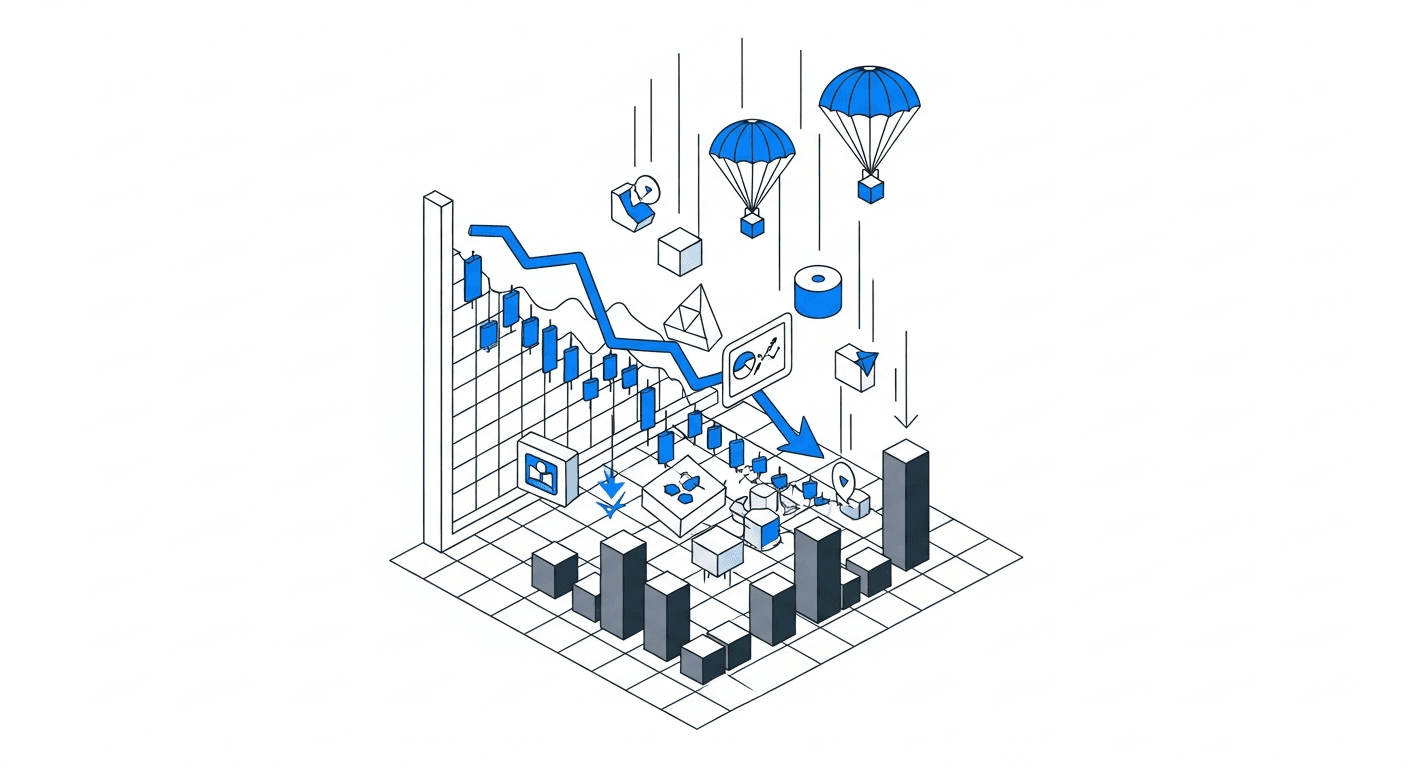
A Warning Signal from the Tech Community
In May 2025, a Reddit post titled "My god there is an enormous crash just waiting to happen" garnered over 1,570 upvotes and nearly 600 comments. The message was clear: AI company valuations are disconnected from their actual revenue, investments exceed all economic rationality, and a brutal correction seems inevitable.
This isn't an isolated alarm bell. Goldman Sachs analysts estimate that AI infrastructure investments will reach $1 trillion in the coming years, with returns on investment still uncertain. Sequoia Capital has calculated an "AI revenue gap" of $500 billion between infrastructure spending and revenue generated by AI applications.
For SME and mid-market company leaders in France and Belgium, the question is no longer whether a correction will occur, but how to prepare for it. This article breaks down the signs of the AI bubble and offers concrete strategies to transform this risk into a competitive advantage.
Anatomy of a Bubble: Signals You Need to Monitor
Valuations Disconnected from Fundamentals
Nvidia, symbol of the AI gold rush, saw its market capitalization exceed $3 trillion in 2024. The price-to-earnings ratio of many AI companies ranges between 50 and 200, compared to a historical average of 15 to 20 for the S&P 500. This disconnect echoes the Internet bubble of 2000, where "eyeballs" replaced revenue as a valuation metric.
Infrastructure Overcapacity
Hyperscalers (Microsoft, Google, Amazon, Meta) are building data centers at a frantic pace. Meta announced a $65 billion investment for 2025. The problem: actual demand for AI inference remains below installed capacity. When supply structurally exceeds demand, prices collapse and margins follow.
AI Vendor Consolidation
The B2B AI tools market currently includes over 15,000 startups. The majority will never achieve profitability. Acquisitions and closures will accelerate in 2025-2026. If your business depends on a niche AI tool, you risk seeing your supplier disappear or pivot abruptly.
User Fatigue and "AI Washing"
According to a 2024 Gartner study, 30% of generative AI projects will be abandoned after the pilot phase by 2025. Marketing promises exceed the actual capabilities of tools. This growing disappointment fuels skepticism that can turn into rejection.
Why SMEs and Mid-Market Companies Are Particularly Exposed
Large enterprises can absorb the failure of a €2 million AI project. For an SME with an annual technology budget of €200,000, a bad AI investment can compromise digital transformation for three years.
Three vulnerabilities specific to SMEs and mid-market companies:
- Single vendor dependency: many companies have bet everything on ChatGPT or a vertical tool. If OpenAI changes its pricing (already +300% on certain API plans in 2024), your business model could become unviable.
- Lack of internal expertise: without a data team, you depend entirely on external providers to evaluate solution relevance. This information asymmetry exposes you to snake oil salesmen.
- Poorly calculated ROI: AI productivity gains are often overestimated. A 2024 MIT study shows that real gains range between 10 and 40%, far from the 300% announced by certain vendors.
At AISOS, we observe that 60% of SMEs consulting with us have invested in AI tools without defining clear success metrics. This absence of framework makes any objective evaluation of return on investment impossible.
Defense Strategy Number One: Diversify Your AI Stack
The golden rule: never depend on a single supplier for a critical function. Here's how to apply this principle to your AI infrastructure.
Map Your Current Dependencies
List all AI tools used in your company, including "shadow AI" adopted by teams without IT validation. For each tool, identify:
- The business function covered
- Monthly or annual cost
- Level of dependency (critical, important, accessory)
- Existence of viable alternatives
Build a Multi-Model Architecture
For critical uses, test and maintain connections with at least two LLM providers. Concrete examples:
- Content generation: GPT-4 (OpenAI) + Claude (Anthropic) + Mistral Large
- Data analysis: Azure OpenAI + Google Vertex AI
- Automation: Zapier AI + Make + n8n (open source)
This redundancy has a cost, but it protects you against unilateral price increases, service outages, and changes in terms of use.
Prioritize Solutions with Data Portability
Before adopting an AI tool, verify that you can export your data in a standard format. Custom prompts, fine-tunings, and knowledge bases must remain your property and be transferable.
Defense Strategy Number Two: Establish a Realistic ROI Framework
Enthusiasm for AI has generated unrealistic expectations. To avoid disappointments, adopt a rigorous evaluation methodology.
The RICE Framework Adapted for AI
For each AI project, calculate a score based on four criteria:
- Reach: how many employees or processes are impacted?
- Impact: what measurable gain (time, euros, quality)?
- Confidence: what level of certainty on these estimates?
- Effort: what total investment (license, integration, training, maintenance)?
RICE Score = (Reach × Impact × Confidence) / Effort
Ruthlessly prioritize projects with the best score. Abandon those based on unverified assumptions.
Measure Before, During, and After
Too many companies deploy AI without a baseline. How can you know if you've gained 20% productivity if you haven't measured initial productivity?
Metrics to track mandatory:
- Average time per task before and after AI
- Error or rework rate
- User satisfaction (internal NPS)
- Total cost of ownership including human supervision time
Integrate the Cost of Failure into Your Projections
With an AI project failure rate estimated at 70-80% (source: Gartner), your business case must integrate this probability. A project promising €100,000 in gains with a 30% chance of success has an expected value of only €30,000.
Defense Strategy Number Three: Build an Anti-Fragile Position
The concept of anti-fragility, developed by Nassim Taleb, describes systems that strengthen under stress. Here's how to apply it to your AI strategy.
Invest in Skills Rather Than Tools
Tools change, skills remain. Train your teams to:
- Understand the fundamentals: what is an LLM, how does a prompt work, what are the limitations?
- Evaluate output quality: detect hallucinations, verify sources, maintain critical thinking
- Orchestrate multiple tools: value comes from intelligent integration, not individual tools
An employee who understands AI can switch from ChatGPT to Claude in one day. An employee who has memorized specific prompts is lost if the interface changes.
Capitalize on What AI Cannot Do
During a correction period, companies that invested in AI as "human replacement" will suffer. Those who used it to enhance their distinctive capabilities will prosper.
What AI will not replace:
- Authentic and personalized customer relationships
- Deep sector expertise
- Judgment capacity in unprecedented situations
- True creativity, not statistical recombination
Invest in these areas alongside your AI projects.
Maintain a Technology Cash Reserve
Don't deploy 100% of your innovation budget in AI today. Keep 20 to 30% in reserve to:
- Seize post-crash opportunities (tool acquisitions at bargain prices, available talent)
- Migrate quickly if your main supplier goes bankrupt
- Invest in the next technology wave
Prepare Your Visibility for the Post-Bubble Era
An AI crash will have consequences on how businesses search for information. AI answer engines (ChatGPT, Perplexity, Gemini) might see their usage evolve, but they won't disappear.
Why GEO Remains Relevant Even in Case of Correction
A stock market correction doesn't erase established usage patterns. Google survived the bursting of the Internet bubble. LLMs will survive the bursting of the AI bubble, probably in consolidated form around three or four major players.
Companies that have built their thematic authority and presence in sources cited by LLMs will benefit from a lasting advantage. AISOS audits reveal that companies mentioned in AI responses today retain this position in 85% of cases six months later, even after major model updates.
Concrete Actions for Your Visibility
- Create content that answers specific questions: LLMs cite sources that give direct answers, not vague content
- Structure your data: schema.org, FAQ, clear definitions of your entities (company, leaders, products)
- Diversify your presence: don't bet everything on Google, be present on sources that LLMs consult (Wikipedia, trade press, sector databases)
Conclusion: Transforming Threat into Opportunity
The predicted AI crash is not a fatality to endure, but a scenario to integrate into your strategic planning. Companies that will emerge stronger are those that will have:
- Diversified their technological dependencies
- Established realistic and measurable ROI frameworks
- Invested in human skills rather than tools alone
- Maintained reserves to seize post-correction opportunities
- Built lasting visibility in new discovery channels
The Internet bubble destroyed thousands of overvalued companies, but it also enabled the emergence of Amazon, Google, and digital commerce fundamentals. The AI bubble will probably follow the same pattern: destruction of excesses, consolidation around viable players, and massive opportunities for prepared companies.
Your next step: audit your current AI dependency and build your resilience plan. Leaders who act now will have a decisive advantage when the correction arrives.


