DeepSeek rank tracking in 2026: how to monitor your AI visibility
Looking for a DeepSeek rank tracking tool like you use for Google? This guide explains why traditional rank tracking does not apply to LLMs, and how to actually measure your brand visibility in DeepSeek, ChatGPT, and Perplexity responses.

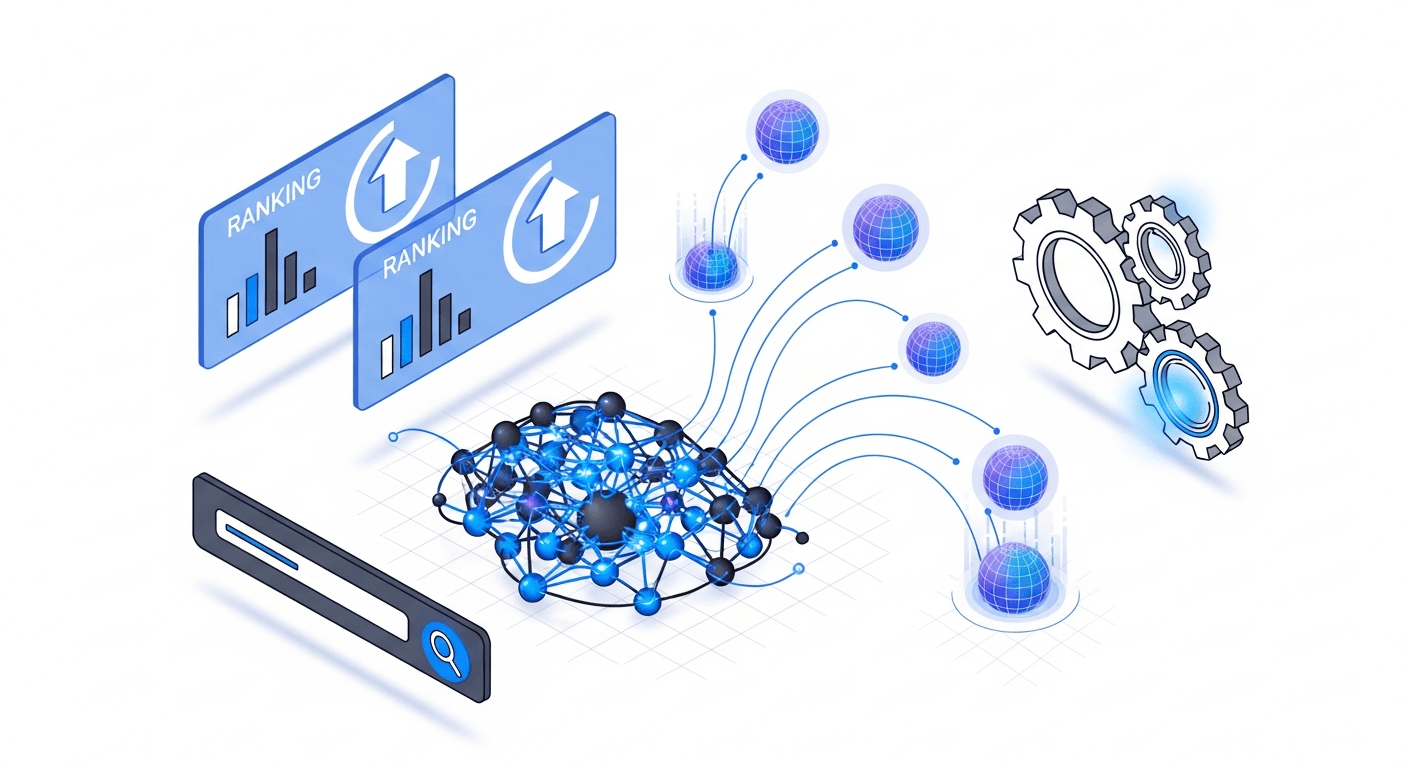
Why so many people are searching for DeepSeek rank tracking tools
Since DeepSeek R1 launched in January 2026, this Chinese LLM has gained massive adoption worldwide. Marketers, SEO managers, and business owners quickly asked a natural question: does my website appear in DeepSeek answers?
The logic is straightforward: if millions of users are asking DeepSeek questions instead of Googling, and DeepSeek answers without linking back to your site, you are losing a growing share of potential audience. Hence the search for a "DeepSeek rank tracking" solution.
There is just one problem: DeepSeek is not a search engine. And that changes everything.
DeepSeek is an LLM, not a search engine
Google ranks web pages in a numbered SERP (position 1, 2, 3...). DeepSeek generates a natural language response from billions of parameters trained on web text. There is no "position 1" or "page 2" in DeepSeek.
What you actually want to measure is not a numeric rank. It is a binary and then qualitative question:
- Does DeepSeek cite my brand or website when a user asks a question relevant to my industry?
- In what context am I cited (recommended, compared, cautioned against)?
- Across how many LLMs am I visible (ChatGPT, Gemini, Perplexity, Claude, DeepSeek)?
This is what is called AI visibility, as opposed to traditional SEO positioning.
How does DeepSeek decide what to cite?
DeepSeek, like all large language models, was trained on massive web text corpora. Its responses reflect statistical patterns from that training data. Several factors influence whether your brand or content is mentioned:
- Presence on authoritative sources: Wikipedia, specialist press, sectoral forums (Reddit, etc.) are over-represented in LLM training data. A site cited in these sources is more likely to appear in responses.
- Brand entity consistency: if your name, services, and positioning are described consistently across many sites, the model has clear signals to associate you with a topic.
- Content quality and depth: LLMs preferentially cite content that answers specific questions exhaustively, with data, numbers, and clear structure.
- Mention frequency: the more your brand is positively mentioned in quality web sources, the more the model perceives it as a reference in its domain.
3 methods to track your visibility in DeepSeek
Method 1: manual testing (free, but not scalable)
The simplest approach is to ask DeepSeek questions about your industry and check whether your brand appears. For example, if you run a cybersecurity consultancy:
- "What are the best cybersecurity consulting firms in Europe?"
- "Who would you recommend for a GDPR compliance audit?"
- "Which companies specialise in data protection for SMEs?"
This gives a quick impression but does not scale. LLM responses vary with question phrasing, language, and even session. Getting a representative view would require testing hundreds of prompts manually — not realistic.
Method 2: AI monitoring tools (automated)
Platforms specialising in AI visibility tracking have emerged since 2025. Their principle: automatically send defined prompts to multiple LLMs (ChatGPT, Perplexity, Gemini, DeepSeek, Claude) and analyse whether your brand is cited in responses, in what context, and with what frequency.
These tools allow you to:
- Track how your mention rate evolves over time
- Compare your visibility to that of competitors
- Identify prompts for which you do not yet appear
- Receive alerts if your mention rate drops sharply
Method 3: AI visibility audit (baseline diagnosis)
Before setting up ongoing monitoring, an AI visibility audit gives you a complete picture of your current situation. The audit tests your presence across major LLMs for a set of questions relevant to your industry, and identifies gaps and priority opportunities.
This is the recommended starting point if you are beginning from scratch: there is no value in monitoring without first understanding your baseline.
DeepSeek vs ChatGPT vs Perplexity: what differs for your visibility?
Each LLM has distinct behaviours that influence your visibility:
- ChatGPT (OpenAI): the most used model worldwide. Rarely cites URLs directly but mentions brands and services by name. Priority: be mentioned in sources GPT-4 has crawled (Wikipedia, press, authority blogs).
- Perplexity AI: AI search engine with explicit citations. Cites Reddit in 46.7% of its answers. Very oriented towards recent web sources. Priority: optimising for Perplexity means optimising for the sources it crawls (Reddit, specialist press, your own site with structured content).
- Google Gemini: integrated into the Google ecosystem. Favours sources well-ranked in Google Search. If you rank well on Google, you already have a base.
- DeepSeek: model trained on broad web crawl with strong representation of Chinese and international sources. Its citation behaviour differs from ChatGPT, notably for non-English sector sources.
- Claude (Anthropic): model prioritising accuracy and caution. Less likely to name brands without strong justification. Priority: be the obvious answer, not just mentionable.
An effective AI visibility strategy does not target a single LLM. It builds a coherent presence that registers across all models simultaneously.
What to actually measure
If you want to replace your SEO dashboard with an AI equivalent, here are the relevant metrics:
- Mention rate: out of 100 prompts relevant to your sector, in how many is your brand cited?
- LLM coverage: across how many LLMs are you visible? (ChatGPT, Gemini, Perplexity, DeepSeek, Claude)
- Citation context: are you cited as a primary recommendation, in a comparison, or as a warning?
- AI share of voice: among brands cited for your target queries, what is your share?
- Time trend: is your visibility growing or declining week over week?
How to improve your visibility in DeepSeek (and other LLMs)
The levers are the same across all LLMs, because they share common training fundamentals:
- Build a consistent brand entity: your name, positioning, and specialisations must be described identically across all your platforms (website, LinkedIn, Wikipedia if applicable, press).
- Publish content that answers specific questions: LLMs preferentially cite content that directly answers a question, with concrete data and readable structure (H2, lists, tables).
- Earn mentions on third-party sources: specialist press, forums, comparison platforms, third-party case studies. External mentions are the strongest signal for models.
- Implement structured data: Schema.org (Organization, FAQPage, HowTo) helps LLMs understand who you are and what you do.
- Create an llms.txt file: this emerging standard (inspired by robots.txt) allows you to indicate to LLMs which part of your content is most relevant for answering questions.
Frequently asked questions
Does a dedicated rank tracking tool exist for DeepSeek?
There is no Google Search Console equivalent for DeepSeek. DeepSeek does not provide a public API to see which sites are cited in its responses. AI monitoring tools work around this by automatically sending prompts to DeepSeek and analysing the responses received.
Does DeepSeek have positions like Google?
No. DeepSeek generates a natural language response without ranking pages in a numbered list. The concept of "position 1" does not exist. What matters is whether your brand is cited in the response, and in what context.
How do I know if DeepSeek cites my site?
Three methods: (1) manual testing by asking DeepSeek questions about your industry, (2) using an AI monitoring tool that automates these tests, (3) an AI visibility audit that gives a complete diagnosis of your presence across all major LLMs.
If my site ranks well on Google, does it automatically appear in DeepSeek?
Not necessarily. LLMs were trained on static data (web corpus at a given date). Good Google rankings today do not imply good LLM visibility, whose training data may be months or years old. The signals that matter for LLMs (third-party mentions, brand consistency, structured content) are not identical to classic SEO signals.
Is optimising for DeepSeek different from optimising for ChatGPT?
The fundamentals are shared: brand consistency, quality content, mentions on authoritative sources, structured data. The nuances lie in which sources each model favours in its training data. A well-built multi-LLM strategy makes you visible across all models simultaneously without adapting your content to each one separately.
Co-founder and COO of AISOS. GEO Expert, he builds the AI visibility system that turns businesses from invisible to recommended.


