AI Visibility vs SEO: Key Differences and Why Both Matter in 2026
Classic SEO and AI visibility are two distinct disciplines. The data proves it. We analyze the differences and what they mean for your digital strategy.

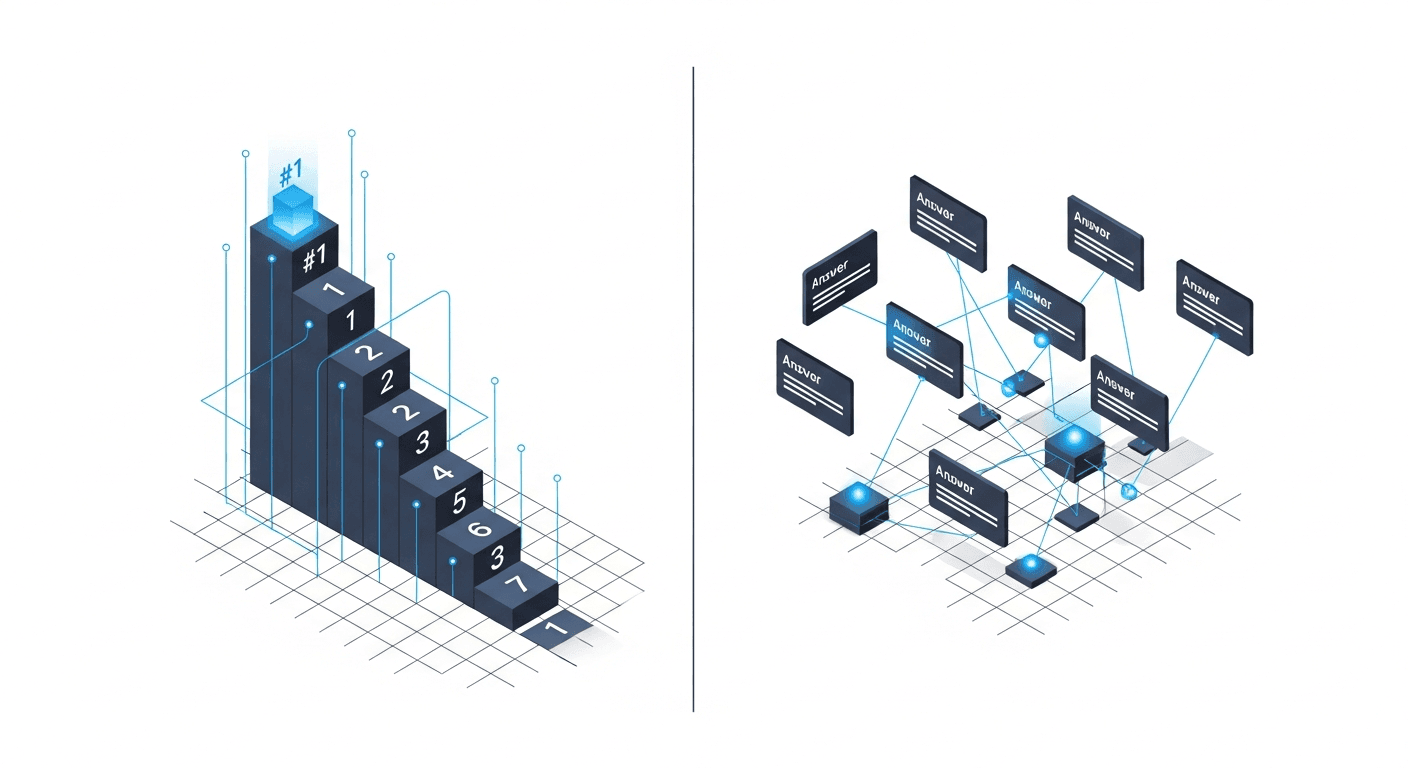
One number should be enough to convince: nearly 80% of sources cited by major LLMs don't appear in Google's top 100 for the corresponding queries. This data comes from a SparkToro/Rand Fishkin analysis, and it changes everything we thought we knew about online visibility.
Ranking first on Google doesn't mean being cited by AI. Being absent from Google doesn't prevent being recommended by ChatGPT.
We work with B2B companies that discover this with astonishment. Sites with a Domain Authority of 60+ that don't exist for LLMs. Niche blogs with 500 monthly visits that are systematically cited by Perplexity.
Two systems, two logics
Google ranks URLs. It analyzes your page, measures its technical and editorial relevance, evaluates your backlinks, and assigns it a position. It's a document ranking system.
An LLM does something else. It doesn't rank pages -- it synthesizes knowledge. When someone asks "What's the best invoicing software for a Belgian SME?", it doesn't look for the best page on the topic. It compiles everything it "knows" about invoicing software, Belgian SMEs, and the reviews it encountered in its training data, then generates a coherent response.
The consequence is radical: the criteria that make you visible are not the same.
What Google values (and AI doesn't)
Backlinks. SEO pillar for 20 years. A link from a high-authority site measurably boosts your Google ranking. But an LLM doesn't count your backlinks. It doesn't even know how many you have. What matters to it is the frequency your name appears in varied contexts -- not the number of links pointing to your site.
Page speed and Core Web Vitals. Google penalizes slow sites. An LLM couldn't care less. It ingested your content during training; your server speed changes nothing about its memory.
Technical site architecture. Flawless internal linking, clean URLs, an up-to-date sitemap -- all helps Google. For an LLM, your site architecture is largely invisible. What interests it is the text, not the HTML structure around it.
What AI values (and Google doesn't)
Multi-source presence. An LLM cross-references information. If your brand appears on your website, in a press article, on a Clutch profile, in a Reddit discussion, and in a LinkedIn publication -- the model accumulates "evidence" that you exist and are relevant. Google doesn't care about your Reddit profile.
Clear definitions and affirmative sentences. "AISOS specializes in AI visibility for B2B companies in Belgium." This sentence is perfect for an LLM. It's factual, specific, and easily "citable." For Google, it has no particular SEO value.
Perceived notoriety in a specific domain. An LLM associates entities with areas of expertise. If multiple independent sources mention your company in the context of [your expertise], the model eventually considers you a reference in that field. It's not PageRank. It's semantic reputation.
Companies winning on both fronts
The good news: the two disciplines aren't incompatible. Some actions serve both.
Quality content, for example. A deep article with original data and demonstrated expertise will rank well on Google AND be retained by LLMs. But the nuance is in the format. For Google, you'll optimize title tags, meta descriptions, keyword density. For AI, you'll include affirmative sentences, clear definitions, and contextual brand mentions.
Schema.org serves both too. Google uses it for rich snippets. LLMs use it to identify entities and understand relationships between them.
But some actions are specific to each channel. Investing in backlinks is pure SEO. Publishing on Reddit and LinkedIn to increase your multi-source footprint is pure AI visibility.
What this means for your budget
The practical question: do you need to double your investments? Not necessarily. But you need to allocate differently.
We see too many companies putting 100% of their digital budget into classic SEO. Backlinks, technical optimization, keyword-driven content marketing. That was a perfectly good choice in 2023. In 2026, it's a risky bet.
Our recommendation for European B2B companies: dedicate 30% of your efforts to pure AI visibility. Digital press relations, review platform profiles, "citable" content, advanced semantic markup, llms.txt file.
It's a modest investment that opens an entirely new visibility channel. A channel where competition is still low, because the majority of companies haven't even started.
The time to act is when nobody else is
We often hear: "We'll wait until AI visibility is more mature." That's exactly what companies said when they ignored SEO in 2005. Those who waited then spent three times more catching up with those who started early.
LLMs have 2 billion active users. Perplexity processes 100 million queries per week. Google's AI Overviews now reach 40% of searches in Europe.
These numbers aren't going down.
Classic SEO remains useful -- we're not saying to abandon it. We're saying it's no longer enough. Digital visibility in 2026 is Google and AI. The companies that understand this are pulling ahead. The others are waiting.
Which camp are you in?
Co-founder and COO of AISOS. GEO Expert, he builds the AI visibility system that turns businesses from invisible to recommended.


