Why ChatGPT recommends your competitors (and not you)
You rank first on Google, but ChatGPT never mentions you. Your competitors appear in every response. Here's why -- and how to turn it around.

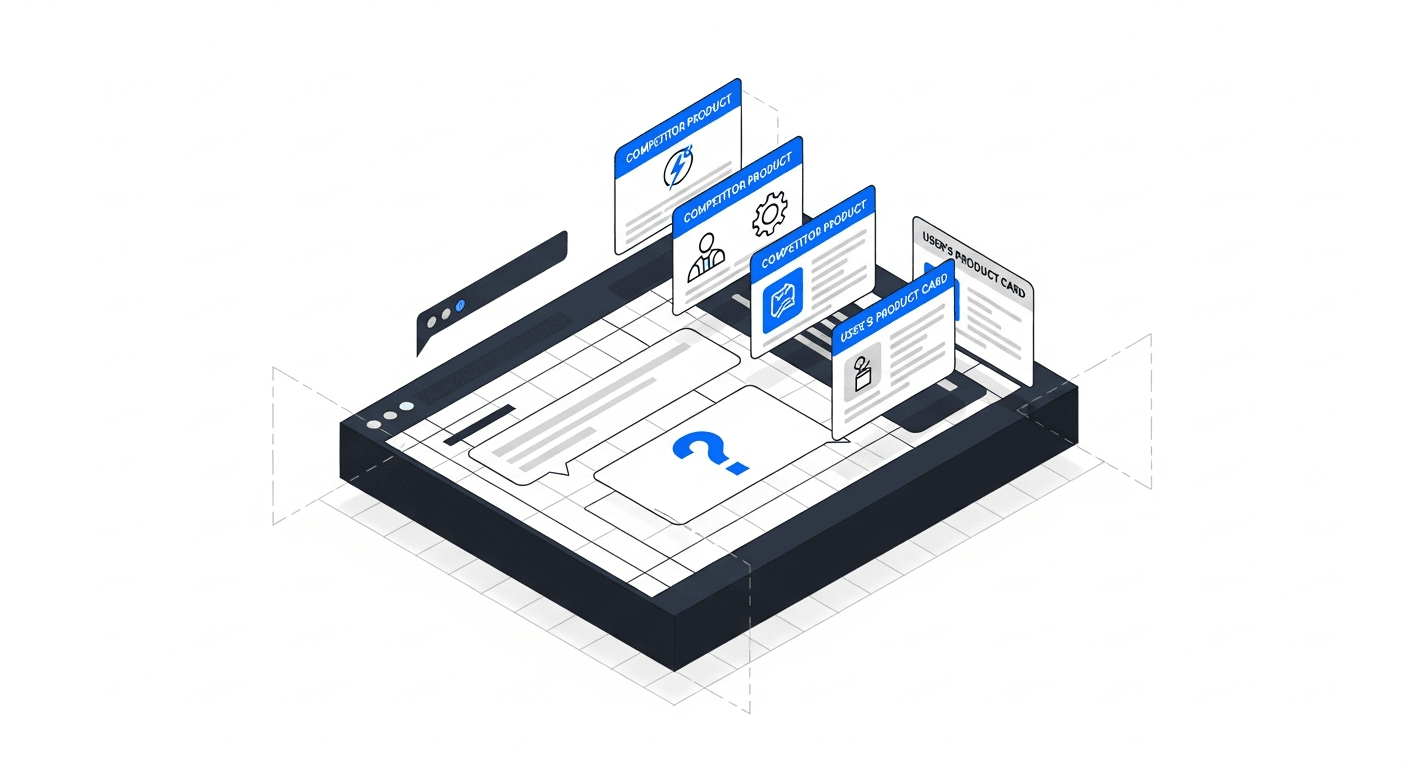
The owner of an industrial SME in Namur asked us the question last week: "We rank #1 on Google for our main keywords. But when I ask ChatGPT to recommend a supplier in our sector, it cites three competitors. Not us."
This question keeps coming up on professional forums. And the answer is uncomfortable, because it challenges a deeply held belief: ranking well on Google is enough to be visible.
No. Not anymore.
LLMs don't work like Google
Google ranks pages. ChatGPT, Perplexity, and Gemini synthesize knowledge. The difference is fundamental, and most companies haven't grasped it yet.
A search engine crawls your site, indexes your pages, and ranks them according to hundreds of technical and editorial criteria. An LLM has absorbed billions of texts during its training. It doesn't "search" your site in real time -- it recalls what it has learned. And what it learned depends on what was available, repeated, and structured in its training data.
Concretely: if your competitor is cited in press articles, comparisons, case studies, technical forums, and LinkedIn publications -- and you're only present on your own site -- the LLM "knows" your competitor. Not you.
Google ranking and AI citation are two different things
A study by Rand Fishkin (SparkToro) showed that nearly 80% of sources cited by LLMs don't even appear in Google's top 100 for the corresponding queries. Read that number again. It means your Google position has virtually no correlation with your visibility in AI responses.
Why? Because LLMs prioritize:
- Clearly defined entities -- your brand must be unambiguously associated with your industry
- Multi-source repetition -- a mention on your site isn't enough; others need to talk about you too
- Semantic structure -- organized data (schema.org, marked-up FAQs, clear definitions) that the model can easily extract
- Perceived authority -- not PageRank, but the frequency your name appears in trustworthy contexts
Your competitors probably do these three things you don't
We've audited over 40 B2B companies in Belgium and France since January. Those that appear in LLM responses share three traits.
First, they exist outside their own website. Guest articles, interviews in industry press, contributions on specialized forums, detailed answers on Quora or Reddit. Every external mention is a signal the LLM can pick up.
Second, they use semantic markup. Schema.org Organization, structured FAQs, author tags with verifiable profiles. This isn't cosmetic SEO -- it's how models identify and categorize an entity.
Third, they publish content that answers specific questions. Not vague "our services" pages. Articles that directly address the questions users ask chatbots. "What's the best ERP for an industrial SME in Belgium?" If your competitor has an article answering exactly that question, they'll be cited. You won't.
What you can do this week
First, test your current visibility. Open ChatGPT, Perplexity, and Gemini. Ask the 10 questions your potential clients ask before buying. Note who gets cited. If it's not you, you have your diagnosis.
Then, three immediate actions:
Create a page that clearly defines your expertise. Not a corporate "about" page. A page that clearly states: "[Your company] specializes in [specific domain] for [specific audience] in [geographic area]." LLMs love clean definitions.
Publish on at least 3 external platforms this month. A guest article, a detailed answer on an industry forum, a long-form LinkedIn post. The goal: your name appearing in varied contexts.
Add schema.org Organization and FAQ markup on your key pages. It's technical, takes two hours, and changes how AI models interpret your content.
The real problem is time
LLM training data isn't updated in real time. What you publish today will take weeks, sometimes months, to be integrated. Tools like Perplexity and ChatGPT's "search" mode are faster -- they access the web live -- but the base model has a dated memory.
That means one thing: every day you don't act is another day of delay behind your competitors who are already building their AI presence.
We see this daily with our Belgian clients. Those who started three months ago are beginning to appear. Those waiting "to see how things evolve" are still invisible.
Your Google ranking no longer protects you. The question is no longer "are you well-referenced?" -- it's "does AI know you exist?"
Co-founder and COO of AISOS. GEO Expert, he builds the AI visibility system that turns businesses from invisible to recommended.


