
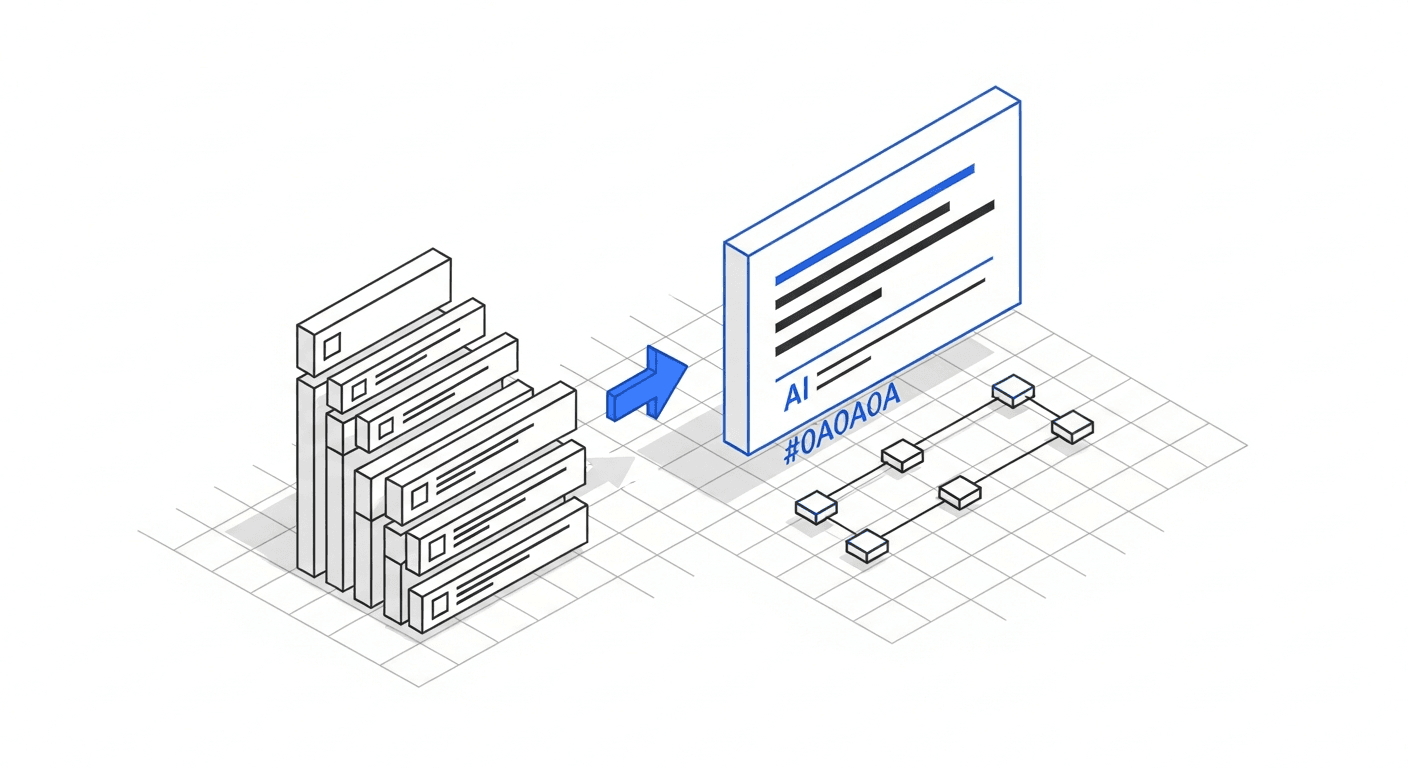
Definition: AEO in simple terms
AEO -- Answer Engine Optimization -- is the set of techniques that allow your content to be selected, cited and recommended by AI answer engines.
An answer engine is not a classic search engine. A search engine gives you a list of links. An answer engine gives you the answer. And that answer is synthesised from sources the AI judges trustworthy.
AEO is the art of becoming that trusted source.
The term was popularised in Europe by agencies like Authoritas (London) and Searchmetrics (Berlin), which observed as early as 2024 that optimisation for featured snippets and direct answers was becoming more profitable than optimisation for classic positions. Today, AEO goes well beyond featured snippets: it encompasses the entire AI ecosystem.

SEO vs AEO: the paradigm shift
Let us stop beating around the bush. Classic SEO is not dead, but it has become insufficient. Here are the fundamental differences:
| Criterion | Classic SEO | AEO |
|---|---|---|
| Objective | Rank in the 10 blue links | Be cited in the AI response |
| Key metric | Position, CTR, organic traffic | AI citations, AI Visibility Score, mention share |
| Optimal format | Long pages, keyword-optimised | Direct answers, structured data, Q&A |
| Backlinks | Factor #1 | Important but non-linked mentions count too |
| Freshness | Variable depending on query | Critical (web LLMs prefer recent content) |
| Schema markup | Nice-to-have | Near-mandatory |
| Competition | 10 spots on page 1 | 1 to 3 sources cited per response |
For an in-depth analysis, see our dedicated article: SEO vs AEO: what are the differences in 2026?
The most critical point: in SEO, you can be in position 7 and still receive traffic. In AEO, either you are cited, or you are invisible. There is no position 7 in an AI response.
How AEO works in practice
To understand AEO, you need to understand how an LLM constructs its response. Let us simplify:
Step 1: Query comprehension. The LLM analyses the intent behind the question. "What is the best CRM for an SME?" is not treated as a purely informational query -- it is a decisional query.
Step 2: Source selection. The LLM (via its web access or pre-trained index) identifies the most relevant and trustworthy sources. This is where AEO intervenes: your goal is to be on that shortlist.
Step 3: Synthesis. The LLM extracts relevant information from each source, synthesises it, and builds a coherent response with citations.
Step 4: Attribution. The sources used are cited (more or less visibly depending on the engine). This is your visibility.
Lily Ray, SEO Director at Amsive Digital, based in London, explains: "AEO is not a technical revolution. It is a mindset revolution. You are no longer optimising for a ranking algorithm, but for a comprehension and trust system."
The 6 pillars of AEO
1. Response-format content
Your content must directly answer questions. No 300-word introduction before getting to the point. The LLM looks for extractable text blocks. Start each section with the answer, then develop.
2. Comprehensive structured data
Schema.org is no longer optional. FAQPage, HowTo, Article, Organization -- each schema type helps AI understand and categorise your content. It is the machine language of AEO.
3. Thematic authority
Publish in depth on your topic. An isolated article does not generate AI trust. A cluster of 15-20 interconnected articles on the same theme does. That is the difference between being a commentator and being a reference. See our complete AI visibility guide.
4. External mentions and citations
LLMs cross-reference sources. If your brand is mentioned on Wikipedia, recognised media, specialised forums, your trust score increases. Classic link building counts, but non-linked mentions also count in AEO.
5. llms.txt file
The new robots.txt for AI. This file tells AI crawlers which pages are most relevant and how to categorise them. Our complete guide on llms.txt explains how to implement it.
6. Freshness and updates
AI engines with web access (ChatGPT, Perplexity) prefer recent content. A 2023 article not updated will be ignored in favour of a competitor updated in 2026. Update your key content at minimum every quarter.
Implementing AEO: practical guide
Let us move to action. Here is the 4-phase process we deploy at AI SOS:
Phase 1 -- Audit (week 1). Test your 30 most strategic business queries on ChatGPT, Perplexity, and Google AI Overview. Document: are you cited? Who is cited in your place? What type of content is selected?
Phase 2 -- Quick wins (weeks 2-3). Optimise your existing pages closest to citation: add direct answers at the top of the page, structure in Q&A, add Schema.org structured data, implement llms.txt.
Phase 3 -- Creation (weeks 4-8). Produce AI-first content on queries where you have no content. Ideal format: 1500-2500 words, question-answer structure, comparison tables, FAQ, cited sources.
Phase 4 -- Monitoring (continuous). Track your AI Visibility Score every week. React quickly to citation losses. Iterate.
Ready to launch your AEO strategy?
We freely audit your visibility in AI answer engines. Discover where you stand and what you could gain.
FAQ
Is AEO the same as GEO?
Should you stop SEO to do AEO?
Absolutely not. SEO remains the foundation: good SEO feeds the Google index, which is itself the main source of Google AI Overview. AEO is an additional layer that optimises your content to be extracted and cited by AI engines. Both are complementary.
Which tools to use for AEO?
For AI citation monitoring: Otterly, Peec AI, ZipTie. For structured data: Merkle's Schema Markup Generator, Google Rich Results Test. For content analysis: Clearscope, Surfer SEO (with "AI-readiness" focus). And of course, manual monitoring remains essential.
Does AEO work for small businesses?
Yes, and it is actually an opportunity. LLMs do not rank by company size or advertising budget. They rank by content relevance and quality. An SME with expert, well-structured content can be cited ahead of a large corporation. This is one of the great advantages of AEO over traditional SEO where large budgets dominate.
How long before seeing results in AEO?
First results (appearing in Perplexity and ChatGPT responses) generally appear in 3 to 6 weeks. For Google AI Overview, count 6 to 12 weeks. The key is consistency: the more AEO-optimised content you publish, the more AI considers you a reliable source. Contact us for a personalised timeline.
Conclusion
AEO is not a buzzword. It is the reality of search in 2026. Companies that master this discipline today are building a durable competitive advantage: once AI identifies you as a reference source, it is a virtuous cycle. The more you are cited, the more you are cited.
The opposite is also true. The longer you wait, the more your competitors reinforce their position in AI responses, and the harder it will be to displace them.
The rules have changed. AEO is the new rule.


