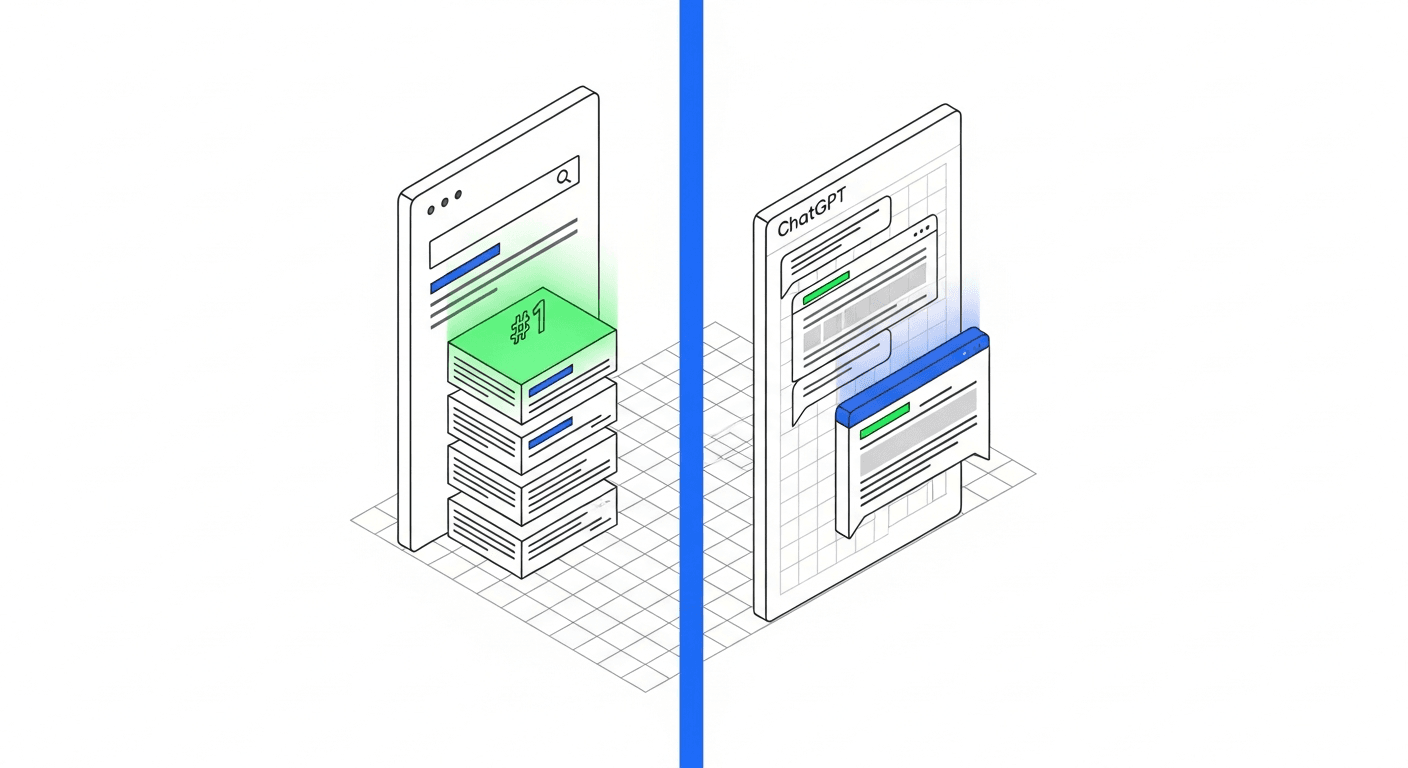
You rank #1 on Google and you're invisible on ChatGPT. Here's why.
Ranking first on Google no longer guarantees anything in AI responses. The signals LLMs use to cite a source are different from Google's. And most SEO-optimized sites ignore them.

The paradox nobody explains
A client contacted us in January. HR consulting firm, based in Liege. #1 on Google for "payroll outsourcing Belgium." Stable organic traffic. Decent conversions. Everything looked fine, on paper.
Then they typed "which firm should I outsource my payroll to in Belgium" in ChatGPT. Their company appeared nowhere. Not in the main response. Not in the sources. Not even mentioned. Instead: three competitors, including one they considered clearly inferior.
Their reaction: "Is this a bug?"
No. It's how it works.
Google and LLMs don't read your site the same way
Google ranks pages. It looks at backlinks, load speed, keywords in the title, domain authority. Twenty years of refined technical signals. You know the rules, you play the game, you climb.
LLMs don't rank pages. They synthesize information. When ChatGPT responds to "which firm should I outsource my payroll to in Belgium," it doesn't rank websites. It constructs a response from everything it ingested during training and, increasingly, from what it finds in real-time via web search.
The signals that matter are radically different:
For Google: backlinks, domain authority, on-page optimization, speed, Core Web Vitals, content freshness.
For LLMs: brand mentions on third-party sources (Reddit, forums, Quora, press), exploitable structured data, clarity of direct responses, consistency of information across different sources, presence in knowledge bases (Wikipedia, Wikidata).
Our client had flawless SEO. But zero mentions on Reddit, no Wikipedia page, minimal structured data, and a blog that talked about itself without ever being cited by others.
The three most common reasons
Reason 1: you don't exist outside your own website. LLMs give considerable weight to third-party mentions. If nobody talks about you on Reddit, Quora, industry blogs, or specialized directories, you're invisible to AI. Google can rank you first thanks to your backlinks and technical setup. LLMs need to "see" you across the broader web.
Reason 2: your content is optimized for bots, not for answers. A classic SEO article structures its H2s around keywords, places semantic variations, and matches search intent. Content that LLMs cite does something else: it answers directly, clearly, with verifiable data. No 200-word intro paragraphs before getting to the point. The answer first. The context after.
Reason 3: your brand doesn't have an entity profile. LLMs reason in "entities." An entity is a clearly identifiable concept: a person, a company, a product. For a model to cite you, it must first know who you are. That requires: a complete Organization schema, consistent information across platforms, and mentions that link your name to your area of expertise.
How to fix it
The good news: the fix doesn't require rebuilding your entire digital presence. It requires adding a new layer.
Keep your SEO. It still drives traffic and it still matters. But add these three things:
Build your off-site presence. Guest articles, press mentions, forum participation, Reddit engagement. Every third-party mention is a signal that LLMs pick up.
Add comprehensive structured data. Organization schema with sameAs links, FAQPage schema on relevant pages, Author schema on blog posts. Give the machines a clear, structured map of who you are.
Create answer-first content. When writing about a topic, lead with the answer. "The best payroll outsourcing firms in Belgium are X, Y, and Z. Here's why." LLMs love content that gets to the point.
Our client started this work in February. By April, they appeared in 5 out of 20 ChatGPT responses for their target prompts. Not perfect. But from zero to five in two months, while keeping their Google #1 position.
The two channels aren't competitors. They're complements. But you have to work both.
Co-founder and CEO of AISOS. GEO Expert, she guides businesses in their Google + AI visibility strategy.


