
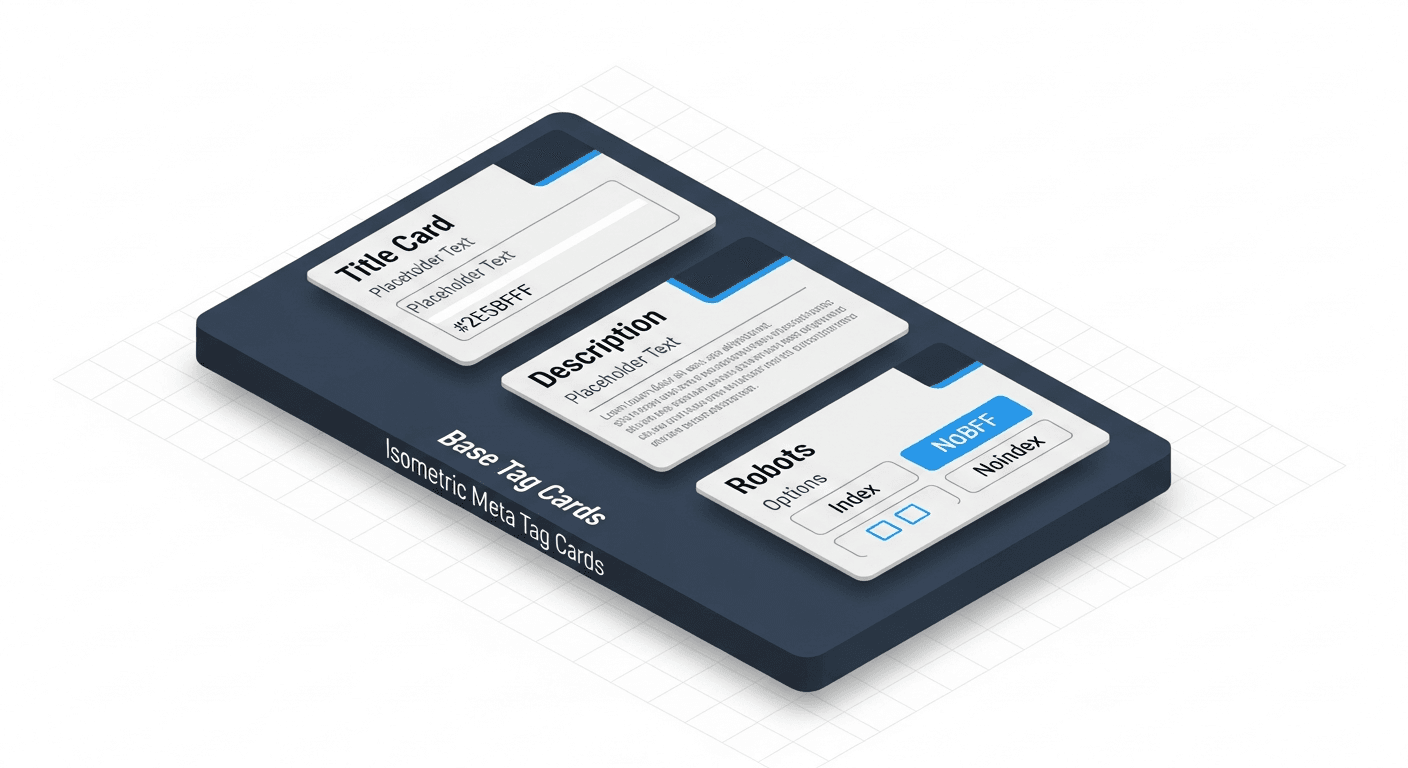
Meta tags are often treated as a chore — a field to fill in the CMS before publishing. This is a mistake. They are the first information that Google, social networks, and LLMs read about your page. They define the first impression of your content in search results, in social shares, and in AI summaries.
Paradoxically, as SEO grows more complex with the advent of AI, meta tags remain one of the simplest and most impactful levers. But they must be optimised correctly.
Essential meta tags in 2026

| Tag | SEO impact | AI impact | Recommended length |
|---|---|---|---|
| Title | High (direct ranking factor) | Medium (used to identify the topic) | 50-60 characters |
| Meta description | Indirect (influences CTR) | High (summary for LLMs) | 150-155 characters |
| Meta robots | Critical (controls indexing) | Critical (controls AI crawling) | — |
| Canonical | High (avoids duplicate content) | Medium | Full URL |
| Open Graph | Indirect (social visibility) | Low | Variable |
| Hreflang | High (multilingual sites) | Medium (content localisation) | — |
Optimising the meta title: rules and examples
The meta title is the only meta tag that is a confirmed direct ranking factor by Google. It appears in search results, in the browser tab, and in social shares (unless an Open Graph title is defined).
The golden rules
- Length: 50-60 characters. Beyond that, Google truncates with "..."
- Keyword at the start: place the main keyword within the first 30 characters
- Uniqueness: each page must have a unique title
- Relevance: the title must exactly reflect the content of the page
- Brand: add the brand name at the end of the title, separated by " | " or " - "
Concrete examples
Bad: "Home | My Company" — no keyword, no informative value.
Mediocre: "SEO - Everything you need to know about SEO in 2026 - My Company" — repetitive, too long.
Good: "Technical SEO 2026: complete optimisation guide | AISOS" — keyword at the start, correct length, brand at the end.
According to Cyrus Shepard, founder of Zyppy (Dublin office): "The meta title is the most valuable real estate on your page. Every character must work for you. An optimised title can increase CTR by 20-30% without changing a single line of content."
Optimising the meta description for CTR and AI
Google has confirmed that the meta description is not a direct ranking factor. But its indirect influence is considerable: a compelling meta description increases click-through rate (CTR), and a high CTR sends a positive signal to Google.
In 2026, a new argument is added: LLMs use meta descriptions as a quick summary to understand the content of a page. When Perplexity or Google AI Overview scans dozens of sources, the meta description is often the first (and sometimes the only) text read before deciding whether or not to cite the page.
Optimal format
150-155 characters. Start with the main benefit. Include the main keyword naturally. End with an implicit call-to-action or a value promise. Avoid generic meta descriptions that could apply to any article on the same topic.
Meta robots: controlling indexing with precision
The meta robots tag is your control tool to tell search engines what they can and cannot do with your page. The main directives:
index, follow— default value, the page is indexed and links are followednoindex, follow— the page is not indexed but links are followednoindex, nofollow— the page is not indexed and links are not followednosnippet— prevents Google from displaying a snippet in resultsmax-snippet:155— limits the snippet length to 155 charactersnoai/noimageai— emerging directives to control use by LLMs
In 2026, the noai directive is gaining traction. It signals to AI crawlers that you do not want your content used for training or summarisation. Google respects a version of this directive via the google-extended meta tag. Be aware however: blocking AI crawlers also means renouncing AI visibility. This is a strategic choice, not a technical decision.
Open Graph and Twitter Cards
Open Graph tags (og:title, og:description, og:image) control the appearance of your page when shared on social networks. They do not directly impact SEO but contribute to the overall visibility of your content.
Best practices: define OG tags distinct from the SEO title/description if necessary (the social format is different from the SERP format), use an OG image of 1200x630px, and test your shares with each platform's debugger.
Meta tags and AI visibility
The Botify study from November 2025 on 500 million European pages reveals a surprising finding: pages with unique, descriptive, and factual meta descriptions are 23% more likely to be cited in Google's AI Overviews. Because RAG systems use meta descriptions as a pre-selection filter. Before analysing the full content of a page, they evaluate relevance via the title and description. A vague meta description ("Discover our solutions") is filtered out. A precise meta description ("Guide to the 12 Google indexing issues with diagnosis and solutions for each case") is retained.
This aligns with the principles we detail in our guide on AI-optimised site architecture and schema markup: machine readability starts with meta tags.
The 8 most common errors
- Duplicate meta descriptions — multiple pages with the same description. Solution: each page deserves a unique description.
- Truncated title — more than 60 characters, Google cuts. Solution: stay under 60 characters, measure in pixels if possible.
- Keyword stuffing in the title — "SEO | Technical SEO | SEO Audit | SEO Guide". Solution: one main keyword, one unique angle.
- Missing meta description — Google generates an automatic excerpt, often unconvincing. Solution: write a description for each important page.
- Accidental noindex — often a staging noindex remains after going to production. Solution: systematically check with a technical SEO audit.
- Incorrect canonical — points to the wrong URL or a 404 page. Solution: each page canonicalises to itself unless there is an explicit contrary intention.
- Missing Open Graph — social shares display a generic title and image. Solution: add at minimum og:title, og:description, og:image.
- Incomplete hreflang — multilingual sites often forget language versions in their hreflang tags. Solution: each version must reference all others, including itself.
FAQ
Does Google often rewrite meta titles in results?
Yes, Google rewrites approximately 60% of meta titles in SERPs (Zyppy data, 2025). It does so when the title is too long, too short, irrelevant to the query, or when it judges that another element on the page (H1, content) describes the topic better. The best way to avoid rewrites: a precise title, of the right length, aligned with the H1.
Does the meta keywords tag still have an impact?
No. Google confirmed in 2009 that it completely ignores the meta keywords tag, and this has not changed in 2026. Adding it does no harm, but it is wasted time. Focus your energy on the title, description, and schema markup.
Should you include emojis in meta titles?
Google removes the majority of emojis from titles in SERPs. In 2026, this practice is discouraged: it takes up space, is rarely displayed, and can give an impression of a lack of seriousness. Reserve emojis for social networks via Open Graph tags.
How do I optimise meta tags for an e-commerce site?
For product pages: include the product name, brand, and a distinctive attribute (price, promotion, size) in the title. The description must include key specifications and a reason to buy. For categories: use the format "[Category]: [number] products | [Brand]" and a description that mentions the available brands or product types.
Do meta tags impact loading speed?
No, meta tags in the <head> have no measurable impact on loading speed. They represent a few bytes of HTML. However, certain meta tags such as viewport and charset must be placed as early as possible in the <head> so that the browser processes them quickly.
Are your meta tags optimised?
We audit and optimise your site's meta tags to maximise your CTR and AI visibility.
Optimise my meta tags

