
TL;DR
"AI-first" content follows different rules from classic SEO: clear definitions, short and factual paragraphs, sourced figures, FAQ format, and complete schema markup. LLMs extract text fragments — every paragraph must be self-contained and "citable". This guide details the 8 optimisation rules tested on 200+ articles for our clients.
You have published 50 blog articles, gained hundreds of backlinks... and yet ChatGPT never cites you. The problem is not your authority — it is your content format.
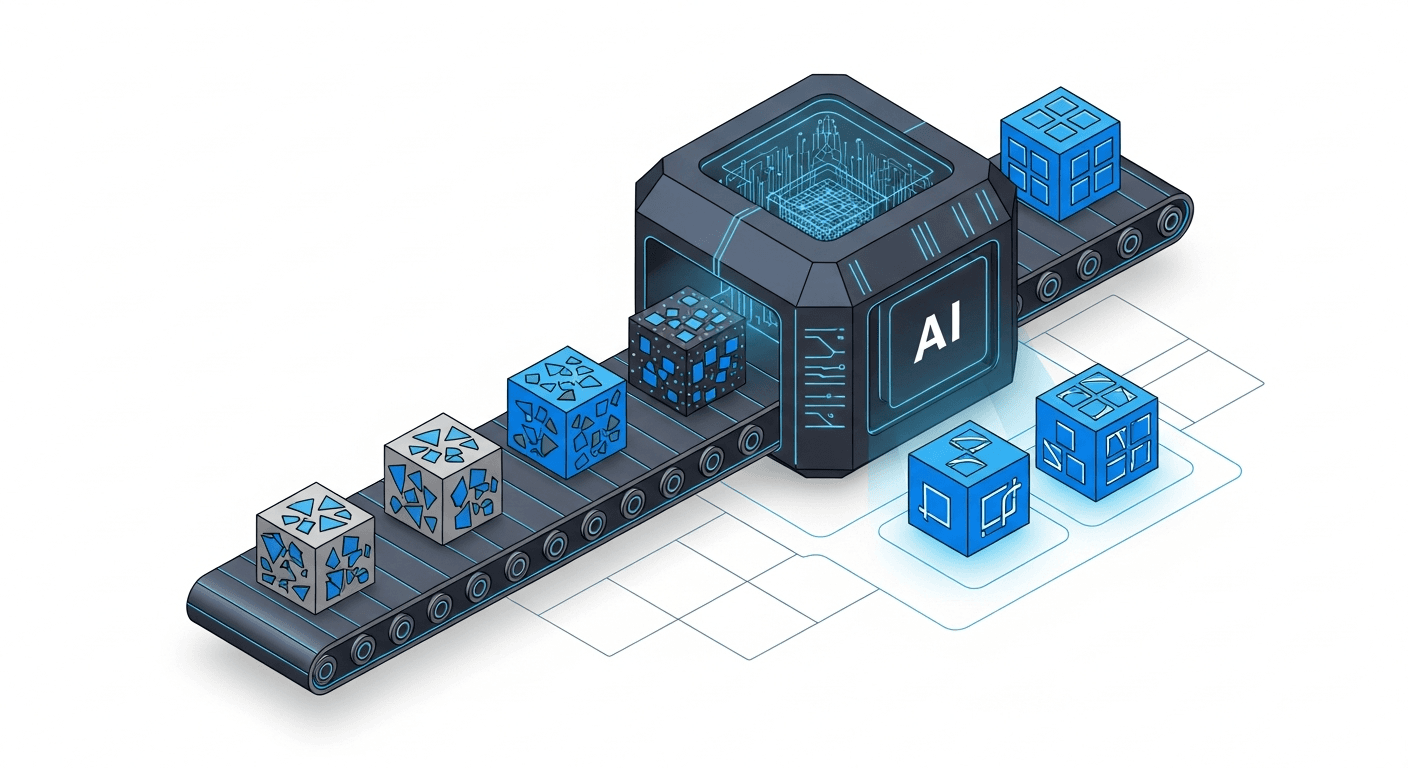
LLMs do not read like a human. They extract text fragments, evaluate them for relevance and reliability, then synthesise them into a response. A classic SEO article — optimised for Google's 10 blue links — is often unreadable for an LLM: too much padding, too few facts, vague structure.
GEO (Generative Engine Optimization) is the discipline that corrects this. This guide gives you the concrete rules, tested on 200+ articles for our clients at AISOS.
1. Why AI content differs from SEO content

Classic SEO optimises for a ranking algorithm that evaluates signals like backlinks, keyword density and time on page. Generative AI works radically differently:
- Fragment extraction: LLMs extract passages of 50-200 words, not entire pages. Each paragraph must be self-contained and informative.
- Reliability assessment: LLMs favour content with figures, cited sources and clear definitions.
- Multi-source synthesis: the LLM combines information from 5-10 sources. Your content must bring a unique piece of the puzzle, not a generic synthesis.
- Semantic understanding: LLMs understand meaning, not keywords. Information quality takes precedence over keyword density.
Diagram: how an LLM selects and cites your content (RAG pipeline)
Dr. Sebastian Riedel, Director of the UCL NLP Lab (London), who has contributed to research on retrieval augmented generation, explains:
"Language models do not reward keyword stuffing — they reward informational precision. A well-structured 100-word factual paragraph will be more likely to be cited than a 3,000-word article filled with generalities."
2. The 8 optimisation rules for generative AI
Rule 1: start with a clear definition
Every article must contain a clear definition of the concept covered in the first 200 words. Recommended format: "[Concept] is [definition]. [Context]. [Importance]." LLMs use these definitions as the basis for their responses.
Rule 2: one fact per paragraph
Each paragraph should contain exactly one fact, statistic or claim. Paragraphs of 60-120 words are optimal for extraction by LLMs. Avoid long, dense paragraphs.
Rule 3: source every piece of data
LLMs favour content that cites its sources. Include the name of the institution, year and country for each statistic. Priority to European sources for the French-speaking market.
Rule 4: use structured lists
Bullet lists and numbered lists are the preferred format of LLMs for extraction. Transform your descriptive paragraphs into lists whenever possible.
Rule 5: integrate comparative tables
Well-structured HTML tables are easily parseable by LLMs. One comparative table per article significantly increases your chances of citation.
Rule 6: implement complete schema markup
JSON-LD for Article, FAQPage, HowTo and Organization. Structured data is not directly read by LLMs, but it influences ranking in RAG engines and AI Overviews.
Rule 7: add a rich FAQ
FAQ sections are an ideal format for LLMs: each question-answer pair is a self-contained, citable fragment. Include 5-8 questions per article, using the real questions your clients ask.
Rule 8: update regularly
RAG engines favour recent content. Update each flagship article every 60-90 days with new data, statistics or examples.
3. Comparison: content formats and AI citation rates
| Content format | AI citation rate | Production effort | Estimated ROI |
|---|---|---|---|
| Structured guide (H2/H3, lists, FAQ) | High (35-45%) | High | Excellent |
| Data article (stats, tables) | High (30-40%) | Medium | Excellent |
| Comparison (vs, alternatives) | Medium (20-30%) | Medium | Good |
| Case study | Medium (15-25%) | High | Good |
| Opinion / thought leadership article | Low (5-15%) | Medium | Low |
| Generic article (no structure) | Very low (<5%) | Low | None |
4. Before/after examples: GEO optimisation
BEFORE (classic SEO content):
"SEO is very important for businesses in 2026. There are many reasons why you should invest in SEO. SEO can help you get more traffic and improve your online visibility. In this article, we will discuss the best SEO strategies."
Problem: no data, no precise definition, no citable information.
AFTER (AI-first content):
"AEO (Answer Engine Optimization) is an optimisation discipline that aims to get a brand to appear in responses generated by AI engines (ChatGPT, Perplexity, Gemini). In 2026, 42% of European adults use an AI assistant weekly (Eurostat, February 2026), generating queries that escape classic SEO."
Result: clear definition, sourced statistic, self-contained and citable fragment.
Prof. Maarten de Rijke, chair of AI at the University of Amsterdam, confirms:
"Informational clarity is the primary selection criterion of RAG systems. Content that passes the 'self-contained paragraph' test — readable and useful without additional context — has 4 times more chances of being selected as a source."
5. AI-first publication checklist
- ☐ Clear definition of the concept in the first 200 words
- ☐ Minimum 3 sourced European statistics
- ☐ 4-6 H2s with IDs for anchoring
- ☐ At least 1 comparative table
- ☐ FAQ of 5-8 questions
- ☐ 2+ European expert citations
- ☐ JSON-LD schema markup (Article + FAQPage)
- ☐ 3-5 internal links to other blog articles
- ☐ CTA to /contact or /#pricing
- ☐ Paragraphs of max 60-120 words
- ☐ LLMs.txt updated with the new article
6. FAQ — AI content optimisation
Do I need to rewrite all my existing articles?
Not all of them. Prioritise your 10-20 best-performing articles and update them with AI-first rules. This is the best effort/result ratio.
Is AI-first content less "human" to read?
On the contrary. Structured, factual and concise content is also more enjoyable for the human reader. AI-first and UX rules converge.
Does article length matter for LLMs?
Less than for classic SEO. A well-structured 1,500-word article will outperform a verbose 5,000-word article. Informational density takes precedence over length.
Do images influence AI citations?
Images themselves are not read by textual LLMs. But descriptive alt tags and captions contribute to the extracted textual content. Infographics accompanied by rich alternative text are recommended.
Can you use AI to generate "AI-first" content?
Yes, but with caution. AI-generated content without unique added value (proprietary data, field expertise, original viewpoint) will be lost in the crowd. Use AI to structure, not to replace your expertise.
Does AI-first content also work for classic SEO?
Absolutely. AI-first rules (clear structure, sourced data, FAQ) are also positive factors for classic SEO. It is a win-win approach.
Conclusion: write for LLMs or become invisible
The era when generic SEO content was sufficient is over. In 2026, every article must be designed to be citable by LLMs. This is the sine qua non condition of digital visibility.
At AISOS, we support businesses in transforming their content strategy. From audit to production, we apply GEO principles to every piece of content.
Transform my content strategy

