
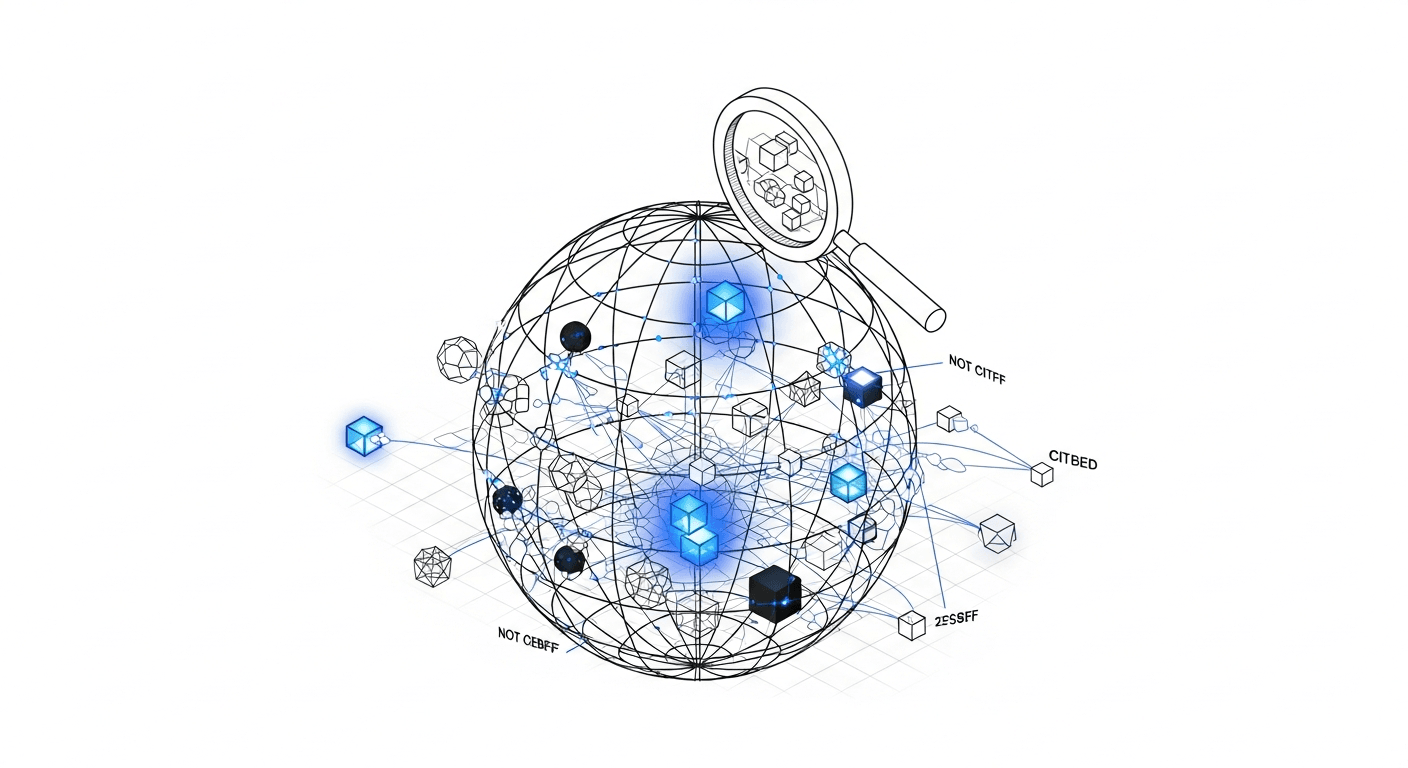
GEO: definition and origins
The term GEO -- Generative Engine Optimization -- was formalised in 2024 by researchers from Georgia Tech and IIT Delhi in a foundational paper, then rapidly adopted by the European SEO community. But it is in Europe that the discipline has been most quickly put into practice, notably by pioneer agencies such as Peak Ace (Berlin) and Re:signal (London).
GEO starts from a simple observation: LLMs do not work like classic search engines. Google ranks pages. An LLM understands concepts, synthesises information, and constructs responses. Optimisation techniques must therefore be fundamentally different.
In practice, GEO covers all strategies that increase the probability that your content is:
- Correctly understood by the LLM (structure, clarity, structured data)
- Judged reliable (authority, sources, consistency with consensus)
- Selected as a source (relevance, extractable format)
- Cited in the final response (visible attribution)

GEO vs SEO vs AEO: clarification
Confusion between these terms is common. Let us clarify:
| Discipline | Target | Objective | Metrics |
|---|---|---|---|
| SEO | Search engines (Google, Bing) | Rank in organic results | Position, CTR, organic traffic |
| AEO | Answer engines (includes featured snippets + AI) | Be the source of the direct answer | Citations, visibility score |
| GEO | Specifically generative AI engines | Be cited in LLM-generated responses | AI citations, mention share, source rank |
In summary: GEO is a subset of AEO, which is itself an evolution of SEO. All three coexist. For a detailed SEO/AEO comparison, see our dedicated article.
Bastian Grimm, CEO of Peak Ace (Berlin), summarised the situation at SMX Munich 2025: "GEO is not a replacement for SEO. It is an indispensable extension. Agencies that do not offer GEO to their clients in 2026 are engaging in professional malpractice."
The 7 GEO citation factors
After analysing thousands of AI responses, the European GEO community has identified 7 key factors that determine whether content is cited:
1. Entity authority
LLMs evaluate the reliability of a source via the concept of entity. Your company, your authors, your domain are entities. The more an entity is associated with a topic in the LLM's training data, the more likely it is to be cited. That is why presence on Wikipedia, in the press, and on specialised platforms is critical.
2. Topical relevance
An article on a precise topic is more likely to be cited than a generalist article. LLMs favour content that covers a topic in a complete and deep rather than superficial manner.
3. Extractable format
Content structured in short paragraphs, lists, tables, and Q&A blocks is 2 to 3 times more cited than long narrative text (source: Searchmetrics study, Berlin, 2025). LLMs extract content blocks, not entire pages.
4. Consensus and consistency
LLMs cross-reference sources. If your content contradicts the consensus of multiple other sources without solid justification, it will be ignored. Note: this does not mean you need to be consensual -- but contrarian positions must be substantiated.
5. Freshness
For engines with web access (ChatGPT, Perplexity), recently updated content is preferred. Include dates, temporal references ("in 2026"), and update regularly.
6. Technical trust signals
HTTPS, Schema.org structured data, llms.txt file, fast loading times. These technical signals reinforce the trust of the crawling system.
7. Multi-angle coverage
LLMs prefer sources that cover a topic from multiple angles (advantages, disadvantages, comparisons, use cases, FAQ). One-sided content is less likely to be cited than balanced content.
Advanced GEO techniques
"Answer-First" writing
Each section must start with the answer, then develop. LLMs generally extract the first sentences of a section. If your answer is buried in the 3rd paragraph, it will not be extracted.
"Citation hooks"
These are phrases formatted to be easily extracted and cited: precise statistics, clear definitions, structured comparisons. Example: instead of "many companies are losing traffic", write "47% of European companies lost between 25% and 40% of their organic traffic on queries where an AI Overview appears (Sistrix, 2025)".
Schema stacking
Combine multiple Schema.org types on the same page: Article + FAQPage + HowTo + Organization. The more structured context you provide to the AI, the more it can exploit your content.
Internal cluster linking
Strongly link articles in the same thematic cluster. The LLM follows internal links during crawling and associates the entire cluster with your domain. This is what builds topical authority. Your pillar page must link to each article in the cluster, and vice versa.
GEO deployment framework
Here is the 5-step framework we use at AI SOS:
1. AI query mapping. Identify the 50 most strategic queries for your business. Test each one on ChatGPT, Perplexity, Google AI Overview, Gemini.
2. AI competition analysis. For each query, document who is cited. Analyse their content: format, length, structure, structured data, domain authority.
3. Gap analysis. Compare your existing content with cited sources. Identify gaps: lack of structure, lack of structured data, outdated content, insufficient coverage.
4. Optimisation and creation. Optimise existing content (quick wins) and create new content for uncovered queries. Use the GEO techniques described above.
5. Continuous monitoring. Track your AI Visibility Score every week. GEO is an iterative process, not a one-shot project.
Need a custom GEO strategy?
We deploy the GEO framework for B2B companies in Europe. Audit, strategy, execution: everything is included.
FAQ
Does GEO replace SEO?
No. GEO is complementary to SEO. Good SEO remains necessary to feed the Google index (source of Google AI Overview) and to maintain classic organic traffic. GEO adds an optimisation layer specific to generative AI engines.
What types of content work best in GEO?
The content most cited by LLMs is: complete guides with Q&A structure, comparative articles with tables, step-by-step tutorials, data analyses with precise statistics, and detailed FAQs. Format matters as much as substance.
How much does a GEO strategy cost?
At AI SOS, our GEO packages start from EUR 1,500/month for an SME. The cost depends on the number of targeted queries, the volume of content to create, and the level of competition. The investment is generally recouped in 3 to 4 months through leads generated by AI citations.
Does GEO work for B2C?
Yes, but the impact is more pronounced in B2B. B2B queries are more informational and comparative, generating more detailed AI responses. In B2C, GEO is most effective for queries like "best [product]", "comparison [category]", or "[product] review".
Is llms.txt required for GEO?
It is not strictly mandatory, but it is strongly recommended. The llms.txt file helps AI crawlers understand your site's structure and identify your most relevant content. It is an additional trust signal that facilitates AI indexation.
How do you measure the effectiveness of a GEO strategy?
The key GEO metrics are: AI Visibility Score (% of target queries where you are cited), Citation Share (your citation share vs competitors), Source Rank (position in citations), and referral traffic from AI engines (measurable in GA4). See our guide on the AI Visibility Score.
Conclusion
GEO is the SEO discipline of the 2020-2030 decade. Classic search engines are not disappearing, but they are progressively supplemented (or even replaced) by AI answer engines. Companies that master GEO today are building a durable advantage.
The mistake would be to wait for the market to be "mature". In GEO, early entrants are disproportionately rewarded: once AI identifies you as a reference on a topic, it becomes extremely difficult for a competitor to displace you.
The rules have changed. GEO is the new game.


