80% of Employees Reject AI: How to Overcome Resistance in Your Organization
Practical guide for executives facing widespread AI rejection by teams. Concrete change management methods and demonstrable ROI.

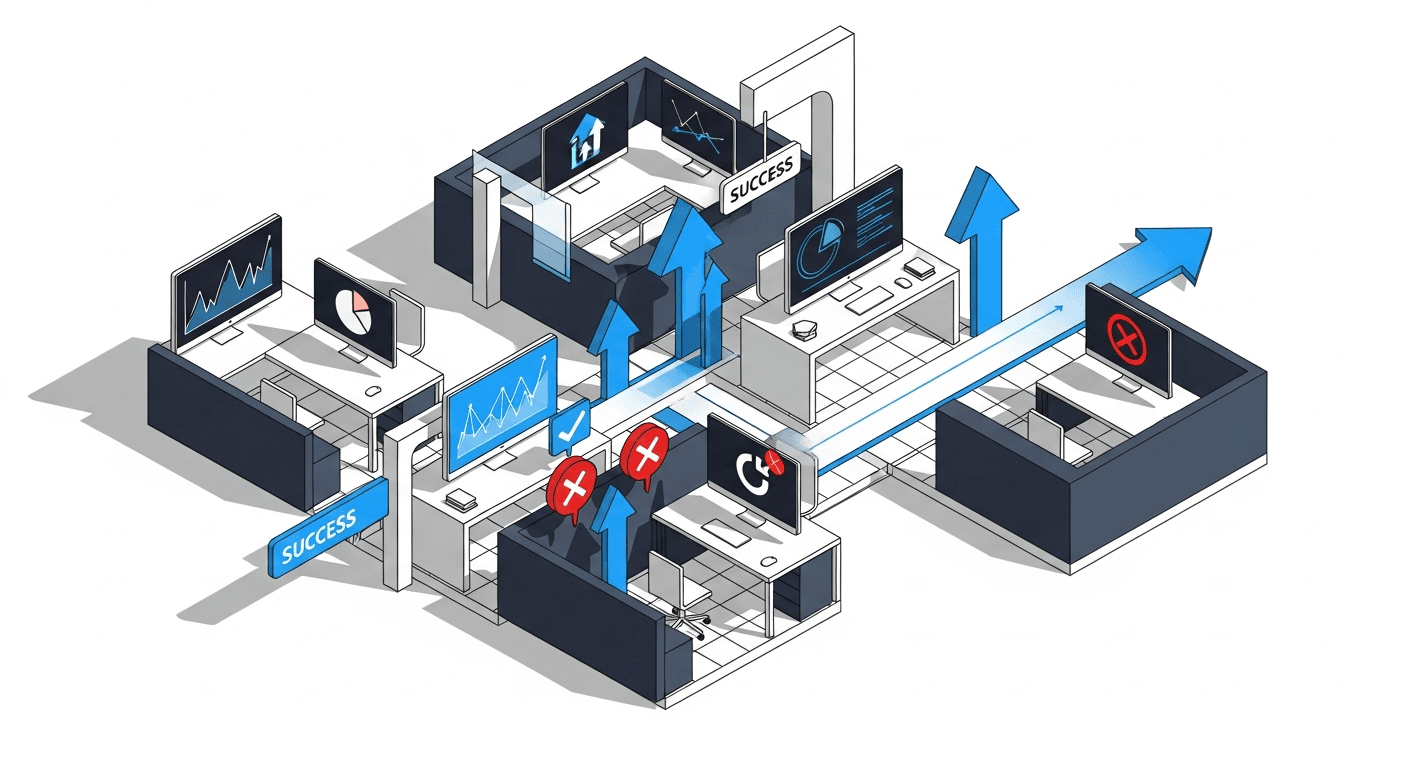
The Number That Should Alarm Every Business Leader
80% of office workers actively refuse to use AI tools mandated by their management. This figure, revealed by several concordant studies in 2024, reflects a reality that many SME and mid-market leaders discover after investing in expensive licenses: AI cannot be adopted by decree.
This silent resistance takes multiple forms. Some employees simply ignore the new tools. Others use them superficially to check the box, without any real impact on their productivity. The most reluctant develop elaborate avoidance strategies, continuing to work "the old way" while maintaining the illusion of adoption.
For a business leader who has approved a digital transformation budget, the finding is bitter: the ROI promised by vendors never materializes. Worse, teams feel misunderstood, and a gap widens between strategic vision and operational reality. This guide provides the keys to understanding this resistance and transforming it into lasting buy-in.
Why Your Teams Reject Artificial Intelligence
The Fear of Becoming Obsolete
The first cause of resistance is existential. 65% of French employees fear that AI will replace their position in the medium term, according to a 2024 IFOP study. This fear is not irrational: announcements of job cuts linked to automation regularly fuel the news.
An accountant asked to use a tool that automates 70% of their tasks legitimately wonders: "What will be left of my job in two years?" This anxiety generates a protective reflex: refusing the tool means delaying the perceived deadline.
Technological Imposter Syndrome
Many experienced employees, high performers in their field for years, suddenly feel incompetent when faced with these new tools. They don't dare ask questions, fearing they'll appear outdated. Result: they avoid AI rather than confront their discomfort.
At AISOS, we observe that this phenomenon particularly affects employees over 45, often the most expert in their field, whom companies desperately need to train AI on sector-specific requirements.
Tools Imposed Without Consultation
The way AI is introduced largely determines its adoption. When management announces a new tool "decided in executive committee," without involving end users, resistance is almost automatic. Teams perceive this imposition as a lack of respect for their expertise and autonomy.
A 2024 McKinsey study confirms that AI projects involving employees from the selection phase have an adoption rate three times higher than top-down deployments.
Lack of Perceived Benefit
"It saves me time, but my manager asks for more." This phrase, heard in many companies, sums up a fundamental problem: if productivity gains are captured solely by the organization, with no benefit for the individual, why would they invest in adoption?
Employees intuitively evaluate the personal cost-benefit ratio. Learning time, cognitive effort, risk of error on one side. Recognition, career advancement, improved working conditions on the other. If the equation is unbalanced, rejection sets in.
Classic Management Mistakes When Facing Resistance
Forcing Adoption Through Constraint
Some companies choose the hard line: quantified usage objectives, elimination of old working methods, penalties for resisters. This approach produces short-term results, measurable in number of connections or queries. But it generates resentment, superficial use and, ultimately, disengagement.
AISOS audits regularly reveal considerable gaps between usage metrics displayed by tools and real impact on business processes. Teams "use" AI without ever exploiting its results.
Multiplying Generic Training
A reflexive response from many managements: organize training sessions. Problem: these trainings are often standardized, disconnected from real use cases, and perceived as an additional chore. Skill retention rates drop below 20% after three months.
Ignoring Weak Signals
AI resistance is rarely frontal. It manifests through discrete signs: repeated questions about the same features, requests for "exceptional cases" justifying the old method, declining engagement in project meetings. Leaders who don't listen to these signals discover the scope of the problem too late.
Five Concrete Levers to Transform Resistance into Adoption
1. Identify and Activate Natural Ambassadors
In any organization, 10 to 15% of employees are naturally curious about new technologies. These early adopters aren't always the youngest or most digital on paper. They share one characteristic: the desire to improve their professional daily life.
Concrete action: launch a call for volunteers for a pilot group. Give them early access to tools, dedicated time to experiment, and a clear mission: identify relevant use cases for their team. Their peer-to-peer testimony will have more impact than any institutional communication.
2. Start with Daily Pain Points
The classic mistake: deploying AI on complex strategic processes. The effective approach: target tasks everyone hates. Writing meeting minutes, formatting spreadsheets, searching for information in bulky documents, responding to repetitive emails.
Concrete action: organize 30-minute workshops per team with a single question: "What task wastes your time and energy each week?" Rank responses by frequency and configure AI to solve the three most cited pain points. Immediate benefit creates buy-in.
3. Explicitly Guarantee Job Security
This step is often neglected because it commits management. Yet it's decisive. Clear communication, ideally written, stipulating that productivity gains from AI will not lead to job cuts within 24 months, radically changes the dynamic.
Concrete action: draft an explicit management note. Explain how freed time will be reinvested: skills development, higher value-added projects, service quality improvement. Visibly honor this commitment.
4. Create Rapid Feedback Loops
AI adoption is an iterative process. First uses reveal unexpected friction, edge cases, customization needs. If this feedback goes unanswered, users become discouraged. If addressed quickly, trust builds.
Concrete action: set up a dedicated channel, like Slack or Teams, where any employee can report a problem or suggestion. Commit to a 48-hour response time. Communicate weekly about improvements made thanks to field feedback.
5. Measure and Celebrate Individual Victories
Global adoption metrics, number of active users or query volume, don't motivate anyone. What creates engagement are personal successes: the salesperson who won a bid thanks to a faster-generated proposal, the assistant who cut their planning time by two-thirds.
Concrete action: establish a monthly "AI wins" sharing ritual. Ask volunteers to present in five minutes a concrete case where the tool made their life easier. Highlight these testimonials in internal communication.
The Key Role of Middle Management
Frontline managers are the pivot of adoption. If they perceive AI as a threat to their authority or an additional burden, they'll transmit this resistance to their teams, even unconsciously. If they become convinced facilitators, adoption accelerates.
Three conditions are necessary to bring managers on board:
- Give them the means: dedicated time, thorough training, priority access to tools
- Align their objectives: integrate AI adoption into their evaluation criteria, with qualitative and not only quantitative indicators
- Include them in decisions: consult them on tool choice, priority use cases, deployment pace
A convinced manager can transform a reluctant team in three months. A skeptical manager can sabotage a transformation project for years.
Building an ROI That Speaks to All Levels
AI return on investment is traditionally calculated in productivity gains and cost reduction. These metrics speak to the executive committee, but leave teams indifferent, even worried.
To create buy-in, build a multi-layered ROI:
- Organizational ROI: productivity gains, error reduction, deadline acceleration
- Managerial ROI: better activity visibility, decision support, simplified reporting
- Individual ROI: reduced tedious tasks, skills development, expertise valorization
Communicate these three dimensions from project launch, and measure them throughout deployment. An employee who sees tangible improvement in their daily life becomes AI's best ambassador.
Typical Timeline for Successful Deployment
An AI deployment that minimizes resistance spans six to twelve months, depending on organization size:
Months 1-2: Assessment and Onboarding
- Map potential uses with teams
- Identify ambassadors
- Communicate vision and commitments
Months 3-4: Targeted Pilot
- Deploy on limited scope, two to three volunteer teams
- Rapid iterations based on feedback
- Document first successes
Months 5-8: Progressive Extension
- Expand in successive waves
- Peer training
- Continuous use case adjustment
Months 9-12: Generalization and Embedding
- Deploy across entire organization
- Integrate into standard processes
- Review and define next steps
Transforming Resistance into Competitive Advantage
Your teams' resistance to AI isn't an obstacle to eliminate. It's valuable feedback on your change management quality, vision clarity, and the trust you inspire. Companies that take time to listen and support their employees build lasting adoption, while those that force the issue accumulate costly failures.
The paradox is this: the more you respect your teams' pace, the faster adoption will be. The more you listen to resistance, the more you'll identify true high-value use cases. The more you invest in people, the higher the technological return on investment will be.
AI transformation is a marathon, not a sprint. Leaders who understand this are now transforming their teams' initial resistance into sustainable competitive advantage. Those who continue to impose without supporting will discover, too late, that the most powerful tool is useless without buy-in from those who must use it.
To assess your readiness level and identify specific barriers in your organization, external assessment provides an objective perspective that internal teams sometimes struggle to achieve. AISOS supports SME and mid-market leaders in this approach, from initial audit to sustainable embedding of new practices.


