80% of Employees Reject Imposed AI: How to Achieve Successful Enterprise Adoption
Facing silent resistance from teams, discover proven strategies to transform AI rejection into voluntary and measurable adoption.

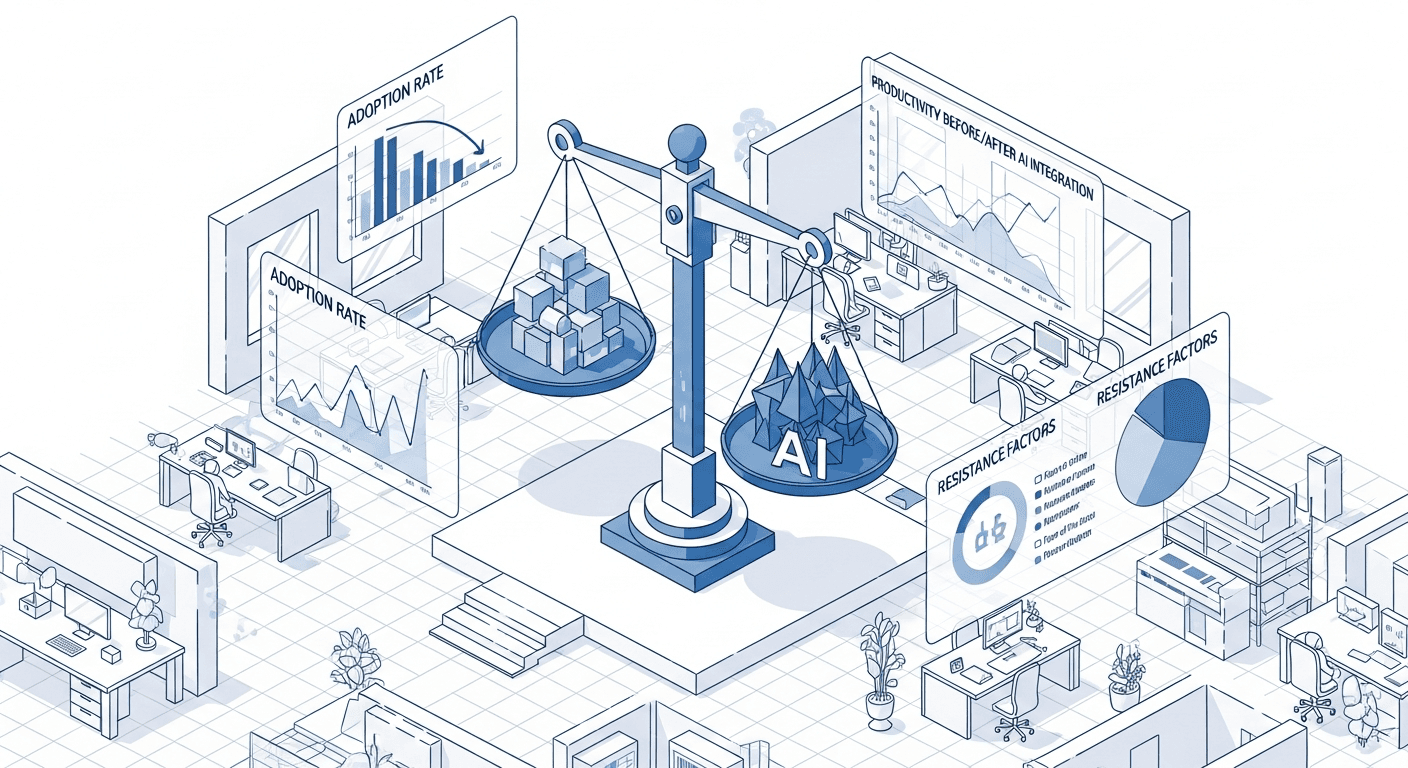
The numbers are brutal: 80% of white-collar workers refuse to comply with AI adoption mandates imposed by their management. This statistic, revealed by several recent studies on digital transformation, exposes a reality that many leaders prefer to ignore. Your teams aren't resisting AI due to incompetence or ill will. They're resisting because the implementation method is flawed.
This silent rebellion comes at a high cost. Unused software licenses, failed transformation projects, talent demotivation, loss of competitiveness against more agile competitors. For French and Belgian SMEs and mid-market companies, the stakes go beyond simply adopting tools: it's about economic survival in a market where AI is redefining productivity standards.
This guide provides concrete methods to transform this resistance into buy-in. No abstract theory: field-tested change management strategies with measurable ROI indicators to convince your teams and board of directors.
Why Your Employees Reject AI: The Real Reasons
Resistance to artificial intelligence in business isn't a generational whim or irrational fear. It's based on legitimate foundations that leaders must understand before taking action.
Fear of Professional Obsolescence
The primary driver of refusal: the fear of losing one's job or value in the job market. A Goldman Sachs study estimates that 300 million jobs could be impacted by generative AI globally. Your employees read these figures. They observe layoffs justified by automation. Their resistance is a professional survival strategy.
This fear manifests in several ways: refusing to learn tools, minimal usage to check a box, passive sabotage of implementation projects. The employee who refuses to use ChatGPT for their reports isn't rejecting the technology: they're protecting their position.
Lack of Appropriate Training
Second major cause: the absence of structured skills development. Too many companies deploy AI tools with two hours of video conference training, then wonder about low adoption rates. AISOS audits reveal that 67% of adoption failures are directly linked to a deficit in job-specific training.
An accountant doesn't use AI like a salesperson. An HR manager has different needs than a project manager. Generic training fails because it ignores these specificities.
Imposition Without Consultation
Third factor: top-down deployment without team involvement. When management announces a new AI tool without consulting end users, it triggers a defensive reflex. Employees perceive this decision as questioning their expertise and autonomy.
Research in organizational psychology is clear: involvement in the decision-making process increases buy-in by 40 to 60%. Ignoring this principle means programming failure.
The Hidden Costs of AI Resistance
Silent rebellion against artificial intelligence generates financial losses rarely quantified in dashboards. Here are the main cost categories.
Wasted Software Licenses
A Microsoft Copilot license costs approximately EUR 30 per user per month. A ChatGPT Team license costs $25. Multiply by the number of employees who never use these tools: waste quickly reaches tens of thousands of euros annually for a 100-person SME.
This calculation doesn't account for integration, configuration, and maintenance costs of abandoned solutions.
Loss of Competitive Productivity
While your teams resist, competitors who have successfully adopted AI gain efficiency. McKinsey estimates that generative AI can increase productivity by 20 to 40% on certain cognitive tasks. Each month of delay widens the gap.
For a mid-market company with EUR 50 million in revenue, a 10% productivity differential represents a loss of competitiveness equivalent to EUR 5 million in annual value.
Turnover of Pro-AI Talent
Employees enthusiastic about technological innovation leave companies that hinder their skills development. They join more advanced organizations where they can develop their AI expertise. The replacement cost of a manager equals 6 to 9 months of salary.
Strategy 1: Co-Build Adoption with Teams
The first strategy to overcome resistance is to reverse the implementation logic. Instead of imposing tools from top to bottom, involve employees in the selection and deployment.
Create Adoption Committees by Function
Form working groups of 3 to 5 people per department. Their mission: identify repetitive or time-consuming tasks, test different AI solutions, recommend tools best suited to their real needs.
This process takes 4 to 6 weeks but generates organic buy-in. Committee members become natural ambassadors to their colleagues.
Formalize a Non-Replacement Pact
Address the fear of obsolescence head-on. Communicate in writing that AI's objective is to augment human capabilities, not eliminate positions. Specify that productivity gains will be reinvested in new value-added missions.
This guarantee must be credible. If you're planning restructuring, don't lie: destroyed trust cannot be rebuilt.
Document Quick Wins
Identify use cases with rapid, visible impact. A salesperson who writes their reports twice as fast. An assistant who automates email sorting. These quick victories create a ripple effect.
Publish these results internally with user testimonials. Social proof also works within the company.
Strategy 2: Train by Function and Level
Generic training kills adoption. Structure your skills development program along three axes.
Segmentation by Function
Develop specific training paths for each profession. Salespeople learn to use AI for prospecting and proposal writing. HR professionals train on candidate sourcing and job description writing. Finance teams explore data analysis and anomaly detection.
Each path lasts 4 to 8 hours, spread over 2 to 3 weeks to allow practice between sessions.
Adaptation to Digital Maturity Level
Not all your employees have the same relationship with technology. Offer three levels: beginner for those discovering AI, intermediate for occasional users, advanced for early adopters who want to master complex prompts and automated workflows.
A 10-minute placement test directs each person to the appropriate path.
Continuous Training and Support
AI evolves rapidly. ChatGPT-4 is nothing like GPT-3.5. Copilot features are enhanced every quarter. Plan quarterly 2-hour update sessions to maintain skills.
Also create an internal support channel, Slack or Teams, where users can ask questions and share discoveries.
Strategy 3: Measure and Communicate ROI
Resistance weakens in the face of tangible proof of value. Implement a rigorous measurement system.
Define KPIs Before Deployment
Before launching an AI tool, identify the indicators you'll track: time saved per task, production volume, error rate, customer satisfaction, processing time. These metrics must be measurable and comparable with the previous situation.
At AISOS, we recommend choosing 3 to 5 KPIs maximum per use case to avoid analytical paralysis.
Establish a Precise Baseline
Measure current performance before any implementation. How long does it take an employee to write a standard report? What's the average response time to customer requests? This baseline allows calculating real gains, not optimistic estimates.
Communicate Results Monthly
Share adoption and performance figures each month. Present gains in hours saved, converted to full-time equivalent or monetary value. A simple dashboard, accessible to all, reinforces transparency and motivates teams.
Communication example: "This month, the sales team saved 45 hours through proposal automation. This equals EUR 2,700 of time reinvested in customer relationships."
Strategy 4: Identify and Activate Internal Champions
Every organization has employees naturally enthusiastic about innovation. These champions are your most powerful adoption lever.
Spot Early Adopters
Observe who already uses AI tools personally. Who asks questions about new technologies in meetings? Who shares articles about artificial intelligence? These signals identify your potential ambassadors.
Also conduct an internal survey to assess each employee's appetite. A 1 to 10 scale on AI interest is sufficient to segment your population.
Structure a Champion Network
Formalize the AI champion role with clear missions: test new tools, help colleagues with adoption, report usage difficulties, propose improvements. Plan 2 to 4 hours per week dedicated to this mission.
Meet this network monthly to share feedback and coordinate actions.
Value Their Contribution
Recognition motivates. Mention champions in internal communications. Offer them advanced training as a priority. Integrate their role into their annual evaluation and career development.
Typical Successful Adoption Timeline
Here's a realistic schedule for an SME or mid-market company with 50 to 500 employees.
- Month 1: AI maturity diagnosis, identification of priority use cases, formation of functional committees
- Month 2: Tool selection with committees, KPI definition, communication of non-replacement pact
- Month 3: Champion training, pilot deployment in one department
- Months 4-5: Adjustments based on pilot feedback, training of other teams
- Month 6: General deployment, activation of continuous support, first ROI assessment
This timeline can accelerate for digitally mature organizations or slow down for those starting from behind.
Fatal Mistakes to Avoid
Certain practices doom adoption before it even begins.
Imposing Without Explaining the Why
"Starting January 1st, everyone uses Copilot." This announcement triggers resistance. Instead, explain the strategic vision, expected benefits for the company and each individual, timeline, and support resources.
Neglecting Middle Management
Managers are the relay between leadership and teams. If they're not convinced, they'll passively sabotage the project. Train them first and involve them in designing the adoption plan.
Waiting for Perfection to Deploy
Generative AI isn't perfect. It sometimes hallucinates, produces errors, requires human verification. Accept this reality and communicate it. Waiting for an infallible tool means never starting.
Ignoring Resistance Signals
Stagnant usage rates, canceled training sessions, repeated negative feedback: these signals alert you. React quickly by organizing listening sessions and adjusting your approach.
Transform Resistance into Competitive Advantage
The rebellion of 80% of employees against imposed AI isn't inevitable. It's a symptom of an inappropriate approach that you can correct.
Companies that succeed in adoption aren't those that force. They're those that involve, train, measure, and value. This method requires more upfront time but generates sustainable adoption and real ROI.
AI transformation is a marathon, not a sprint. SMEs and mid-market companies that take time to build buy-in today will be tomorrow's market leaders.
Start with an honest diagnosis of your current situation. Identify your potential champions. Choose a high-impact pilot use case. And measure each step. Artificial intelligence isn't a threat to your teams: it's an opportunity to make them more productive and fulfilled in their work.


