Google AI Overviews: Why Commercial Queries Display Fewer Businesses (and How to Respond)
AI Overviews treat informational and commercial queries differently. Discover why and how to adapt your SEO strategy.

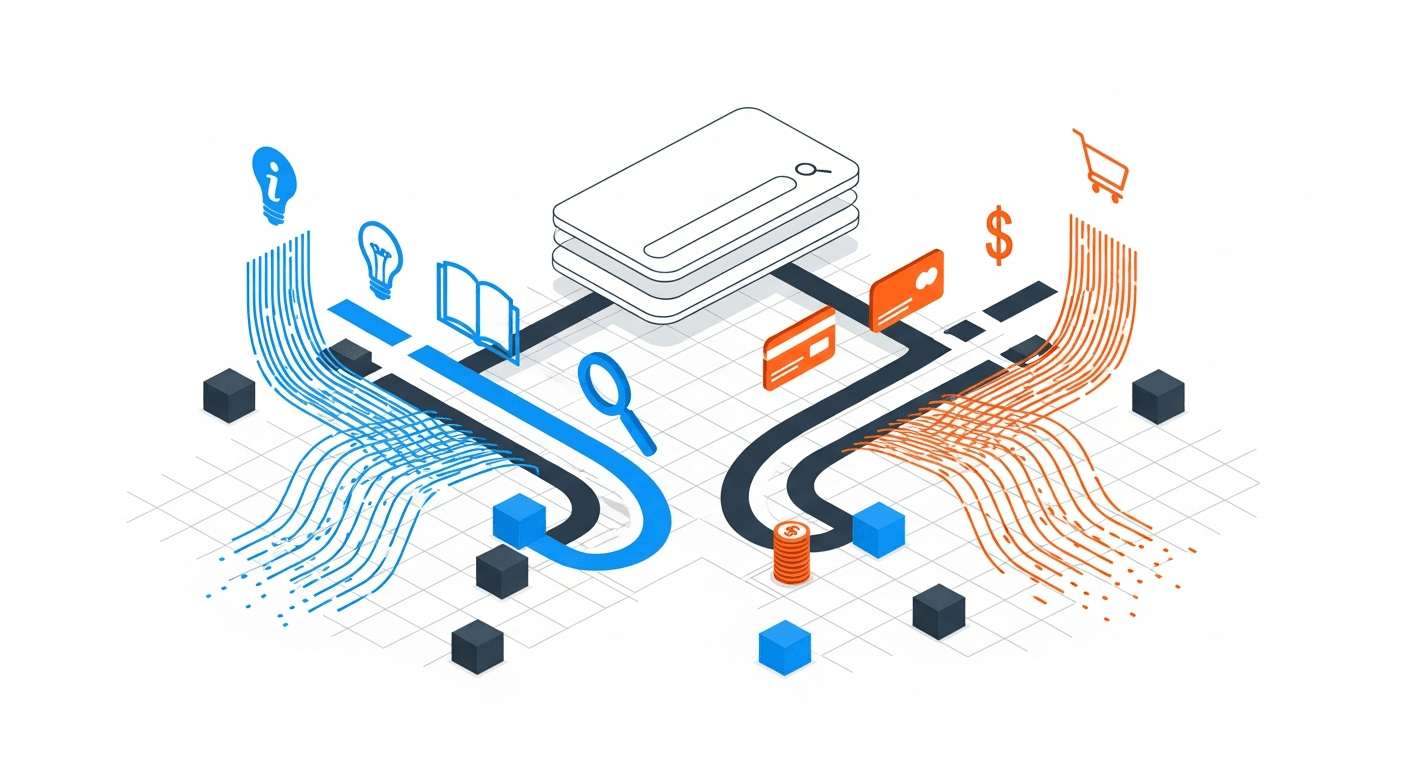
The AI Overviews paradox: ubiquitous for informational content, discreet for commercial searches
You may have noticed a strange phenomenon: Google systematically displays AI Overviews when you search for "how does ERP work" but remains silent on "best ERP for industrial SMEs." This isn't by chance. Recent data published by Search Engine Journal reveals a reality that few B2B leaders anticipated: AI Overview appearance rates drop drastically for commercial intent queries.
For companies investing in their digital visibility, this distinction changes everything. A traditional SEO strategy optimized for informational queries provides no guarantee of presence in generative AI responses for queries that actually generate business. French and Belgian SMEs and mid-market companies need to understand this mechanism to adapt their approach.
In this article, we decode the tracking data that explains this differentiated treatment, analyze Google's technical and commercial reasons, then detail concrete strategies to maximize your chances of appearing in AI Overviews for B2B commercial queries.
What the data reveals: two separate worlds
Informational queries: AI Overviews almost systematic
Tracking studies conducted on millions of queries show considerable gaps. For purely informational queries like "what is," "how does" or "difference between," AI Overviews appear in 60 to 80% of cases depending on the sector. Google considers these queries ideal for its generative summaries: users are seeking an explanation, not a transaction.
These responses typically cite between 3 and 6 sources, with a marked preference for structured content, clear definitions, and sites with strong topical authority. For a B2B SME, appearing in these informational AI Overviews remains accessible with well-optimized expert content.
Commercial queries: AI Overview presence drops by two-thirds
The picture changes dramatically for purchase intent queries. For phrasings like "best software for," "comparison," "price," or "supplier," AI Overview appearance rates fall to between 15 and 35%. Google more often displays traditional results: blue links, Google Ads, product listings.
When an AI Overview appears for a commercial query, its format also differs. Cited sources are fewer, often limited to 2 or 3 references. Comparison sites, review sites, and specialized media dominate. Company websites themselves are rarely cited directly, unless they produce neutral editorial content.
Data varies according to tracking tools
A crucial point raised by Search Engine Journal's analysis: tracking results depend heavily on the prompts and methodologies used. A tool that primarily tracks informational long-tail queries will report a high AI Overview rate. Another focused on short transactional queries will show much lower figures. Leaders must therefore interpret overall statistics with caution and analyze their own semantic universe.
Why Google limits commercial AI Overviews
Protecting the Google Ads business model
The main reason is economic. Commercial queries represent the majority of Google's advertising revenue. Displaying a complete AI Overview that directly answers "best CRM for SME" would mechanically reduce clicks on Google Ads positioned for this query. Google arbitrates between user experience and preserving its revenue.
This tension explains why commercial AI Overviews, when they exist, often remain partial. They guide toward general selection criteria rather than recommending specific solutions. Users must still click to finalize their search.
The complexity of product recommendations
Beyond the financial aspect, Google faces a technical and ethical challenge. Recommending a product or service provider engages its responsibility. Informational queries allow for synthesizing verifiable facts. Commercial queries involve value judgments, variable usage contexts, subjective criteria.
The risk of erroneous recommendations is higher for commercial content. An AI Overview that would recommend unsuitable software or a failing supplier would expose Google to criticism. Algorithmic caution on these queries reflects this reputational risk management.
Less univocal user intent
Commercial queries often carry mixed intentions. "SME accounting software" can mean: I want to understand the options, I want to compare prices, I want to buy now, I want user reviews. This ambiguity complicates generating a relevant AI response. Google then prefers to let users refine their search through traditional results.
Criteria that favor appearance in commercial AI Overviews
Neutral editorial content rather than promotional
At AISOS, we observe that pages most cited in commercial AI Overviews share one characteristic: they adopt an editorial rather than commercial tone. An article "How to choose your ERP in 2025: criteria and pitfalls to avoid" has better chances of being cited than a page "Our ERP: the ideal solution for your business."
Google prioritizes content that helps decision-making without explicitly pushing toward a single solution. Buying guides, methodological comparisons, and selection criteria analyses correspond to this expected format.
Structure in explicit entities and attributes
AI Overviews extract structured information. To maximize your chances, your content must present clearly identified entities (product names, categories, features) and comparable attributes (prices, capabilities, target sectors, targeted company size).
A well-tagged comparison table, a criteria list with definitions, subsections by use case: these formats facilitate extraction by language models. Dense narrative content without clear structure is harder to cite.
Demonstrated topical authority
For commercial queries, Google is more selective about sources. Topical authority matters more than for informational content. A site that regularly publishes on a specific domain, with identified authors and expertise signals (citations, sector backlinks, press mentions) will be prioritized.
For a B2B SME, this means concentrating content efforts on your domain of expertise rather than dispersing topics. Better to have 20 in-depth articles on your specialty than 100 superficial articles on various themes.
Freshness and update signals
Commercial AI Overviews preferentially cite recent or regularly updated content. A comparison from 2022 will be ignored in favor of a 2025 analysis, even if the older content is more comprehensive. Include dates in your titles, update existing articles, add sections on recent developments.
Adaptation strategies for B2B companies
Create a distinct editorial content layer
The first strategy is to separate your commercial content from your editorial content. Your product and service pages remain optimized for direct conversion. In parallel, develop a resources section, blog, or expertise center with informative content on your prospects' challenges.
This editorial content serves as a gateway in AI Overviews. It establishes your expertise, generates visibility on informational and commercial informational queries ("how to choose," "selection criteria"), and creates citation opportunities.
Target hybrid commercial queries
Certain commercial phrasings trigger AI Overviews more often than others. Hybrid queries that mix purchase intent with information needs represent the best playing field:
- "How to choose a [product/service] for [specific context]"
- "Selection criteria [category] company [size/sector]"
- "[Product A] vs [Product B] for [use case]"
- "Questions to ask before buying [category]"
- "Mistakes to avoid [category] [sector]"
These queries allow Google to display a useful AI Overview without directly short-circuiting ads on pure transactional queries.
Optimize for partial citations
Even when your page isn't the main source of an AI Overview, it can be cited as a complementary source. Work your content to be "citable" for extraction: autonomous and complete sentences, framed definitions, sourced figures, bullet lists with context.
A paragraph like "Industrial SMEs with 50 to 250 employees dedicate on average 3 to 5% of their revenue to their information system, of which 40% for ERP" has better chances of being extracted than an equivalent narrative development.
Invest in rich snippet formats
Structured data (schema.org) influences Google's ability to extract and cite your content. For B2B commercial queries, the most relevant formats include:
- FAQ schema for frequently asked questions about your products/services
- HowTo schema for selection guides and purchasing processes
- Product schema with detailed attributes for your offerings
- Review schema for structured customer testimonials
These markups don't guarantee AI Overview appearance but facilitate information extraction by algorithms.
Monitor and analyze your specific semantic universe
Global AI Overview statistics mask significant variations by sector and query type. Implement tracking of your strategic target queries to identify those that trigger AI Overviews, those that never do, and those where your competitors are cited.
AISOS audits often reveal that 20% of a sector's commercial queries concentrate 80% of AI Overview opportunities. Identifying these priority queries allows for focused content creation efforts.
Anticipating commercial treatment evolution
Google tests transactional AI Overview formats
Google's current behaviors aren't fixed. Tests are underway on more transactional AI Overview formats, including price comparisons, direct purchase links, Google Shopping integrations. If these formats become widespread, organic visibility on commercial queries could evolve further.
Companies that will have invested in their Google Merchant Center presence, structured product data, and topical authority will be better positioned for these developments.
Other AI engines as alternatives
Google is no longer the only playing field. Perplexity, ChatGPT with browsing, Gemini, and Bing's AI Overviews treat commercial queries differently. Some are more inclined to cite company sources, others prioritize independent comparators.
A complete GEO strategy integrates these different platforms and adapts content to each generative engine's specific behaviors.
Conclusion: adapting strategy to the new landscape
The differentiated treatment of commercial queries by Google AI Overviews requires an evolution of B2B visibility strategies. Companies that rely solely on traditional SEO or informational AI Overview presence will miss opportunities on queries that actually generate business.
The answer lies in a structured approach: neutral and expert editorial content for AI citations, targeting high-potential hybrid queries, technical optimization for extraction, and continuous monitoring of a rapidly evolving landscape.
For SME and mid-market leaders who want to evaluate their current positioning on strategic commercial queries and identify AI Overview opportunities in their sector, AISOS offers specific GEO audits that map these new visibilities and define action priorities.


