Cited by AI, invisible on Google: the paradox nobody predicted
Some companies are heavily cited by ChatGPT and Perplexity while ranking nowhere on Google. Others dominate Google but AI ignores them. Welcome to the new paradox.

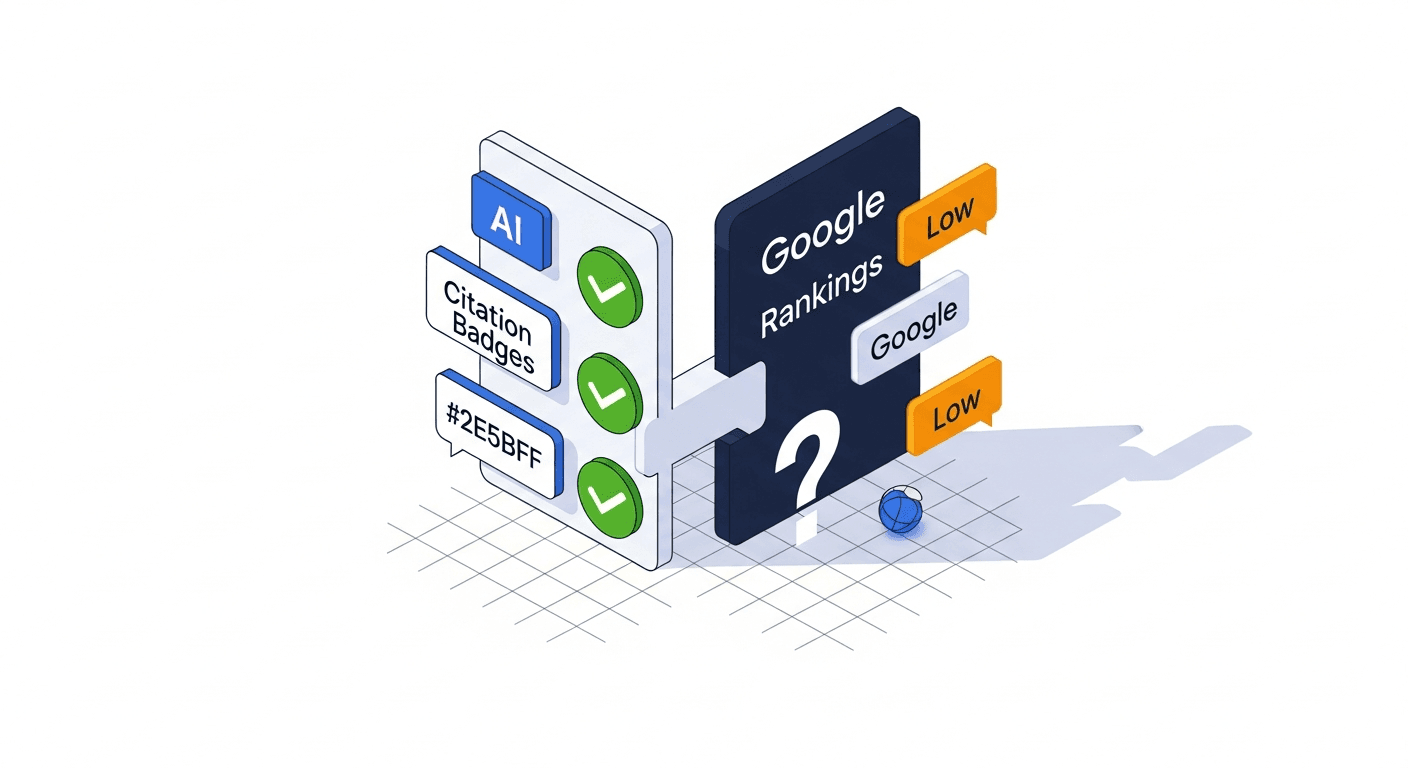
A client showed us something last month that perfectly illustrates the new reality. Their niche blog -- a 500-page site about Belgian tax law -- gets cited by Perplexity in 9 out of 10 relevant queries. ChatGPT recommends it as a primary source. Yet on Google, their best ranking is position 14 for their main keyword.
Meanwhile, their main competitor -- a large accounting firm with a Domain Authority of 65 -- ranks in the top 3 on Google for every relevant term but gets cited by AI in exactly zero responses.
This is the paradox of 2026: AI visibility and Google visibility are increasingly decorrelated.
Why the decorrelation exists
Google ranks pages based on a complex mix of backlinks, technical optimization, user engagement, and domain authority. These signals have been refined over 25 years. They're reliable predictors of what a human searcher wants to see on a results page.
LLMs cite sources based on different criteria: clarity of information, consistency across multiple sources, structured data quality, author credibility, and topical specificity. A small site that perfectly answers a specific question can outperform a major brand that answers vaguely.
The SparkToro data confirms this: nearly 80% of sources cited by LLMs aren't in Google's top 100 for corresponding queries. The two systems are measuring different things.
Three profiles we see in practice
Profile 1: Google strong, AI invisible. Usually large companies with established SEO. Lots of backlinks, high domain authority, well-optimized pages. But generic content, minimal structured data, no third-party mentions outside their own properties. Google loves them. AI doesn't know them.
Profile 2: AI strong, Google weak. Often niche experts, bloggers, or small companies with deep domain knowledge. They answer specific questions with original data. They're active on Reddit and industry forums. They have complete schema markup. LLMs cite them; Google doesn't rank them.
Profile 3: strong on both. The winners. Companies that combine technical SEO excellence with AI-optimized content, structured data, and multi-source presence. They rank on Google AND get cited by AI. This is where you want to be, but it requires intentional work on both fronts.
The practical implications
Don't assume Google success translates to AI success. If you rank #1 on Google for your main keywords, that's great. But test ChatGPT and Perplexity. You might be invisible there. The two channels require separate strategies.
Don't ignore Google for AI. Companies that abandon Google optimization to focus solely on AI are making a different mistake. Google still drives the majority of web traffic and isn't going away. The goal is both, not either/or.
Measure both independently. Your SEO dashboard should track Google rankings AND AI mention rates. Treat them as two separate channels with different KPIs, different strategies, and different timelines.
How to close the gap
If you're in Profile 1 (Google strong, AI invisible), your priority is: structured data, llms.txt, off-site mentions, answer-first content. You don't need to change your Google strategy -- you need to add an AI layer.
If you're in Profile 2 (AI strong, Google weak), your priority is: backlinks, technical SEO, on-page optimization. Your content is great for AI -- now make it discoverable on Google too.
If you're in Profile 3, keep doing what you're doing and invest in monitoring. You're ahead of 95% of your competitors.
The prediction
We believe this decorrelation will narrow over time. As AI search tools mature, they'll incorporate more Google-like quality signals. And as Google evolves AI Overviews, it'll adopt more LLM-like citation patterns. The two worlds will converge.
But that convergence is 2-3 years away. Right now, companies that optimize for both channels have a structural advantage that compounds monthly. The paradox isn't permanent. But while it lasts, it creates opportunities for those who see it -- and risks for those who don't.
Which profile are you? Test it today. The answer might surprise you.
Co-founder and CEO of AISOS. GEO Expert, she guides businesses in their Google + AI visibility strategy.


